
Table of Contents
- Protection Requirements, Threats, and Planning
- Understanding Security Glass Fundamentals
- Security Glass Types and Applications
- Security Glass Standards and Testing
- Common Challenges and Solutions
- Conclusion and Next Steps
- Frequently Asked Questions
Protection Requirements, Threats, and Planning
Security glass represents a specialized category of glazing engineered to resist intentional threats ranging from forced entry attempts to ballistic attacks and bomb blast forces. Unlike standard glass or basic safety glass, security glass provides a critical delay mechanism that protects people and property while allowing authorized personnel time to respond to incidents.
This guide covers the complete spectrum of security glass technology, including laminated security glass construction, bullet resistant glass specifications, blast resistant glazing systems, and the global standards that govern their performance. The content is designed for building owners, architects, security professionals, and facility managers who need to make informed decisions about protecting commercial property, government buildings, schools, retail storefronts, and other demanding applications.
Security glass is specially engineered glazing designed to resist forced entry, ballistic impact, blast forces, and other security threats through multi-layer construction that maintains structural integrity even when shattered.
By reading this guide, you will gain:
- Clear understanding of security glass fundamentals and how they differ from normal glass and basic safety glass
- Knowledge of specific security glass types matched to forced entry, ballistic, and blast threat scenarios
- Familiarity with global testing standards including ASTM F1233, EN 356, EN 1063, and EN 13541
- Practical selection criteria for matching security glazing to your specific protection requirements
- Solutions to common challenges in balancing security with visibility, aesthetics, and cost-effectiveness

Understanding Security Glass Fundamentals
Security glass differs fundamentally from standard glass and conventional safety glass in both construction and purpose. While tempered glass is designed to break into small, blunt granular chunks to reduce injury risk, and basic safety glass prevents large sharp shards from causing harm, security glass provides superior protection against deliberate attacks. The engineering principles behind security glazing focus on maintaining barrier integrity even after the glass cracks, creating resistance that delays or prevents an attacker from gaining access. There are various types of security glazing designed for different threat levels.
Laminated Security Glass Construction
Laminated glass consists of two or more layers of glass with an interlayer, usually made of polyvinyl butyral (PVB), which holds the glass together if it breaks, reducing the risk of sharp shards and keeping the glass intact. This multi-layer construction forms the foundation of most security glazing systems, with the interlayer serving as the critical element that provides post-breakage integrity.
The interlayer options extend beyond standard PVB to include ionoplast materials like SentryGlas Plus (SGP), which offers approximately five times the tear strength and one hundred times the shear rigidity of conventional PVB. This enhanced stiffness allows thinner laminates to achieve equivalent security performance while maintaining better post-breakage structural behavior. EVA (ethylene-vinyl acetate) interlayers provide superior moisture resistance but offer less structural integrity under high-stress conditions.
Laminated glass is often specified in configurations with multiple panes and interlayers, with the total thickness determined by the specific threat level required. The combination of glass type (annealed, heat-strengthened, or tempered) with interlayer material and thickness creates the engineered resistance that distinguishes security glazing from standard glass products.
Security vs. Safety Glass Distinction
The difference between safety and security glass lies in their protective intent. Safety glass addresses accidental breakage scenarios—preventing injury when someone falls through a window, protecting against natural disasters, or meeting code requirements for glass doors and glass entryway doors near stairs and high-traffic areas. Tempered glass breaks into small, blunt pieces when shattered, significantly reducing the risk of injury, but it provides no resistance once fractured.
Security glass includes these safety features but adds the critical ability to resist intentional threats. After impact or attack, security glass maintains its barrier function, preventing an intruder from creating an opening to gain access. This distinction matters because tempered glass, despite being stronger than normal glass before it breaks, offers zero protection once an attacker shatters it. Security glass is designed to resist heavy impacts, forced entry, ballistic attacks, or explosions while maintaining its protective function.
This relationship means all security glass provides safety benefits, but not all safety glass provides security protection. The selection between them depends on whether the primary concern is accidental injury prevention or deliberate threat resistance.
Security Glass Types and Applications
Security glass can be categorized into four main types based on their resistance capabilities: forced-entry resistant, bullet resistant, blast resistant, and hurricane resistant, each serving different protective needs. Understanding these categories enables proper matching of glazing specifications to specific threat scenarios.
Burglary and Forced Entry Resistance Glass
Forced entry resistance glass protects against smash-and-grab attacks and deliberate break-in attempts using blunt force, sharp tools, and prying instruments. Laminated glass can provide protection against smash-and-grab thefts at retail storefronts by maintaining its barrier integrity even when the glass surface cracks under attack. Security glass provides a very high level of penetration resistance to protect people and items from burglary attempts, allowing authorized personnel to respond to incidents more effectively. This protection is especially valuable for retail and business environments.
Performance testing for forced entry resistance involves using various tools and methods to assess the glass’s ability to withstand attempts to create an opening, similar to burglary resistance testing. North American testing protocols include using sledgehammers and propane torches to simulate realistic attack scenarios. The glass is evaluated based on how long it delays penetration and whether attackers can create openings large enough for body passage or contraband removal.
Typical applications include retail storefront windows, commercial glass doors, existing glass doors requiring security upgrades, bank lobbies, jewelry stores, and residential ground-floor windows in high-risk areas. The time-delay benefit is crucial—even a few minutes of additional resistance can determine whether law enforcement or security personnel arrive before a burglary succeeds. These are examples of locations where security glazing delivers measurable benefits.
Polycarbonate panels are significantly more impact-resistant than glass and are preferred for forced-entry resistance against blunt-force attacks, though they may be combined with glass in composite security systems for enhanced durability and optical clarity.

Ballistic Resistant Glass
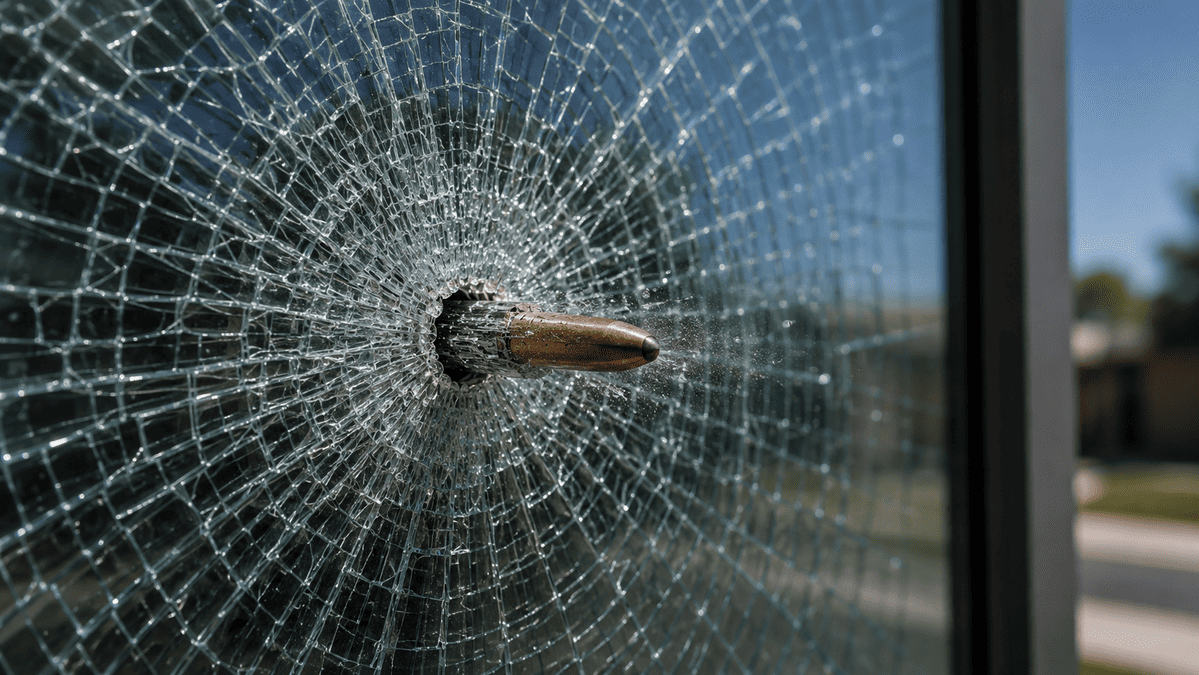
Bullet resistant glass requires significantly more complex construction than forced entry glazing, utilizing multiple layers of glass with polymer interlayers and sometimes polycarbonate backing layers. Ballistic resistance glazing systems use laminated glass constructed with multiple layers to withstand bullet penetrations and minimize injury from ballistic attacks. The performance of ballistic resistance glass is determined by its ability to resist bullet penetration from specified weapons and the number of shots it can withstand.
Protection levels range from resistance against small handguns (.22 LR) to high-powered rifle rounds and armor-piercing ammunition. The thickness required for bullet resistance increases substantially with threat level—handgun protection typically requires one to two inches of laminated construction, while rifle-rated systems may exceed three inches. Beyond stopping penetration, quality ballistic systems also control spall (fragments ejected from the protected side), which can cause serious injury even when bullets don’t penetrate.
Applications include bank teller stations, guard booths, government building reception areas, schools implementing lockdown protection, and any facility where armed attack represents a credible threat. Unlike forced entry glass, ballistic systems must be tested and certified for specific ammunition types and velocities.
Blast Resistant Security Glazing
Blast-resistant glass is engineered to absorb and dissipate energy from explosions, maintaining its integrity post-blast for occupant safety. Unlike ballistic protection, blast resistance focuses on managing shock waves (both positive pressure and negative-phase suction) and preventing glass shards from becoming deadly projectiles.
The critical factors in blast glazing include peak overpressure, impulse duration, interlayer ductility, and the complete system performance including frames and anchoring. The glass itself is expected to crack under significant blast loads—what matters is whether the laminate holds fragments, whether the glazing remains in the frame during both pressure phases, and whether the framing systems successfully transfer loads to the building structure.
Security glass is primarily used in areas such as retail storefronts, banks, schools, and government buildings for protection. Blast-rated systems are specified for embassies, critical infrastructure, military installations, and commercial buildings in areas with elevated terrorism risk. System-level testing evaluates the complete assembly, not just the glazing material.
Security Glass Standards and Testing
Global standards provide the framework for specifying, testing, and certifying security glass performance. In the US, security glass standards address specifications and test methods for anti-theft protection, forced entry resistance, ballistic resistance, and bomb-blast protection. European standards for security glass include EN 356 for impact resistance against manual attack, EN 1063 for bullet resistance, and EN 13541 for resistance against explosion pressure. These standards are commonly referenced when evaluating security glazing systems.
Testing Procedures and Certification
Security glazing requires testing as a complete system—glass, interlayer, frame, and anchoring—to verify real-world performance:
- Impact resistance testing simulates forced entry attacks using standardized tools including blunt implements (sledgehammers, axes), sharp tools (crowbars, saws), and thermal attack (propane torches). Testing evaluates time to create specific opening sizes.
- Ballistic testing fires multiple shots from specified weapons at defined velocities and angles, measuring both penetration resistance and spall behavior. Tests typically require the glass to stop a specific number of rounds while limiting fragment ejection on the protected side.
- Blast testing subjects complete glazing systems to controlled explosive charges or shock tube simulation, measuring response to both positive pressure waves and negative-phase suction. Performance is rated based on fragment hazard levels to occupants.
- Certification and compliance verification requires third-party laboratory testing with documented results matching the claimed standard and performance level. Certification applies to the specific tested configuration—changes to glass thickness, interlayer, or framing may invalidate results.
Security glass performance levels vary based on local building codes, application requirements, and specific project needs.
Global Standards Comparison
| Standard | Application Type | Performance Levels | Regional Use |
|---|---|---|---|
| ASTM F1233-21 | Forced entry + ballistic combined | Classes for tools, time to breach, ballistic levels (HG, R series) | USA—federal buildings, schools, high-security projects |
| UL 752 | Ballistic resistance only | Levels 1-10 (small handgun through AP rifle) | USA—financial, retail, guard installations |
| NIJ 0108.01 | Ballistic materials | Handgun classes (HG1-HG2), rifle classes | USA—body armor crossover, some architectural |
| EN 356 | Forced entry (manual attack) | P1A–P5A (drop test), P6B–P8B (axe test) | Europe—burglar resistance for windows and doors |
| EN 1063 | Bullet resistance | BR1 through BR7 (increasing caliber/velocity) | Europe—used with EN 1522 for complete systems |
| EN 13541 / ISO 16933 | Blast resistance | Classes based on overpressure, impulse, hazard levels | Europe and international—explosive threat protection |
Selection of appropriate standards depends on project location, regulatory requirements, threat assessment results, and whether combined protection (e.g., both ballistic and forced entry) is necessary. Government and insurance requirements often mandate specific standard compliance.
Common Challenges and Solutions
Implementing security glass involves navigating practical constraints that can affect both protection levels and project feasibility.
Balancing Security with Visibility and Aesthetics
Security glass thickness directly impacts optical quality—thicker laminates increase potential distortion, color tinting, and reflectance. Using ionoplast (SGP) interlayers enables thinner constructions with equivalent performance, improving clarity while maintaining protection. Low-iron glass reduces the green edge tinting common in standard security laminates.
For design-sensitive applications, laminated insulating glass units (IGUs) combine security glazing with performance glass for thermal insulation and low-E coatings. Aesthetic modifications including colored interlayers (Saflex/Vanceva systems), fritted patterns, and frosted finishes are available, though compatibility with interlayer adhesion and long-term durability must be verified. Laminated glass blocks over 99% of harmful UV rays, providing additional protection for interiors and occupants while potentially enabling energy savings through reduced solar heat gain.
Integration with Existing Building Systems
Retrofitting security glass into existing windows and glass doors requires verifying that frames and supporting structures can accept the additional weight and load transfer demands of security glazing. Edge sealing becomes critical—PVB interlayers are susceptible to moisture ingress at exposed edges, requiring proper frame capture or sealed edge details. SGP interlayers perform better with exposed edges but still require proper installation. A continuous line of protection depends on proper integration between the glazing and framing system.
For blast mitigation retrofits, window film attachment systems must be tested as complete assemblies including film, adhesive, attachment method, and frame.
Film alone provides inadequate protection if the attachment system fails under load. Coordination with building systems including HVAC and structural elements ensures the installation doesn’t compromise other building performance requirements.
Laminated glass acts as a sound barrier, minimizing acoustical transmission, which enhances comfort in residential and commercial spaces during retrofit projects.
Cost-Effectiveness and Long-term Performance
Security glass costs significantly more than standard glass—forced entry resistance glazing runs 20-30% above equivalent conventional options, while ballistic and blast-rated systems can cost two to five times more depending on threat level specifications. Cost drivers include glass thickness, interlayer type (SGP costs more than PVB), number of layers, panel size, and required framing systems.
Lifecycle considerations include interlayer clarity over time (potential yellowing), edge seal durability, maintenance of frame integrity, and cleaning protocols that avoid chemical damage to edges. Heavier security panels require stronger supporting structures and may demand special handling during transport and installation. Wired glass has a mesh of wire mesh embedded within it, which holds the pieces together when shattered, making it suitable for fire-rated applications, although its use is declining due to modern safety standards and the availability of laminated alternatives offering superior protection.
Conclusion and Next Steps
Security glass provides the critical delay mechanism that transforms vulnerable openings into protective barriers, giving occupants time to respond and deterring attackers who cannot quickly gain access. The technology spans forced entry resistance through blast protection, with each application requiring matched specifications and proper system installation.
To move forward with security glass implementation:
- Conduct a threat assessment identifying specific risks (forced entry, firearms, explosives) and their likelihood
- Select appropriate standards matching your threat profile and regulatory requirements
- Consult with certified security glazing suppliers who can provide tested system solutions
- Plan installation considering frame requirements, structural capacity, and coordination with existing building systems
- Establish maintenance protocols to ensure long-term performance
Related topics worth exploring include security film applications for retrofitting existing glass doors, complete security system integration combining glazing with access control and monitoring, and fire-rated security glazing for applications requiring both security and fire protection compliance.
Frequently Asked Questions
What is the difference between security glass and safety glass? Safety glass (tempered or basic laminated) protects against accidental injury by breaking into small pieces or holding fragments together. Security glass adds resistance to deliberate attacks—it maintains barrier integrity even after cracking, preventing forced entry, stopping bullets, or containing blast fragments. All security glass provides safety benefits, but safety glass alone does not resist intentional threats.
How thick should security glass be for different threat levels? Forced entry resistance typically requires ¼-inch to 1½-inch laminated construction depending on tool resistance requirements. Ballistic protection against handguns (UL 752 Levels 1-3, EN 1063 BR1-BR3) generally requires 1-2 inches. Rifle-rated systems (UL 752 Level 8, EN 1063 BR6-BR7) typically exceed 2-3 inches. Exact thickness depends on interlayer type and glass configuration.
Can security glass be retrofitted into existing windows? Yes, but successful retrofit requires verifying that existing frames and supporting structures can handle additional weight and load transfer, particularly for blast applications. Edge sealing, proper glazing methods, and potential frame reinforcement are typically necessary. Security film systems offer an alternative but must be tested as complete assemblies with attachment and framing.
What maintenance does security glass require? Regular cleaning with non-abrasive materials, avoiding solvents or acids near edges. Periodic inspection of edge seals, frame integrity, interlayer clarity (checking for yellowing or delamination), and hardware function. Professional assessment is recommended when micro-cracks appear or interlayer degradation becomes visible.
How much does security glass cost compared to standard glazing? Forced entry resistance glass costs 20-30% more than equivalent conventional glass. Ballistic-rated systems range from two to five times standard costs depending on protection level. Blast-resistant glazing, including required framing systems and installation, represents the highest cost category. Complete system costs include frames, anchoring, and certified installation.
What certifications should I look for when purchasing security glass? Specify standards matching your threat profile: ASTM F1233 for combined ballistic and forced entry, UL 752 or NIJ 0108.01 for ballistic protection, EN 356 for forced entry in European projects, EN 1063 for European ballistic requirements, EN 13541 or ISO 16933 for blast resistance. Always require third-party test reports for the complete glass and frame assembly being installed.
Can security glass be tinted or have other aesthetic modifications? Yes—colored interlayers, tinted glass plies, fritted patterns, and frosted finishes are available. Low-E coatings and solar control treatments can be incorporated. However, all modifications must be tested with the security system to verify they don’t compromise interlayer adhesion or protection levels. Aesthetic modifications may affect optical clarity and should be specified early in the design process.
How long does security glass installation typically take? Installation time depends on project scope, system complexity, and structural modifications required. Simple replacement of existing glass doors with security glazing may take hours per opening. New construction with blast-rated framing systems in a commercial building can require weeks for complete installation. Retrofit projects often take longer due to structural verification and modification requirements.