Need privacy without sacrificing natural light or redesigning your space? Switchable films give you on-demand control over any glass surface – no blinds, no curtains, no renovation. Here’s everything you need to know before choosing this technology for your next project.
Table of Contents
- What Is Switchable Film and Why It’s Replacing Traditional Blinds
- How Switchable Smart Film Works (PDLC Technology Explained Simply)
- Key Benefits of Switchable Smart Film vs. Conventional Glass Treatments
- Where Can Switchable Films Be Used?
- Installation on Existing Glass: What to Expect
- Control Options: From Simple Wall Switch to Fully Smart
- Technical Snapshot: Performance, Power Use, and Durability
- Frequently Asked Questions About Switchable Films
- Conclusion and Next Steps
What Is Switchable Film and Why It’s Replacing Traditional Blinds
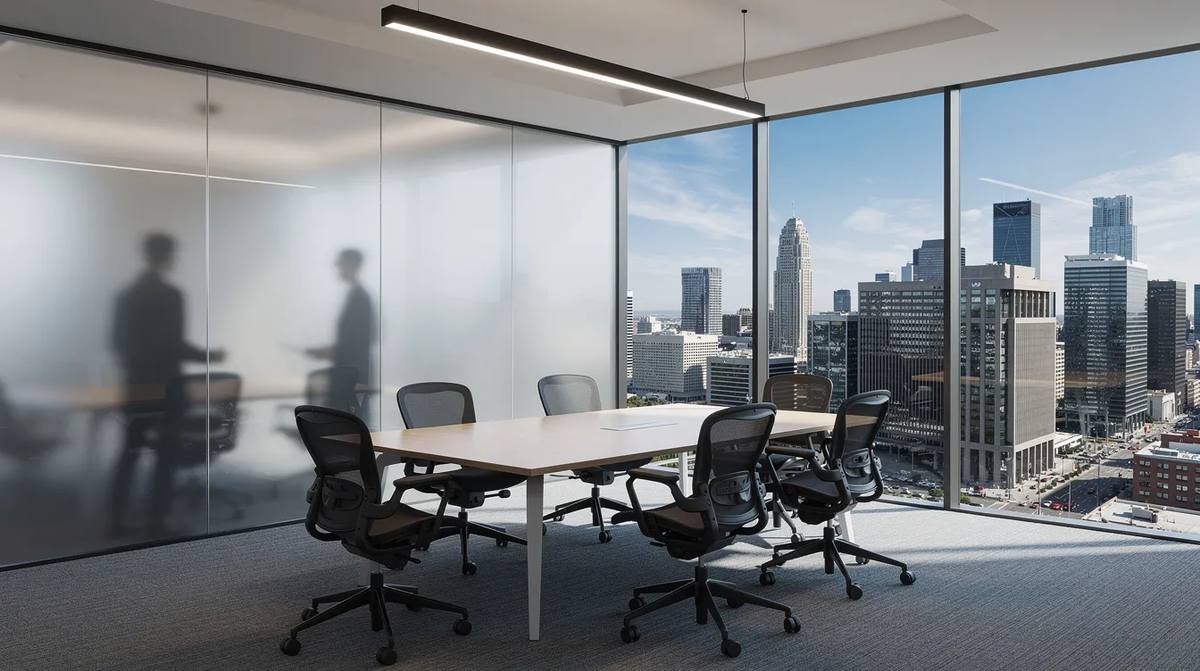
Switchable films are thin, electrically controlled layers that alter their light transmission properties with an external stimulus – typically a low-voltage electrical current. Applied to existing glass, they can switch from clear to opaque in seconds, providing instant privacy at the touch of a button. Polymer Dispersed Liquid Crystal (PDLC) is the most common technology behind switchable films, though other variants exist.
Compared to traditional blinds, curtains, or static window film, switchable smart film delivers privacy control without the visual clutter, dust collection, or maintenance burden. Blinds cast shadows and fray over time. Curtains eat floor space. Static frosted film locks you into one state permanently. Switchable films solve all of these problems in a single, sleek layer of smart film.
Between 2015 and 2025, this technology became mainstream in offices, hospitals, and classrooms, driven by improved materials and lower costs. Most switchable films can be retrofitted onto existing glass windows – they are commonly installed as a retrofit layer onto existing glass, which means no window replacement, less disruption, and lower project costs for any residential or commercial space.
How Switchable Smart Film Works (PDLC Technology Explained Simply)
Here is the process in plain language – no engineering degree required.
PDLC stands for polymer dispersed liquid crystal. It consists of microscopic liquid crystal droplets suspended in a polymer layer, sandwiched between two transparent conductive films. In its unpowered state, PDLC makes glass frosted and opaque because the droplets scatter light randomly. When powered on, PDLC aligns liquid crystals allowing light to pass through, and the glass surface becomes transparent. PDLC cycles from frosted to clear in milliseconds, and liquid crystal molecules align when stimulated by electrical current. This is what makes PDLC technology ideal for on-demand privacy and glare control.
The basic setup works like this:
- A self adhesive layer of film is applied to the interior glass surface
- Copper busbars at the film edges connect to a low-voltage transformer (typically 48–65V AC)
- A wall switch, remote, or smart system sends power to turn the film clear – or cuts power to return it to its opaque state
It is worth noting that switchable film uses electrochromic technology for transparency control as well – electrochromic films darken gradually in response to voltage changes, while Suspended Particle Device (SPD) films dynamically tint glass instead of frosting it. PDLC remains the most versatile option for privacy applications.
Smart glass refers to factory-laminated intelligent glass with PDLC built between panes. Retrofit switchable smart film, by contrast, is a self adhesive window film applied to existing glass – less expensive, faster to install, and adaptable to almost any flat surface.
Key Benefits of Switchable Smart Film vs. Conventional Glass Treatments
Here is why businesses and homeowners choose switchable privacy film over blinds, curtains, or static tint:
- Instant switchable privacy – switchable films provide instant privacy at the touch of a button, perfect for conference rooms, medical consultation rooms, street-facing bathrooms, and entrance doors. They also complement security window films that harden glass against impact by blocking visibility from one side entirely.
- Natural daylight preserved – switchable films preserve natural daylighting while regulating glare. In clear mode, visible light transmission reaches 80–90%, keeping interiors bright and reducing reliance on artificial lighting.
- UV and heat protection – over 98% UV blocking is offered by switchable films, protecting furniture, flooring, and artwork from fading. High-quality switchable films block over 99% of UV radiation. PriWatt® Film blocks 98% of harmful UV rays specifically. Switchable films can also reflect a significant portion of near-infrared radiation and can reduce solar heat gain and glare by up to 50%.
- Energy savings – switchable films lower electricity costs by reducing HVAC and lighting needs. Retrofit friendly switchable film boosts thermal performance without replacing glass, and the energy efficiency gains come from reducing reliance on artificial lighting during daylight hours.
- Projection screen capability – switchable films can transform glass into a projection screen when in the opaque state, and they act as high-impact smart window film projection screens for retail advertising, showrooms, and boardroom presentations.
- Sleek, minimalist aesthetic – no cords, slats, or fabric. The look is clean and modern, designed for contemporary architecture.
- Easy maintenance – wipe with a soft cloth and non-abrasive cleaner. No dust traps, no fabric degradation. When opaque, the film also functions like an electronic blind, cutting glare on screens in any office or classroom environment.
Where Can Switchable Films Be Used?
Switchable smart glass and switchable smart glass film for on-demand privacy work on almost any interior or exterior glass where building codes and wiring allow. The applications are versatile and span both commercial spaces and residential properties.
Commercial:
- Switchable films can be used in corporate offices for glass partitions, providing private meeting areas on demand
- Healthcare facilities use switchable films for patient privacy in consultation and recovery rooms
- Hotels and hospitality venues use them for spa areas, suite partitions, and lobby displays
- Education and training rooms benefit from combined projection and privacy control
Residential: decorative and privacy window films can complement switchable solutions in living spaces.
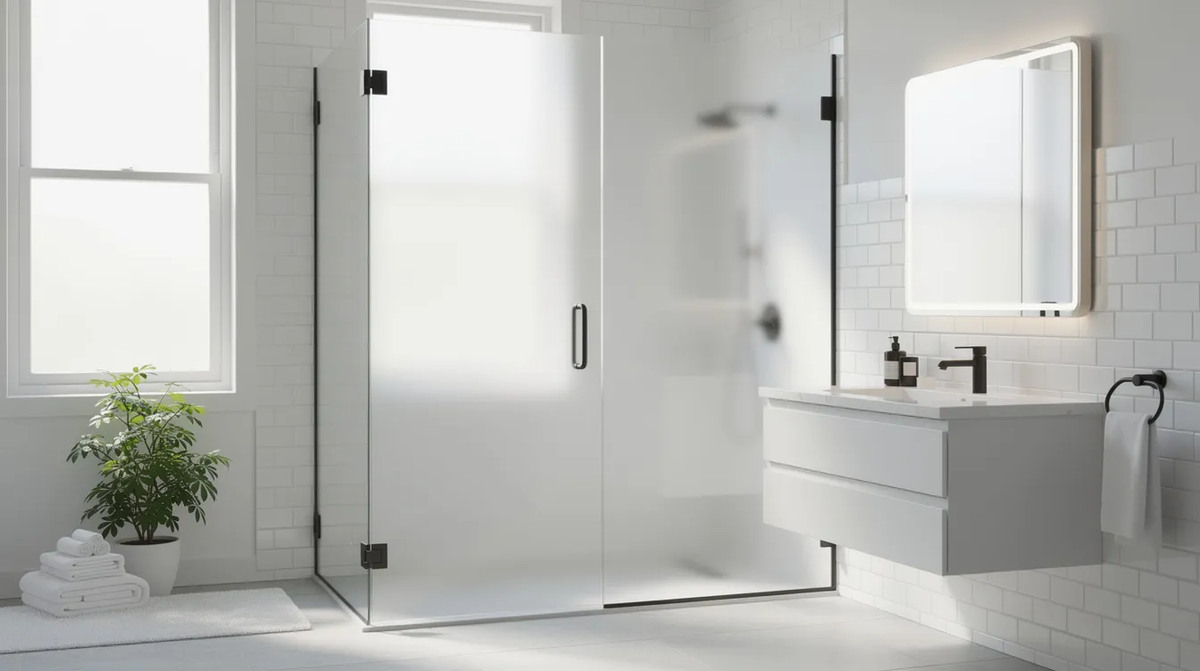
- Bathrooms and shower enclosures gain switchable privacy without permanent frosting
- Street-facing windows turn private at night while staying open during the day
- Home offices, internal glass doors, and room dividers in open-plan living areas all become adaptable
Switchable films are applied to interior glass walls and doors, and the self adhesive PDLC film can be trim to fit sidelights, large glass walls, sliding glass panels, and partitions without changing frames. In wet zones, use tempered or laminated glass and protect all electrical connections from moisture. For exterior windows with heavy sun exposure, factory-laminated solutions offer better long-term durability, while photochromic transitional window films can add adaptive tinting, UV protection, and glare control.
Installation on Existing Glass: What to Expect
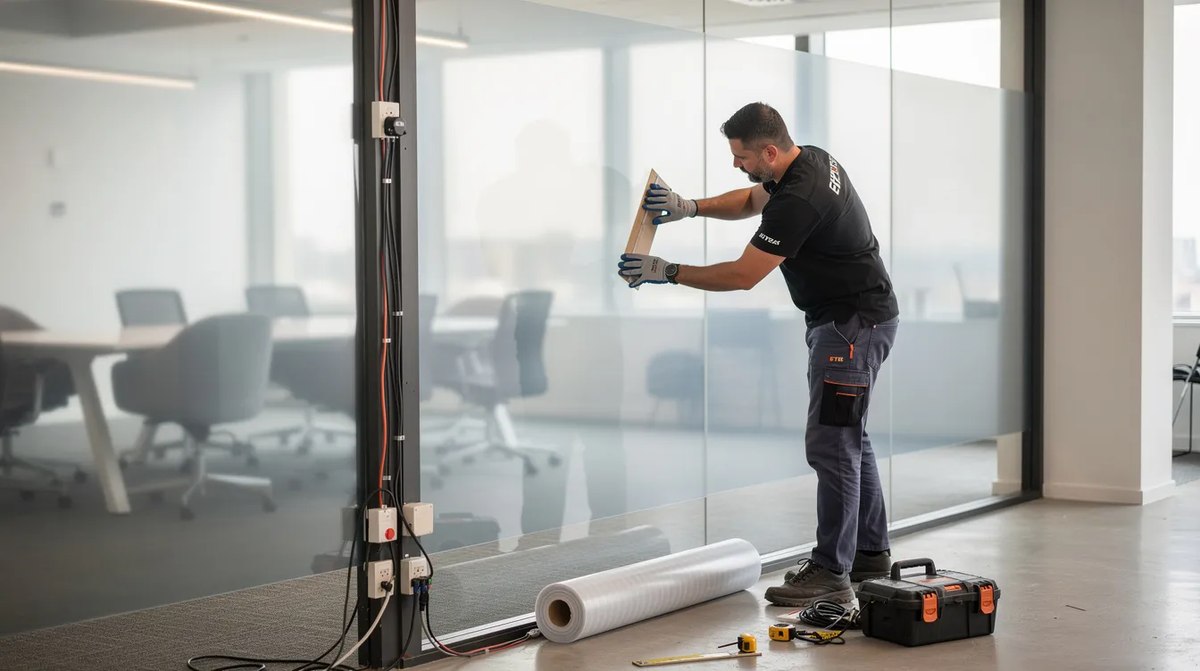
Switchable smart film is typically installed as a retrofit solution on existing windows and glass to minimize downtime and cost. Here is the standard process a professional installer follows:
- Site survey – measure each panel, assess glass type (tempered, laminated, double-glazed), and plan wiring routes
- Surface preparation – clean the glass surface thoroughly; install at 18–28°C in low-humidity conditions
- Film application – cut the self adhesive film 2–5mm smaller than the glass on each side to prevent peel at the edges, then apply with a squeegee to remove air
- Wiring – connect busbars to a transformer, route cables discreetly, and ensure proper electrical isolation from metal frames
- Testing – switch on and off to verify uniform transparency, check for bubbles, and confirm the control system responds correctly
Self adhesive smart film is preferred for most retrofit projects because it bonds directly to the surface without lamination. A single office partition can typically be completed in half a day; a full boardroom with multiple panels and concealed wiring may take one to two days. Always follow manufacturer guidance for glass compatibility – especially with double-glazed units, where applying film to the wrong pane can cause condensation or seal failure.
Control Options: From Simple Wall Switch to Fully Smart
The same film can be controlled in many ways, matching the simplicity or sophistication your environment demands.
- Wall switch – simple on/off operation, ideal for meeting rooms and private offices. Switchable films can be controlled via wall switches or remote controls for intuitive, instant control.
- Remote controls and key fobs – perfect when panels are hard to reach or when you need to cancel visibility across multiple glass walls from a central point.
- Smart home and building integration – compatible with Z-Wave, Zigbee, and Wi-Fi-based controllers for app and voice control. Watch your glass turn opaque with a simple voice command.
- Automation – schedule-based control, occupancy sensors, and scene modes (e.g., “presentation mode” dims light and switches glass opaque simultaneously).
All systems require a certified low-voltage transformer. Have a qualified electrician handle the wiring to mains power for safety and code compliance.
Technical Snapshot: Performance, Power Use, and Durability
Here are the numbers decision-makers ask about most:
| Spec | Clear (ON) | Opaque (OFF) |
|---|---|---|
| Visible light transmission | 80–90% | Below 5% |
| Haze | Under 5% | Over 90% |
| Power draw | 3–6 W/m² | 0 W |
| PriWatt Film consumes less than 3 Watts per square meter when on, making operating costs modest compared to lighting or HVAC loads. Films operate at 48–65V AC via purpose-built transformers. Expect a lifespan of 10+ years and 100,000+ switching cycles under normal indoor conditions. Factors like UV exposure, moisture at the edges, and correct installation affect longevity. PDLC film is silent in operation and does not interfere with Wi-Fi or medical equipment when installed correctly. |
Frequently Asked Questions About Switchable Films
How long does switchable film last? Under normal indoor conditions with proper edge sealing, most films last over 10 years. Lifespan is often rated at 80,000–100,000 hours or 100,000+ switch cycles.
What happens during a power cut? The film reverts to its opaque state – your default is always private. No power means frosted glass, which many customers consider a security benefit.
Can it be used in bathrooms and showers? Yes, provided the glass is laminated or tempered and all electrical connections are protected from moisture. Factory-laminated options are ideal for high-humidity areas.
Is it fully private at night with lights on? In opaque mode, details are obscured but strong interior lighting can create faint silhouettes. For full nighttime privacy on exterior-facing windows, supplementary curtains may still be needed on one side.
Does it improve window insulation? Switchable film primarily adds privacy, UV protection, and glare control rather than significant insulation. However, it does modestly reduce solar heat gain and can complement existing double-glazed units.
Can damaged sections be repaired? Individual panels can usually be re-filmed without replacing or disturbing adjacent glass, keeping repair simple and cost-effective.
Conclusion and Next Steps
Switchable privacy film and smart glass offer an elegant way to combine openness and confidentiality in any modern interior. You get instant control via a wall switch or smart system, retrofit capability on existing glass, a clean architectural look, and freedom from the clutter of blinds and curtains – all from a single, adaptable layer of film.
If you are ready to transform your space, request a site survey or speak with a specialist about the right configuration for your project. The process is straightforward, the installation is fast, and the results are immediate.