
Dichroic materials create some of the most striking visual effects in modern architecture, art, and optical technology. These color-shifting surfaces transmit one color while reflecting another, producing vibrant hues that change with viewing angle and lighting conditions. This guide breaks down how dichroic coatings work, where they’re used, and what you need to know when specifying them.
Table of Contents
- What is dichroic glass and dichroic coating?
- How dichroic glass and filters work
- Manufacturing methods
- Dichroic glass types defined
- Architecture, art, and optical uses
- Market size 2024–2032
- Design and installation tips
- FAQs about dichroic
Readers interested in practical design guidance can jump directly to “Design and specification considerations.”
What Is Dichroic Glass and Dichroic Coating?
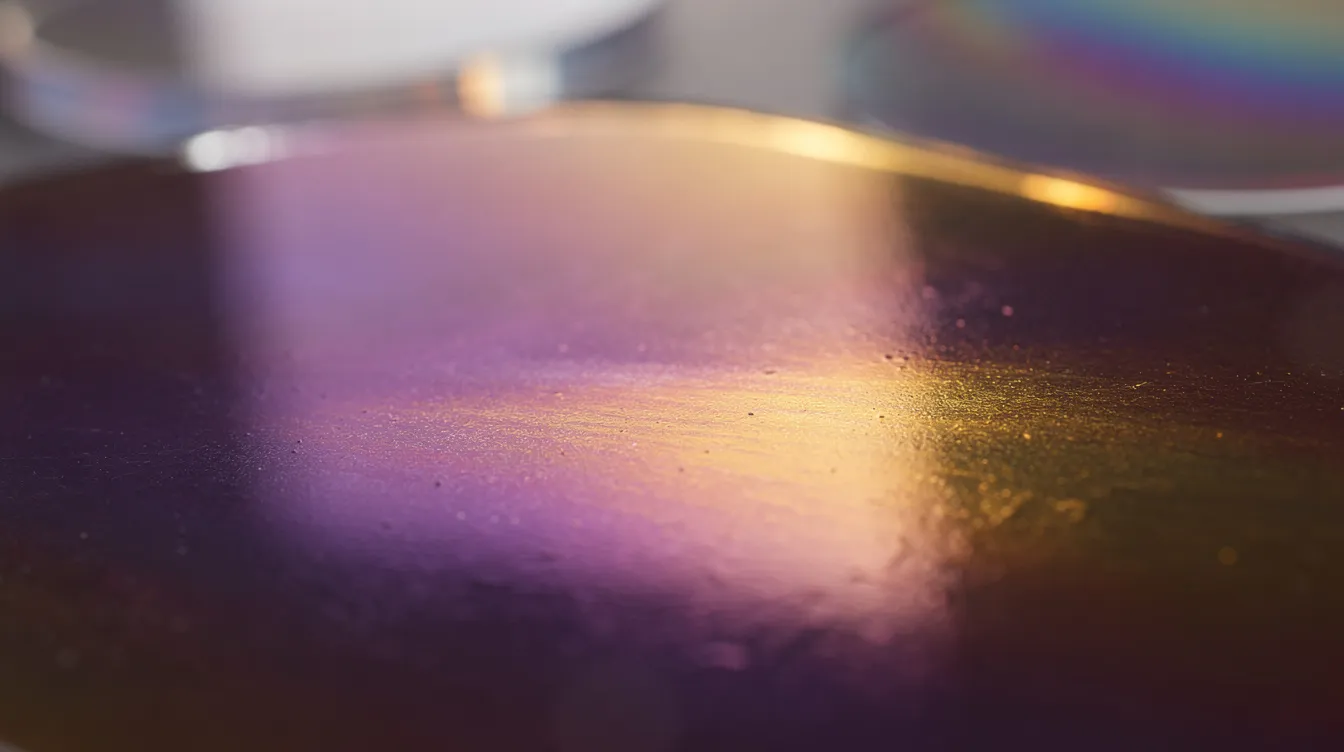
Dichroic materials display two or more distinct colors depending on viewing angle and lighting conditions. This happens because the surface transmits certain light wavelengths while reflecting others—meaning the transmitted and reflected light appear as complementary colors. Different lighting conditions can dramatically influence how these color shifts are perceived.
- Modern dichroic glass consists of float or borosilicate glass coated with 30–50 ultra-thin layers of metals and metal oxides (titanium, silicon, chromium, aluminum, magnesium) deposited in a vacuum chamber.
- The total coating thickness typically ranges from 700–900 nm (about 30–35 millionths of an inch)—comparable to the wavelengths of visible light itself.
- Decorative dichroic glass serves art, jewelry, and architectural applications where aesthetic iridescence matters most.
- Dichroic filters and dichroic mirrors are precision optical components used in projectors, fluorescence microscopy, and laser systems where exact spectral control is required.
- Historical context: NASA and aerospace thin-film research during the 1960s–1980s helped commercialize decorative dichroic glass for artists by adapting satellite coating techniques.
How Dichroic Glass and Filters Work (Optical Principles)
The dichroic effect comes entirely from thin-film interference—not dyes, pigments, or crystals. Each metal-oxide layer has a specific refractive index and thickness, and stacking layers creates precise optical interference patterns.
- When light hits the coated surface, some wavelengths experience constructive interference (amplified reflection), while others experience destructive interference (transmission through the glass).
- Transmitted light appears one color family (example: cyan, magenta, yellow), while reflected light shows the complementary color (red, green, blue).
- Changing the angle of view shifts which wavelengths pass or reflect, producing dynamic color shifts across the surface.
- Unlike gel filters that work by absorbing unwanted light and converting it to heat, dichroic filters reflect unwanted wavelengths away from the beam—making them ideal for extreme heat environments.
- This efficiency makes dichroic coatings more durable in high-intensity lighting, projectors, fluorescence microscopy, and laser systems where absorbing filters would degrade.
- Designers can tune specific colors by altering layer count, sequence, oxide types, and thickness to nanometer precision during manufacturing.
Manufacture of Modern Dichroic Glass and Filters
Most dichroic coatings are produced using vacuum thin-film deposition, particularly electron-beam physical vapor deposition (EB-PVD). This technique allows precise control over layer thickness and spectral performance.
- Substrate preparation: Float glass or borosilicate glass provides optical stability and temperature resistance. Multi-step cleaning (ultrasonic baths, deionized water rinses, clean-room drying) ensures adhesion and minimizes pinholes.
- Coating process: Glass is loaded into a high-vacuum chamber where electron beams vaporize metal oxide targets (TiO₂, SiO₂, Al₂O₃, MgF₂, Cr₂O₃). Vapors condense as ultra-thin layers on the cool glass surface.
- A finished glass filter may have 30–50 alternating layers totaling 760–890 nm, specifically designed for passbands like 488 nm, 532 nm, or 633 nm laser lines.
- In-situ monitoring: Optical sensors track thickness and spectral performance during deposition, ensuring the coating hits precise wavelength targets.
- Downstream processing: Annealing relieves internal stress; CNC waterjet or scribe-and-break cutting achieves tight tolerances for optical components.
- Alternative: Polymer-based dichroic film can be laminated onto existing glazing for retrofit projects—thinner and more flexible but generally less durable than directly coated glass.
Dichroic Glass Defined and Types
This section provides a practical guide to what specifiers, artists, and engineers mean by “dichroic glass.”
- Core definition: Glass exhibiting pronounced color shift between transmitted and reflected light due to multilayer interference coatings.
- Decorative dichroic sheets: Used for kiln-forming, lampworking, and jewelry. These can withstand high temperatures during artistic firing above 800–900°C (1470–1650°F).
- Architectural dichroic panels: Laminated products for façades, canopies, balustrades, skylights, and interior partitions in buildings and public art installations.
- Precision optical dichroic: Mirrors, color filters, and beam splitters for imaging systems, projection optics, and scientific instruments that split light into two distinct beams.
- Color families are often marketed with names like “cyan-magenta,” “blue-gold,” or “green-magenta” indicating the transmitted vs. reflected color pair.
- Some manufacturers offer coatings on textured, patterned, or low-iron glass to enhance specific visual effects and color purity.
Applications of Dichroic Coatings
Dichroic coatings span technical optics, entertainment lighting, architecture, and fine art. Each sector prioritizes different performance metrics—color fidelity, durability, aesthetics, or cost.
Optical and imaging:
- Beam-splitting mirrors in fluorescence microscopy and flow cytometers
- Wavelength-selective elements in DSLR and cinema camera sensors
- Projector color separation in LCD and DLP systems for digital cinema and 3D projection
Entertainment and stage lighting:
- Dichroic color filters and gobos in moving-head fixtures and spotlights
- Superior heat resistance and stable color under long-term high-intensity use compared to gel filters
- Cleaner whites by reflecting IR and unwanted wavelengths
Architecture and interior design:
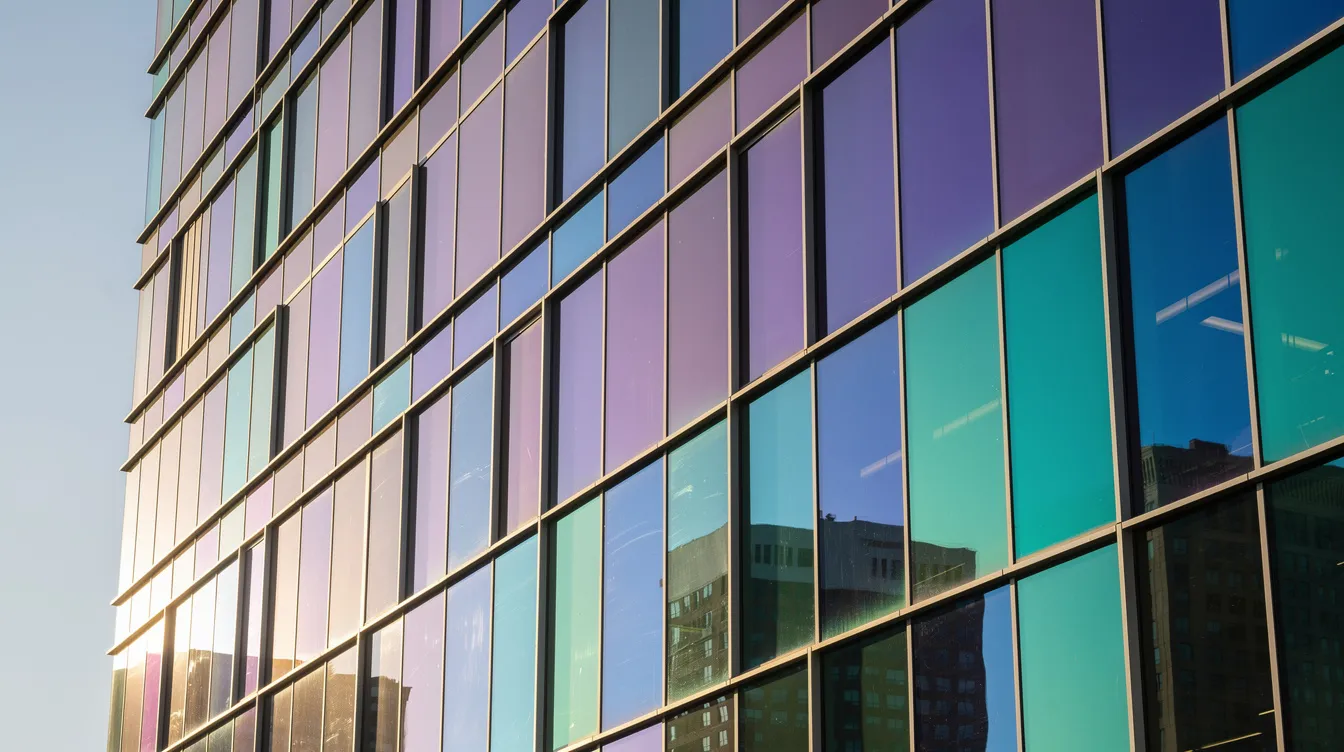
- Exterior façades, canopies, and skylights creating architectural accents that shift color with sun angle
- Interior partitions and feature walls in museum spaces, airports, hotels, and retail producing mood-enhancing, Instagram-friendly environments
Art and jewelry:
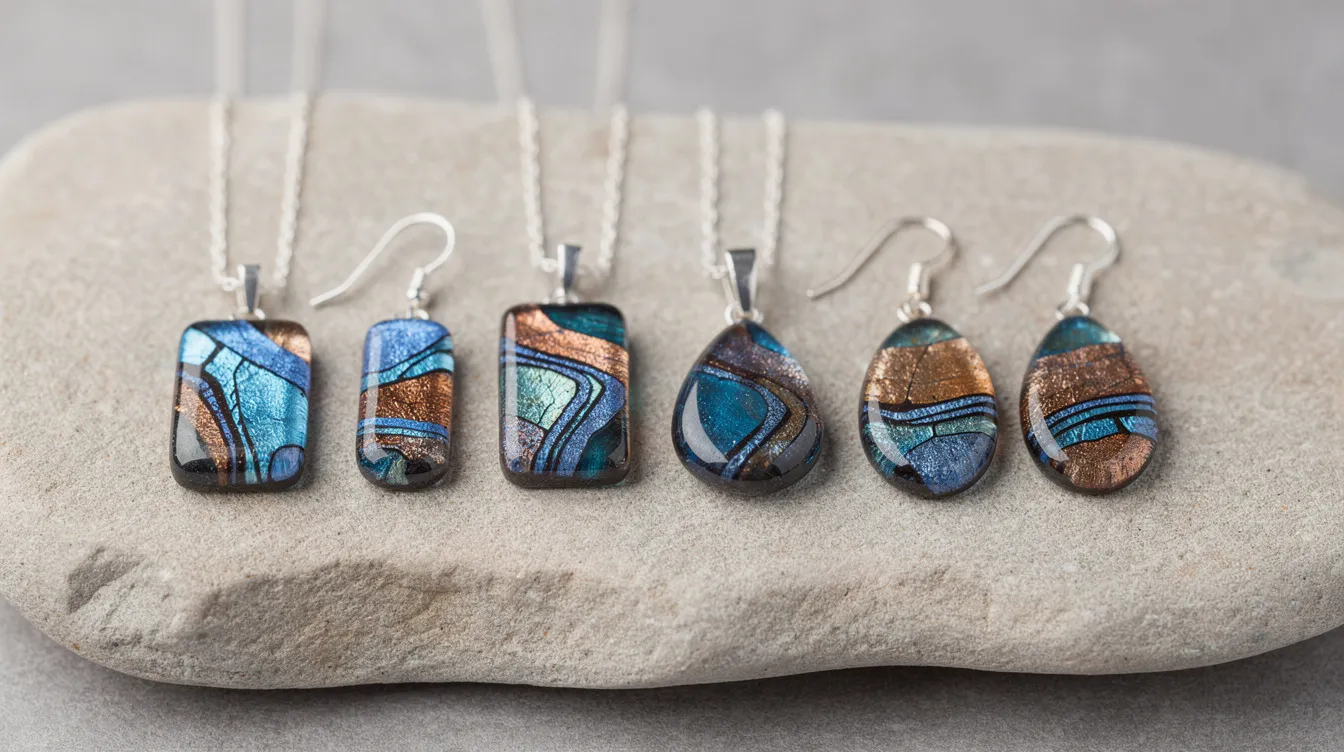
- Kiln-formed panels, wall pieces, and sculptures using dichroic sheet glass
- Wearable art where small pieces mimic opal-like flashes
- Glass art installations that showcase dynamic color shifts and changing visual effects
Industrial and scientific:
- Heat-reflecting dichroic mirrors in high-power illumination
- Laser line filters transmitting specific wavelengths (405 nm, 532 nm, 1064 nm) for measurement, recording, and sensing
Market Demand and Trends for Dichroic Glass (2024–2032)
The dichroic glass and filter market has grown from niche optics into a recognized segment across architecture, design, and entertainment technology.
- One industry analysis valued the global dichroic glass market at approximately USD 100.1 million in 2023.
- Forecasts project growth to roughly USD 109.3 million in 2024 and up to about USD 234 million by 2032.
- This reflects an estimated compound annual growth rate (CAGR) of about 9.9% from 2024 to 2032.
Demand drivers:
- Increasing architectural use of color-shifting façades and feature glazing
- Continued demand from digital projection, cinema, and live event lighting
- Broader adoption in consumer products, furniture, and interior décor
Regional dynamics:
- North America and Europe lead in high-end architectural and entertainment projects
- Asia-Pacific, especially China and Southeast Asia, shows rapid expansion via megaprojects and theme parks
Technology trends:
- Improved thin-film simulation software enabling custom spectral control
- Durable exterior-grade coatings for 20+ year outdoor lifespans
- Polymeric dichroic films as cost-effective retrofit alternatives
Sustainability angle: IR-reflecting dichroic coatings help manage solar heat gain while maintaining daylight—an advantage for energy-conscious building envelopes, much like photochromic transitional window films that adapt tint with sunlight.
Design and Specification Considerations for Dichroic Glass
This section helps architects, lighting designers, and fabricators avoid common pitfalls when specifying dichroic materials.
- Cost and availability: Dichroic glass costs more than standard tinted glass due to vacuum deposition. Source through specialty suppliers rather than general fabricators.
- Color and angle dependence: Create physical mock-ups and view samples under representative lighting (day/night, artificial vs. daylight). Color shifts notably with sun path and background surface.
- Installation durability: Architectural dichroic glass is often laminated or used as one lite in an IGU. Position coatings on internal surfaces to avoid abrasion and weathering.
- Structural requirements: Coordinate with engineers regarding thickness, safety glazing (tempered, laminated), and fixing systems. Check edge-exposure and sealant compatibility.
- Lighting integration: Work with lighting designers to choose color temperatures and beam angles that enhance the dichroic properties rather than wash them out.
- Documentation: Specify exact product names, coating codes, and orientation. Require sample approval and on-site mock-ups before full production. Refer to manufacturer specifications and approved samples throughout the design and installation process to ensure consistency.
FAQs About Dichroic Glass and Filters
This section answers common questions from designers, artists, and engineers considering dichroic materials.
What is the difference between dichroic glass and ordinary colored glass? Ordinary glass relies on pigments or bulk colorants for static coloration. Dichroic glass uses thin-film interference coatings that change color with angle—producing dynamic, complementary hues in transmitted and reflected light.
Can dichroic glass be used outdoors? Yes, when designed with exterior-grade coatings and properly laminated. However, not all decorative products are rated for long-term UV and weather exposure—verify with manufacturers.
Does dichroic glass fade over time? High-quality interference coatings are very stable to UV and heat, unlike dye-based materials. Surface damage or improper installation can affect appearance over time.
Is dichroic glass safe for high-temperature applications? Many art-grade dichroic glasses survive kiln forming above 800°C. Architectural and optical products have separate thermal specifications—check with the manufacturer for your specific region of use.
Can I retrofit existing windows with a dichroic effect? Polymer dichroic films can be applied to existing glazing for interior projects. Exterior retrofits typically require new laminated units with the coating positioned on a protected internal face.
How should I clean dichroic glass? Use non-abrasive, neutral cleaners with soft cloths. Avoid harsh chemicals on exposed coatings to prevent polarization damage or surface degradation that could affect the dichroic properties.
More Posts: