- The Commercial Renter’s Dilemma: Enhancing Your Space Without Permanent Changes
- Why Traditional Window Treatments Are a Risky Bet for Tenants
- The Smart Solution: Professional, Damage-Free Window Films
- Unlocking Strategic Advantages: The ROI of Window Film for Your Business
- Tailoring Your Space: A Guide to Non-Intrusive Film Options
- Conclusion: A Strategic Investment in Your Rented Commercial Space
- Frequently Asked Questions
The Commercial Renter’s Dilemma: Enhancing Your Space Without Permanent Changes

Signing the lease for a new commercial space is a major milestone. You have a vision for your business, and the physical environment is a huge part of that. Yet, this excitement is often tempered by the reality of your rental agreement. You want to create a professional, comfortable, and branded space, but you’re bound by rules that prohibit permanent or even semi-permanent changes. This is the commercial renter’s dilemma: how do you make a space truly your own without risking your security deposit or violating your lease?
Navigating the Constraints of Commercial Lease Agreements
Buried within the legal language of nearly every commercial lease is a section on “Tenant Improvements” or “Alterations.” These clauses are the landlord’s primary tool for protecting their property investment. They typically state, in no uncertain terms, that the tenant cannot make any structural or significant cosmetic changes to the premises without prior written consent.
This includes common activities like painting, installing new fixtures, or altering the walls. For window treatments, this means that drilling holes for curtain rods or blind brackets is often a direct violation of your lease. Obtaining landlord approval can be a slow, difficult process, and it often comes with strict conditions and the requirement that you pay to restore the space to its original condition when you leave.
The High Cost of Unapproved Tenant Improvements
Overlooking or ignoring the alteration clauses in your lease is a significant financial risk. The consequences of making unapproved changes can be severe and costly, extending far beyond a simple slap on the wrist. Landlords have several avenues for recourse, including:
- Forfeiture of Your Security Deposit: This is the most common consequence. The landlord will use your deposit to cover the costs of repairing any damage and restoring the property.
- Imposed Fines and Fees: Your lease may contain specific penalties for unauthorized alterations, adding unexpected costs to your operational budget.
- Mandatory Removal and Restoration: You may be required to immediately remove the improvements at your own expense and then pay for professional repairs to return the space to its pre-lease condition.
- Lease Default and Eviction: In extreme cases, a significant violation of the lease terms can be grounds for default, leading to legal action and even eviction.
These financial and legal risks turn what seems like a simple upgrade into a major liability, forcing many business owners to simply endure a space that doesn’t meet their needs.
Why a Professional Image Matters from Day One
The appearance of your commercial space is not just about aesthetics; it’s a critical component of your brand identity and customer experience. From the moment a client walks past your storefront or a potential employee sits down for an interview, they are forming an opinion of your business. Uncontrolled sun glare on computer screens, a lack of privacy in meeting rooms, or excessive heat can make your space uncomfortable and unproductive.
This puts the renter in a difficult position. You know that a polished, comfortable, and professional environment is essential for success. Yet, the very tools you might use to achieve it—like permanent fixtures or structural changes—are off-limits. You are forced to choose between upholding your lease and creating a space that truly reflects the quality of your brand.
Why Traditional Window Treatments Are a Risky Bet for Tenants
Faced with the need to control light, privacy, and heat, many tenants turn to traditional window treatments like blinds or curtains. They are widely available and seem like a straightforward solution. However, for a commercial renter, these options are often a poor fit, introducing a new set of problems related to damage, functionality, and brand perception.
The Hidden Damage and High Cost of Blinds and Curtains
The most significant issue with blinds and curtains is that they are not truly temporary. Proper installation requires drilling into window frames, drywall, or ceilings to mount hardware and brackets. Each hole is a permanent alteration that violates the spirit, if not the letter, of a standard lease agreement.
When your lease ends, you are responsible for the aftermath. This means not only removing the hardware but also professionally patching, sanding, and painting the damaged surfaces to match the existing wall. The cost of these repairs is often deducted directly from your security deposit, turning your “solution” into a guaranteed expense. Furthermore, the high upfront cost of quality, custom-sized blinds is a sunk investment that you likely cannot take to your next location.
Lack of Versatility for Branding and Privacy Needs
Beyond the physical damage, traditional window coverings are remarkably inflexible. Blinds and curtains operate on a binary system: they are either open or closed. When closed, they block heat and provide privacy, but they also eliminate natural light and cut off the view, creating a dark, disconnected environment. When open, they let in light but sacrifice all privacy and heat control.
This lack of nuance is a major drawback for a modern business. More importantly, these traditional solutions offer zero opportunity to enhance your brand. You cannot print a logo on a set of vinyl blinds or use them to display store hours. They are functionally generic, doing nothing to help your space communicate who you are as a business.
The “Temporary” Look That Undermines Your Brand
In an effort to avoid drilling holes, some businesses opt for cheap, “temporary” stick-on paper shades or ill-fitting curtains held by tension rods. While these may not cause permanent damage, they create another problem: they look unprofessional.
These makeshift solutions often sag, tear, or look out of place, signaling to customers and clients that your business is either temporary or unconcerned with details. A wrinkled paper shade or a crooked curtain undermines the professional image you work so hard to build in every other aspect of your business. It sends a message of impermanence, which is the exact opposite of the confidence and stability you want to project.
The Smart Solution: Professional, Damage-Free Window Films
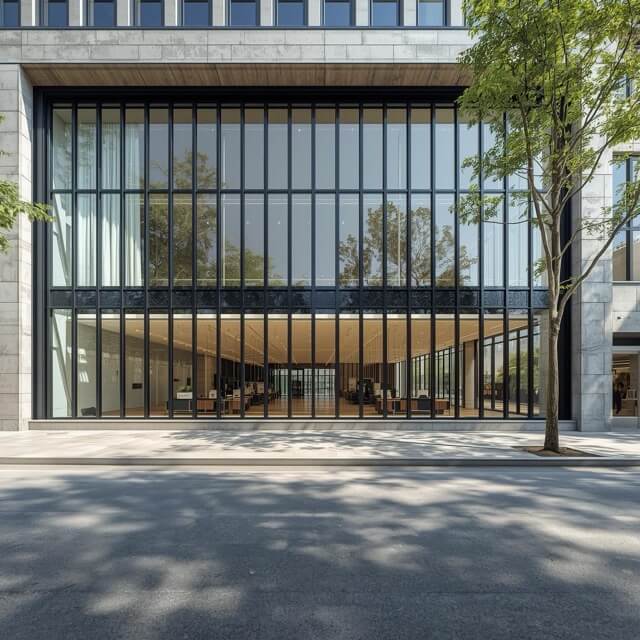
For businesses operating in leased properties, the challenge is always to improve the space without making permanent, costly, or prohibited alterations. The ideal solution needs to solve immediate problems like glare, privacy, and high energy bills, yet be fully removable without a trace. This is precisely where modern, professional-grade window films excel, offering a sophisticated and non-intrusive upgrade for your commercial space.
Understanding Modern Removable Window Film Technology
When you hear “window film,” it’s easy to picture the bubbled, purple tint on an old car. Today’s architectural window films are a world apart. They are advanced, multi-layered products engineered to provide specific benefits. These thin, durable polyester sheets can be embedded with a variety of materials, from nano-ceramic particles that block heat to elegant frosts that create privacy.
The technology is highly specialized, resulting in films designed for distinct purposes:
- Solar Control Films: Prioritize heat and UV rejection to lower energy costs and reduce fading.
- Decorative Films: Offer a vast range of textures, patterns, and colors to enhance interior design and branding.
- Privacy Films: Obscure views with frosted, mirrored, or blackout options.
- Safety and Security Films: Thicker films designed to hold shattered glass together.
Crucially, these professional films are engineered for optical clarity and dimensional stability, ensuring they perform beautifully for years and can be cleanly removed when your lease ends.
How Professional Films Adhere Without Damaging Glass
The secret to a non-intrusive application lies in the adhesive system. Unlike permanent glues or messy alternatives, professional window films use a specially formulated, clear, pressure-sensitive adhesive. During installation by a trained technician, a slip solution is used that allows the film to be perfectly positioned on the glass. As this solution dries over a few days, a clear, strong bond forms between the film and the glass surface.
This process is designed to be completely reversible. The adhesive is strong enough to last for the duration of its intended life but is formulated to be removed cleanly by a professional. When it’s time to move or update your space, a technician can peel the film off, and any trace adhesive residue is easily cleaned away, leaving the original glass in pristine condition. This guarantees you can enhance your space without jeopardizing your security deposit.
The Critical Difference Between DIY Static Cling and Professional-Grade Films
In the search for a temporary solution, many businesses consider DIY static cling products. While they may seem like a simple fix, their limitations often create more problems than they solve, particularly in a professional setting. Understanding the distinction is key to making a sound investment.
DIY Static Cling Films
These products adhere to glass using static electricity or moisture, not a true adhesive. They are best suited for very short-term, decorative home use. In a commercial environment, they fall short.
- Appearance: Prone to peeling at the edges, trapping dust and air bubbles, and creating a distinctly unprofessional look.
- Performance: Offer minimal heat or UV rejection. They are primarily for decoration or basic privacy and lack the advanced features of professional films.
- Durability: Easily scratched, discolored, and damaged by standard window cleaning.
Professional-Grade Adhesive Films
These are an entirely different category of product, engineered for performance, longevity, and a flawless appearance.
- Appearance: When installed professionally, the film is virtually seamless. It looks like the glass was manufactured that way.
- Performance: Delivers certified performance metrics for heat rejection, UV blocking, and glare reduction. The results are measurable and significant.
- Durability: A hard coat protects the film from scratches and allows for normal cleaning, ensuring it maintains its look for years.
Choosing a professional-grade film is not just an aesthetic choice; it is a strategic decision for performance and reliability that a temporary cling film simply cannot match.
Unlocking Strategic Advantages: The ROI of Window Film for Your Business
Investing in professional window film is more than just a lease-friendly upgrade. It is a strategic move that delivers a tangible return on investment across several key areas of your business, turning your windows from a liability into a high-performing asset.
Enhancing Energy Efficiency and Reducing Overhead Costs
One of the most immediate and impactful benefits of solar control window film is the reduction in energy consumption. Large commercial windows, while great for views, can let in a tremendous amount of solar heat, forcing your HVAC system to work overtime to maintain a comfortable temperature.
Advanced solar films can block up to 80% of the sun’s heat-producing infrared rays without making your space dark. This single improvement dramatically lessens the strain on your air conditioning, leading to significantly lower energy bills each month. It also helps eliminate uncomfortable hot spots near windows, creating a more consistent and pleasant environment for employees and customers alike.
Creating Private, Productive Workspaces for Employees
Open-plan offices and glass-walled conference rooms are modern and stylish, but they often lack privacy. This can lead to distractions and a feeling of being “on display,” which can hinder productivity. Decorative and privacy films solve this problem elegantly and affordably.
Instead of resorting to costly and permanent construction, you can use frosted, patterned, or opaque films to:
- Create visual separation for individual offices or departments.
- Ensure confidentiality in conference rooms and HR areas.
- Block distracting views from street-level windows or busy hallways.
This allows you to maintain an open, light-filled aesthetic while providing the focused, private spaces your team needs to do their best work.
Boosting Your Brand with Custom Decorative and Branded Films
Your physical space is a powerful extension of your brand identity. Custom window films offer a unique and sophisticated way to reinforce your brand message without permanently altering the storefront or interior. Glass surfaces on doors, partitions, and exterior windows become prime real estate for branding.
Consider the possibilities:
- Displaying your company logo on the main entrance for a professional first impression.
- Applying brand colors or patterns to glass partitions to carry your theme throughout the office.
- Etching your company’s mission statement or values onto a conference room wall.
- Using films to advertise promotions or business hours on storefront windows.
This turns standard glass into a dynamic marketing tool, enhancing brand recognition and creating a cohesive, polished look that reflects the quality of your business.
Improving Security and Safety for Your Commercial Space
Beyond aesthetics and energy savings, specialized window films can provide a crucial layer of protection for your property, inventory, and people. Safety and security films are made from a thicker polyester and use a more aggressive adhesive, designed to hold glass together upon impact.
This provides two critical benefits. First, in the event of accidental breakage from an impact or severe weather, the film holds the dangerous shards of glass in place, mitigating the risk of injury. Second, it acts as a powerful deterrent to intruders. By making the glass significantly harder to breach, it slows down would-be burglars in a smash-and-grab attempt, often causing them to give up and move on. This added protection provides invaluable peace of mind for any business owner.
Tailoring Your Space: A Guide to Non-Intrusive Film Options
Once you recognize the potential hidden within your commercial windows, the next step is understanding the specific solutions available. Modern window films are not a one-size-fits-all product. They are specialized tools designed to solve distinct business challenges. For the commercial tenant, the beauty of these films lies in their ability to deliver significant upgrades in comfort, branding, and security, all while being completely removable and compliant with most lease agreements. Let’s explore the primary categories of non-intrusive films that can transform your rented space.
Solar Control Film: Managing Heat and Glare
Uncontrolled sunlight can be a major problem in a commercial setting. It creates uncomfortable hot spots near windows, forces your HVAC system to work overtime, and produces harsh glare on computer screens, reducing employee productivity and comfort. Solar control film is the definitive solution to this common issue.
These advanced films are engineered to reject a significant portion of the sun’s infrared heat without dramatically darkening your windows. The result is a more stable and comfortable indoor temperature, leading to tangible energy savings on your cooling bills. Simultaneously, solar films reduce the intensity of visible light, cutting down on disruptive glare while preserving your view of the outside. This creates a more pleasant and productive work environment for your team and a more welcoming atmosphere for your clients.
Privacy Film: From Frosted Elegance to Total Blackout
Open-concept offices and street-level spaces often require a strategic approach to privacy. Whether you need to secure a conference room, shield sensitive information from view, or simply create a more secluded atmosphere, privacy films offer a sophisticated and versatile solution without the expense and permanence of etched glass or physical barriers.
The options range in both function and style, allowing you to tailor the level of privacy to your exact needs.
- Frosted Films: These are a popular choice for creating an elegant, high-end look on glass partitions and doors. They obscure the view while still allowing ample light to pass through, maintaining a bright and open feel.
- One-Way Mirror Films: Ideal for street-level offices or security posts, these films create a mirrored effect on the exterior during daylight hours, preventing outsiders from seeing in. From the inside, however, you retain a clear view out.
- Blackout and Whiteout Films: When total visual privacy is non-negotiable, these opaque films completely block the view from both sides. They are perfect for storage areas, server rooms, or any space containing highly sensitive assets.
Decorative Window Film: Transforming Your Storefront and Office Interior
For a business in a rented space, establishing a strong brand identity can be challenging due to restrictions on permanent signage and alterations. Decorative window film is a game-changer, allowing you to turn plain glass into a powerful branding tool. Your storefront windows and interior glass partitions become a canvas for your company logo, business hours, or custom patterns that reinforce your brand aesthetic.
Beyond just logos, decorative films can be used to add color, texture, and sophisticated design elements to your space. You can mimic the look of expensive etched or sandblasted glass at a fraction of the cost. Because these films are easily removable, you can update your branding for seasonal promotions or completely change the design if your business pivots, all without damaging the underlying glass or violating your lease.
Safety and Security Film: A Layer of Protection
While other films focus on comfort and aesthetics, the primary function of safety and security film is to protect your people and property. This thick, durable film is applied to the interior of your windows and is designed to hold glass fragments together in the event of an impact.
This provides a critical layer of protection against a range of threats. In the case of severe weather or an accidental collision, the film helps prevent dangerous shards of glass from flying into your workspace. It also acts as a deterrent for potential intruders by making forced entry more difficult and time-consuming. For a commercial tenant, installing security film is a proactive, non-structural upgrade that significantly enhances the safety of your premises for employees and customers alike.
Conclusion: A Strategic Investment in Your Rented Commercial Space
Choosing to upgrade your rented commercial space can feel like a balancing act between improving your business environment and adhering to the constraints of your lease. As we’ve explored, modern window films offer a sophisticated solution that sidesteps this dilemma entirely. They are not a permanent alteration but a strategic, non-intrusive enhancement that pays dividends in comfort, professionalism, and operational efficiency.
Recapping the Benefits of Non-Intrusive Window Solutions
For any business operating out of a leased property, the ideal upgrade is one that delivers maximum impact with zero negative consequences. Professional window films are designed for precisely this scenario. They provide an immediate improvement to your workspace by controlling heat and glare, which directly translates into a more comfortable and productive environment for your employees and a more pleasant experience for your customers.
Beyond comfort, these films serve as a protective barrier. They block the vast majority of damaging UV rays, preserving your valuable inventory, furniture, and flooring from fading. At the same time, privacy and decorative films can be used to reinforce your brand identity, create confidential meeting areas, or simply add a level of polish to your storefront—all without the permanence and cost of etched glass or other structural changes. Most importantly, these high-performance films are fully removable, ensuring you can restore the windows to their original state and protect your security deposit when your lease ends.
Your Next Step: Assessing Your Business’s Needs
Before you can choose the right solution, it’s crucial to understand the specific challenges and goals for your space. A brief assessment can provide clarity and ensure you invest in a film that delivers the results you want. Walk through your property and consider the following questions:
- What are the primary problems? Are employees complaining about afternoon glare? Is the front of your store uncomfortably hot? Are you concerned about privacy in ground-floor offices?
- What are your goals for the space? Do you want to lower energy bills, enhance your storefront’s branding, improve employee comfort, or increase security?
- Which areas are most affected? Note specific windows or zones that require the most attention. A south-facing wall of windows will have very different needs than a north-facing entryway.
- What does your lease say? While most modern films are landlord-friendly, reviewing your agreement is always a prudent first step.
Answering these questions will help you build a clear picture of your priorities. This self-assessment is the foundation for a productive conversation with a window film professional, allowing you to move forward with confidence.
Partnering with an Expert for a Seamless, Damage-Free Upgrade
While the benefits are clear, the final result depends heavily on the quality of both the film and the installation. DIY kits may seem tempting, but they often lead to frustrating outcomes like bubbling, peeling, and a less-than-professional appearance. More critically, an improper installation or the use of a low-quality adhesive can potentially damage the glass, creating the very problem you sought to avoid.
Engaging with a commercial window film expert removes this risk. A professional consultation ensures you select the correct type of film from a vast array of options, one that is perfectly matched to your specific needs, window type, and local climate.
An experienced installer has the specialized tools and techniques to guarantee a flawless, bubble-free application that looks like it is part of the glass itself. This professional finish not only maximizes the film’s performance but also upholds the sophisticated image your business deserves. Finally, and perhaps most importantly for a tenant, an expert guarantees that the film can be cleaned and completely removed, providing total peace of mind and protecting your relationship with your landlord.
Frequently Asked Questions
Will window film violate my commercial lease agreement?
Generally, no. Because professional-grade window film is non-permanent and can be removed without leaving a trace or damaging the glass, most landlords view it as a non-structural improvement. Unlike blinds that require drilling, film preserves the integrity of the building’s window frames and drywall.
Can I take the window film with me when I move to a new location?
While the film itself cannot be reused once removed, its low cost and rapid ROI often make it a better investment than custom blinds. You avoid the expensive repair costs typically associated with removing traditional window coverings, such as patching and painting drill holes.
How does window film provide privacy without blocking light?
Unlike opaque window coverings like drapes, privacy films (such as frosted or decorative patterns) use light-diffusing technology. They obscure sightlines to protect sensitive information and patient privacy while still allowing up to 90% of natural light to illuminate your space.
Will the landlord be able to tell the film was there after I remove it?
If removed by a professional, the glass will return to its original state. High-quality adhesive systems are designed to release cleanly with the right tools, ensuring no sticky residue, scratches, or discoloration are left behind on the landlord’s property.
Is window film effective for street-level storefront branding?
Yes. You can have your company logo, hours of operation, or decorative patterns custom-cut into the film. This allows you to brand your space and attract customers with a professional, “etched glass” look that is far more sophisticated and durable than temporary stick-on signs.