Table of Contents
- Why Restaurants Are Turning to Window Film in 2026
- Improving Customer Experience with Restaurant Window Film
- Energy, UV & Glare Control for Busy Dining Rooms
- Safety, Security & Privacy: Protecting Guests, Staff & Storefronts
- Why Choose CoolVu for Restaurant Window Film & How the Process Works
- FAQs About Window Film for Restaurants
Why Restaurants Are Turning to Window Film in 2026
Today, restaurants bring in natural light through floor-to-ceiling windows, glass garage doors, and interior glass walls. That openness creates real problems: heat gain during the sun’s peak hours, glare across tables, fading furnishings, and storefronts vulnerable to vandalism or break-ins. Replacing glass is an enormous expense, often running $2,000–$10,000 per pane.
Commercial window film offers a faster, more efficient alternative. Most projects finish in a day or two without shutting down service, delivering immediate upgrades to comfort, ambiance, and protection. Restaurant owners interested in learning more will find a variety of options – solar film, decorative and privacy film, safety and security window film, anti-graffiti coatings, and traditional window tinting.
CoolVu is a national window film and architectural surface specialist working with independent restaurants, multi-location groups, and hospitality brands. Whether you run a bright brunch cafe, a dim cocktail bar, or a fast-casual chain, the right window film can fit your concept and improve your business.
Improving Customer Experience with Restaurant Window Film
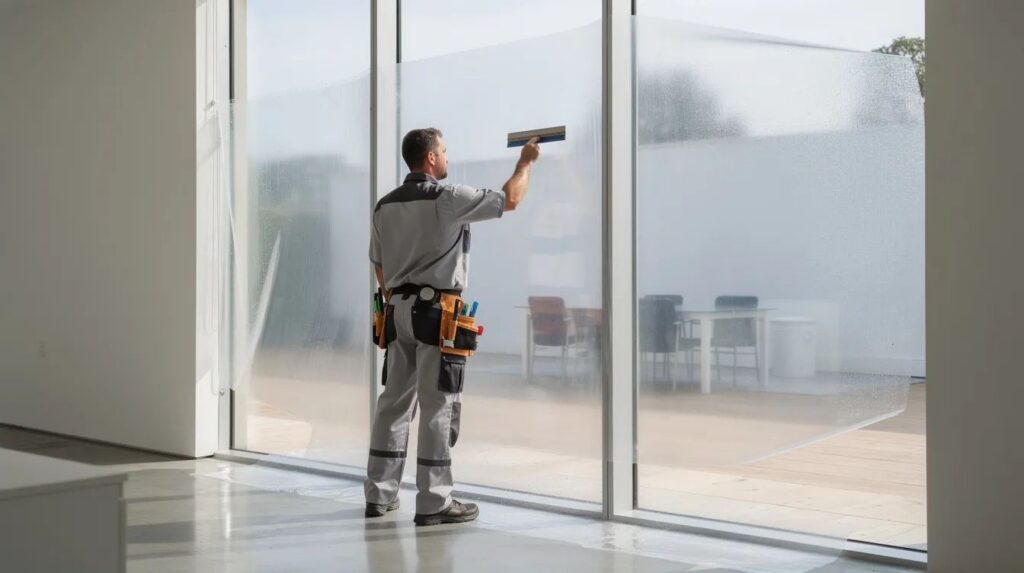
Customer experience starts the moment guests walk in. Window films block glare, improving customer comfort in restaurants by eliminating squinting at menus and harsh reflections on plates. Privacy films prevent passersby from peering into restaurants, letting diners relax without feeling like they’re on display from outside.
Frosted window films create private and intimate dining spaces – think booth dividers, private dining room walls, and wine room partitions. Privacy and decorative window films enhance restaurant ambiance and artistry, while decorative window film adds elegance to high-end restaurant settings at a fraction of the cost of new walls or millwork. Decorative films can enhance a restaurant’s brand identity at a lower cost than renovation, and perforated films allow for branding while maintaining visibility from inside.
Look for film in unexpected places: glass sneeze guards etched with patterns, frosted bands at eye level on half-walls between booths, logo film on entry doors, and directional graphics to restrooms. Privacy films improve the dining experience by preventing outdoor distractions, and window film enhances privacy in restaurant dining areas where guests are waiting for a comfortable, welcoming space. Decorative window film increases privacy in dining areas without sacrificing the openness that makes a restaurant pop.
Energy, UV & Glare Control for Busy Dining Rooms
Restaurants consume roughly four times more energy per square foot than a typical commercial building, and large windows leak heat in and out with the seasons. Solar film tackles this directly: solar control films can cut air conditioning load by up to 30%, and solar window film reduces interior heat by up to 30% on sun-exposed glass. Window film reduces energy costs for restaurants by easing strain on HVAC equipment and helping maintain consistent indoor temperatures year-round – even during colder months when insulation value matters.
Solar window films block 99% of ultraviolet (UV) rays, and window film blocks up to 99% of UV rays that cause fading of upholstery, wood, artwork, and branded finishes. UV protection helps prevent fading of restaurant furnishings, and UV blocking window tint protects employees from harmful rays during long shifts near windows. Solar control window film cuts glare by up to 90%, keeping POS tablets readable and sunshine from washing out the room. Ceramic solar control films offer high heat rejection while remaining clear, so your store’s street appeal stays intact.
Reflective films provide daytime privacy for street-facing windows while preserving outward views at night. Consider a corner restaurant with floor-to-ceiling glass: after a solar film installation, afternoon temperatures drop several degrees, making every table comfortable and turning previously empty seats into revenue.
While 3M window film is a well-known line in the industry, CoolVu specifies and installs premium, performance-tested films selected for each restaurant’s glass type, orientation, and climate zone. Some utilities offer rebates for energy-efficient commercial window upgrades – ask CoolVu to help identify local opportunities that promote sustainability and reduce cost.
Safety, Security & Privacy: Protecting Guests, Staff & Storefronts
Restaurants, bars, and cafes in urban corridors face real risks: smash-and-grab theft targeting liquor displays, vandalism on storefronts, and accidental glass breakage near guests. Security window film is an extra layer of protection that bonds to existing glass and holds shards together on impact – reducing injury hazards and buying valuable response time. Security films protect against vandalism and theft in restaurants, and security window films are essential for high-crime area storefronts.
Security window films can delay breaches by up to 6 minutes, while tier one security films provide a 2-minute delay in breaches – enough for alarms to trigger and intruders to reconsider. Riot Glass® passed Miami Dade large missile impact testing, demonstrating how advanced products achieve scratch resistant, impact-grade performance. For a bar in a nightlife district, thicker security films make forced entry slower and noisier, giving police time to respond before losses mount.
Anti-graffiti films on exterior glass act as a sacrificial layer: when tagged or etched, the film is peeled and replaced at a fraction of the cost of a full glass pane. Safety and privacy matter in unexpected places – glass doors on wine rooms, interior windows near host stands, glass railings on mezzanines, and patio wind screens near sidewalks.
CoolVu installers are trained to work around active kitchens and front-of-house operations, scheduling off-hours work to avoid disrupting service for customers and employees alike.
Why Choose CoolVu for Restaurant Window Film & How the Process Works
CoolVu brings focused hospitality experience to every project – from single-location concepts to multi-unit rollouts across U.S. markets, backed by comprehensive window tinting and window film installation services for commercial properties. Here’s what sets the process apart:
| Step | What Happens |
|---|---|
| 1. Assessment | On-site measurement, glass type identification, orientation review |
| 2. Selection | Film samples shown on your actual glass so you can find the right fit |
| 3. Installation | Scheduled around opening, closing, or off-days – most dining rooms done in a day |
| 4. Walk-through | Final review with care instructions for a closer look at long-term maintenance |
| CoolVu’s advantages include a national franchise network, manufacturer-backed warranties, and consultative reps who understand seating patterns, patio seasons, and service hours, all supported by decades of industry experience at CoolVu Glass & Surface Solutions. Minimal downtime, no need to remove entire storefronts, and easy maintenance with standard glass-safe products keep the investment simple. |
CoolVu can also bundle services – window films, printed graphics, murals, and architectural surface finishes – to deliver a coordinated upgrade before a remodel, rebrand, or seasonal refresh. Request a free estimate today: send photos, floor plans, or schedule a walk-through to achieve the value your space deserves.
FAQs About Window Film for Restaurants
How long does window film installation take for a typical restaurant?
Most small to mid-size dining rooms and storefronts are completed in one day. Larger or multi-location projects take several days, scheduled location by location. CoolVu works before opening or between services to avoid disrupting reservations, with local teams such as CoolVu of South St. Paul tailoring schedules to each restaurant’s service hours.
Will window film make my restaurant too dark or change the view?
Modern commercial window films come in clear, lightly tinted, and reflective options. CoolVu brings samples and can apply test patches so you see the real-world effect from both inside and the street – preserving natural light and view.
Is security window film enough to stop break-ins on its own?
Security window film is a deterrent and delay tool, not a standalone solution. It should be combined with locks, cameras, and alarms. Many insurance carriers view it as part of a layered security strategy for locations with visible liquor displays or high-value equipment near glass, especially in busy urban markets like those served by CoolVu of North Milwaukee.
How does window film affect my energy bills and HVAC equipment?
By reducing solar heat gain, solar film lowers peak cooling loads and helps HVAC cycle less often. Savings vary by glass size, orientation, and climate. CoolVu references performance data during consultations to give you a realistic picture of energy efficiency improvements, whether you’re working with a national franchise or a local market expert like CoolVu of Northeast Columbus.
How long do commercial window films last in a restaurant setting?
Quality films typically last 10+ years when properly installed and maintained. Manufacturer and CoolVu-backed warranties cover bubbling, peeling, and discoloration under normal conditions. Cleaning practices and sun exposure are the biggest factors.
Can I combine decorative graphics with solar or security window film?
Yes. Many restaurants layer a base solar or security film on the commercial window, then apply decorative or branded graphics on top. Some concepts also explore smart window films for on-demand privacy in private dining rooms or chef’s tables. CoolVu coordinates film types and installation sequence so everything performs well and looks intentional – supporting both brand image and building performance.