
Table of Contents
- Introduction to Tempered Glass
- Understanding Tempered Glass Fundamentals
- The Glass Tempering Manufacturing Process
- Applications and Uses of Tempered Glass
- Common Challenges and Solutions
- Conclusion and Next Steps
- Frequently Asked Questions
Introduction to Tempered Glass
Tempered glass is a type of safety glass that undergoes a specialized heat treatment process to achieve strength approximately four times greater than regular annealed glass. This toughened glass is engineered to shatter into small, dull cubes rather than dangerous glass shards when it breaks, making it the preferred choice for applications where human impact is a concern.
This guide addresses the needs of architects, contractors, homeowners, and manufacturers seeking comprehensive knowledge about safety glass solutions. Whether you’re specifying glass for a commercial building project, installing frameless shower doors in residential settings, or evaluating glass options for consumer products, understanding tempered glass fundamentals will help you make informed decisions that prioritize both safety and performance.
Direct Answer: Tempered glass is heat-treated safety glass with a minimum surface compression of 10,000 psi (69 MPa) that is about four times stronger than standard annealed glass and shatters into small, relatively harmless pieces rather than sharp shards when broken, reducing the risk of injury.
Key outcomes from this guide:
- Understanding the complete glass tempering process, including thermal and chemical methods
- Identifying appropriate applications across architectural, automotive, and consumer sectors
- Recognizing safety classifications, building codes, and certification requirements
- Evaluating common challenges like spontaneous breakage and proper mitigation strategies
- Making informed purchasing and specification decisions for your projects
Understanding Tempered Glass Fundamentals
Tempered glass differs fundamentally from normal glass through the internal stress pattern created during its manufacturing. While ordinary annealed glass has little to no internal stress, tempered glass contains carefully balanced compression on the outer surfaces and tension in the center, creating extreme strength and a unique breakage pattern that defines its safety characteristics. This internal balance helps explain how tension breaks occur when the glass ultimately fails.
Physical Properties and Strength
The defining characteristic of tempered glass is its surface compression of at least 10,000 psi (69 MPa), with edge compression reaching approximately 9,700 psi (67 MPa). This compression-tension balance means the glass surface actively resists crack formation and propagation until applied loads overwhelm that compression layer.
Tempered glass can withstand temperatures up to 250°C and is highly resistant to thermal shock, making it suitable for high-heat environments. This thermal resistance allows the glass to handle severe temperature differentials that would cause regular glass to crack. The engineering creates a material that withstands higher temperatures and extreme conditions near heat sources without failure including exposure to extreme temperatures in demanding environments.
When tempered glass breaks, it shatters into small, granular, relatively safe pieces. This contrasts sharply with regular glass, which breaks into large, sharp, jagged shards that pose significant laceration risks. The small cube-like fragments—often called the “dice” pattern—are much safer for those nearby, dramatically reducing injury potential during breakage events. These fragments are far less dangerous than large sharp pieces of broken glass.
Safety Classifications and Standards
Tempered glass that meets ANSI Z97.1 and CPSC 16 CFR 1201 standards qualifies as safety glass in the United States. ANSI Z97.1 establishes test methods for human impact safety, while CPSC 16 CFR 1201 addresses testing requirements specifically designed to reduce laceration risk from glazing materials.
Building codes in the United States require the use of tempered or laminated glass in certain situations, such as near doorways, stairways, and large windows, to prevent injuries from breakage. Compliance with safety codes requires the use of tempered glass in hazardous locations, such as doors, low-level glazing, and shower enclosures where people might accidentally contact the glass surface.
Understanding the distinction between safety glass and security glass is essential for proper specification. Safety glass—including tempered and laminated varieties—is designed to break in safer patterns. Security glass typically refers to laminated constructions with interlayers (PVB, ionoplast) that resist penetration and forced entry while staying in place when shattered. Tempered glass provides safety through its breakage pattern, not through penetration resistance.
The Glass Tempering Manufacturing Process
The tempering process transforms ordinary annealed glass into strengthened glass through precise thermal or chemical treatment. Understanding these processes helps specifiers appreciate why certain preparation steps are mandatory and why tempered glass cannot be modified after fabrication.
Pre-Tempering Preparation
Before tempering, glass must be cut to the desired shape and inspected for defects, as any imperfections can compromise the strength of the final product. One disadvantage of tempered glass is that it cannot be cut or modified after the tempering process, which can lead to higher costs for custom manufacturing. All sizing, edge cutting, shaping, and the ability to drill holes must happen while the glass remains in its annealed state. The glass must be fully fabricated before tempering begins.
Edge finishing and polishing are critical preparation steps. Edges must be properly ground or polished because edge flaws—chips, uneven grinding, or sharp edges—drastically reduce final strength. Industry tolerances govern edge finish quality, thickness uniformity, warp, and flatness to ensure consistent performance.
Quality inspection identifies defects including bubbles, inclusions, scratches, and contamination that could cause failure. Nickel sulfide inclusions are particularly concerning—these tiny particles may be undetectable visually but can cause spontaneous breakage years later. Quality control of raw materials and visual inspection helps minimize this risk. In some cases, a magnified picture can assist with defect evaluation.
Cleaning removes surface contamination including dust, oil films, and residue. Any contamination affects thermal contact during quenching, potentially causing spotting or uneven stress distribution. Thorough cleaning protocols ensure optical clarity and proper stress development.
Thermal Tempering Process
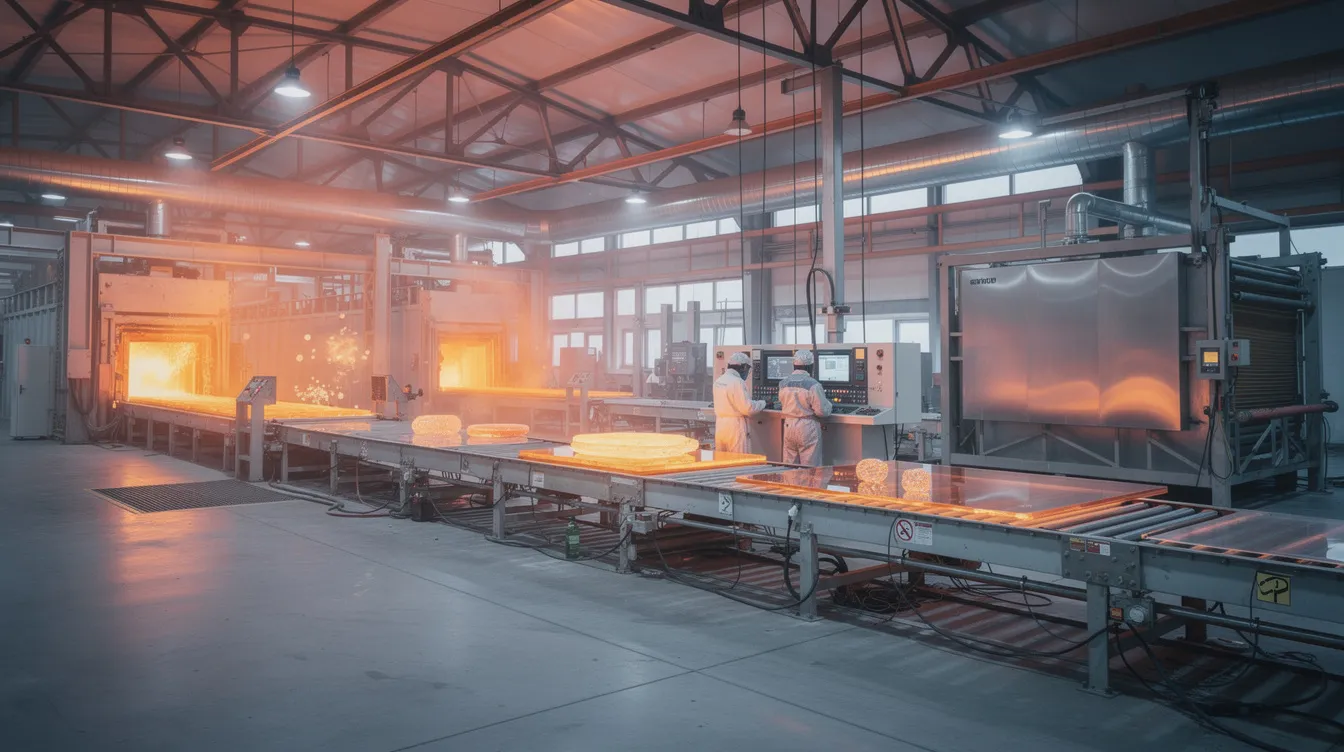
The thermal tempering process creates permanent compression on the surface and tension in the center, locking in extreme strength and a unique breakage pattern. This process involves precise heating and rapid cooling in controlled conditions.
- Loading and Positioning: Cut, shaped, and edge-finished glass loads onto a tempering furnace system, typically roller-supported for uniform heat exposure.
- Heating Phase: The tempering process involves heating glass to a temperature of around 620°C (1,148°F) in the tempering oven. The glass must reach uniform temperature throughout—dwell time varies by thickness, with thicker panels requiring longer heating periods.
- Transfer to Quench: Once uniformly heated, glass moves quickly to the quenching section, minimizing heat loss during transition.
- High Pressure Cooling Procedure: Powerful air jets blast both surfaces simultaneously with rapidly cooled high-pressure air. The outer surfaces contract quickly while the core remains hotter, creating the compression-tension stress pattern. This quenching happens in just seconds and must be precisely controlled for symmetry to avoid warping. These stresses form the foundation of tempered glass performance.
- Temperature Control: Cooling rate, travel speed, and air-flow pressures are calibrated for each thickness. Thin panels (3-6 mm) need shorter dwell times and lower air flow; thick panels (12-19 mm) require higher energy and longer processing.
- Final Inspection: Completed panels undergo quality control including surface compression testing via optical stress meters, warpage measurement, and certification marking. Tempered glass often features a small permanent stamp or “bug” near the corner, indicating it meets safety standards.
Alternative Chemical Tempering
Chemical tempering uses ion exchange rather than thermal stress to strengthen glass. Glass is immersed in a molten potassium salt bath at temperatures below the glass transition point (typically 420-500°C). Smaller sodium ions in the glass surface migrate out while larger potassium ions migrate in, creating surface compression through the size difference.
This method produces much higher surface compression than thermal tempering—sometimes several hundred MPa—but creates a shallower compression layer (often only tens to hundreds of micrometers deep). Ion exchange requires 2-24 hours of immersion depending on desired depth, making it slower and more expensive than thermal tempering.
Chemical tempering excels for thin glass, complex shapes, and applications requiring exceptional optical clarity without the distortion that thermal tempering can introduce. Smartphone screen protectors and device displays commonly use chemically strengthened glass for these reasons. However, the shallow compression layer limits ballistic or heavy impact resistance compared to thick thermally tempered panels.
Applications and Uses of Tempered Glass
Tempered glass is often preferred for modern construction and design due to its superior strength, safety, and versatility. Its applications span architectural, consumer, and transportation sectors, each leveraging specific properties of this strengthened glass type.
Architectural and Construction Applications
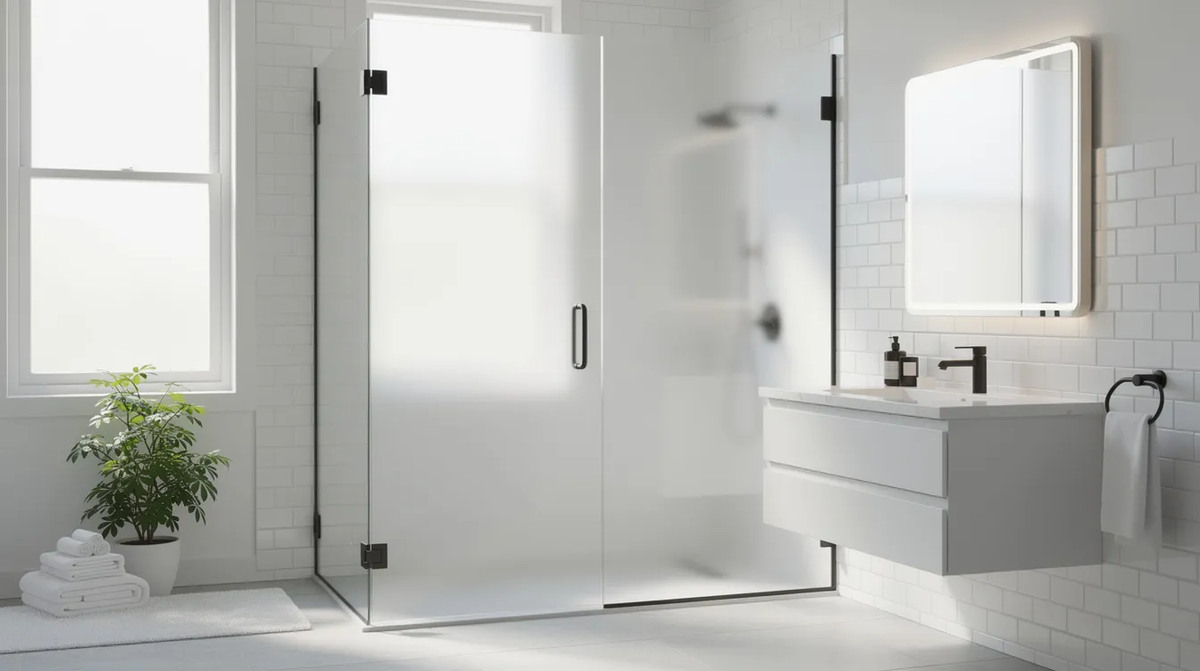
Tempered glass is commonly used in buildings for applications such as frameless glass doors, skylights, and large windows, particularly in areas where safety is a concern due to potential human impact. A tempered glass door is one of the most popular choices for residential and commercial applications that require both safety and modern design. Frameless shower doors represent one of the most common residential applications—safety codes almost universally require tempered glass for shower enclosures due to impact risk and thermal shock from hot water exposure. Standard thicknesses range from 3/8″ (10 mm) to 1/2″ (12 mm) depending on door size.
Storefront windows and glass facades use tempered glass to withstand wind loads, seismic forces, and potential human contact. Large glazing systems often specify heat-soaked tempered units or tempered laminated glass for enhanced performance. Skylights and overhead glazing systems require tempered glass due to the catastrophic potential of overhead glass failure—building codes mandate safety glazing in these locations to protect occupants below.
Glass railings and balustrades rely on tempered or laminated tempered glass to ensure safe fragment behavior if breakage occurs. The glass must maintain structural integrity under load while meeting safety glazing requirements. Fire-rated access panels and doors may incorporate tempered glass, though many fire-rated applications require specialized ceramic glass or purpose-built assemblies.
Consumer and Household Products
In residential settings, tempered glass is frequently utilized in shower doors, glass tabletops, and fireplace glass due to its strength and safety features. Oven doors and appliance glass require high thermal resistance—tempered glass tolerates the cyclical heating and temperature differentials these applications demand.
Glass shelving and furniture tops benefit from tempered glass strength under load and safer breakage behavior. Thickness typically ranges from 6-12 mm depending on span and expected loads. When used as tabletops, tempered glass provides both durability and peace of mind regarding breakage safety.
Tempered glass is also used in various consumer products, including kitchen appliances, vehicle windows, and mobile phone screen protectors, due to its durability and resistance to thermal stress. Phone screen protectors typically use chemically tempered glass—thin (0.3-1 mm) with very high surface compression for scratch and impact resistance.
Automotive and Transportation
Common uses of tempered glass include car side windows, shower doors, patio tables, and smartphone screen protectors. In automotive applications, side and rear vehicle windows are typically tempered glass, providing safe shatter patterns. In emergencies, rescuers or occupants can break through tempered glass more easily than laminated alternatives.
Windshields use laminated glass rather than tempered—DOT/FMVSS standards mandate laminated construction because windshields must remain intact during collisions to protect occupants from ejection, support airbag deployment, and block debris penetration. Premium and luxury vehicles increasingly offer laminated side glass for enhanced security, noise reduction, and UV protection.
Public transportation safety glazing in buses and trains uses tempered or laminated tempered panels depending on location and risk assessment. Marine vessel windows and hatches may use tempered or laminated glass based on pressure resistance, impact risk, and water exposure requirements. In existing buildings, security window films can be applied to glazing to enhance forced-entry resistance and help retain fragments if the glass breaks.
Comparison Table of Applications
| Application | Tempered Glass Suitability | Strength vs Annealed | Safety Pattern | Cost Factor | Alternative Options |
|---|---|---|---|---|---|
| Side & Rear Auto Windows | Required by regulation | 4× stronger | Small dull cubes | Low-moderate | Laminated (premium vehicles) |
| Windshields | Not permitted | — | N/A | — | Laminated required |
| Frameless Shower Doors | Required by code | 4× stronger | Safe fragments | Moderate | Laminated tempered |
| Skylights | Required for overhead | 4× stronger | Reduced fall risk | Moderate-high | Laminated for retention |
| Glass Railings | Required for safety | 4× stronger | Safe if broken | High | Laminated tempered |
| Furniture Tops | Recommended | 4× stronger | Safe fragments | Moderate | Laminated, polycarbonate |
| Device Screens | Chemically tempered | Very high surface stress | Fine cracks | Premium | Standard glass (lower cost) |
| Storefronts | Common specification | 4× stronger | Safe breakage | Moderate | Laminated, security film |

Common Challenges and Solutions
Despite its advantages, tempered glass presents specific challenges that architects, installers, and building owners must address through proper specification, installation, and maintenance practices.
Spontaneous Breakage
Tempered glass can spontaneously break due to impurities or internal stresses, posing safety risks, especially in overhead installations. The primary cause is nickel sulfide (NiS) inclusions—tiny particles introduced during float glass production that undergo phase transformation over time, expanding and creating stresses that exceed the glass’s tension capacity.
Heat soak testing provides the primary mitigation strategy. Tempered glass is reheated to approximately 290°C and held for 2 hours, forcing at-risk NiS inclusions to cause failure during controlled testing rather than during service. For an untested 10,000 m² façade, annual spontaneous breakage risk approaches 1%; heat-soaked glass reduces this risk by approximately 100-fold.
For critical overhead installations, additional protective measures include safety nets, protective films that contain fragments, and specification of laminated tempered glass that retains broken pieces within the assembly. Increased awareness of NiS risk has led many architectural specifications to require heat soak testing for large façades and curtain walls.
Edge Damage and Installation Issues
Edge flaws serve as failure initiation sites—chips or damage during transport and installation can cause cracks that propagate through the stress field. Proper handling procedures require edge protection, compliant spacers, and careful frame contact design.
Window frame design must avoid point loads on glass edges. Supports should use compliant gaskets, allow for thermal expansion, and maintain proper edge clearances. Sharp metal edges or direct metal-to-glass contact creates stress concentrations that may cause delayed failure.
Edge protection requirements include minimum edge distances from holes, proper clearances within framing, and avoidance of overtightening that creates point pressure. Installation personnel need training on tempered glass handling to prevent damage that may not cause immediate breakage but compromises long-term performance.
Thermal Stress Cracking
Thermal stress cracking results from uneven heating across the glass surface. Causes include partial sun exposure, reflections from adjacent buildings, proximity to heat sources, and differential absorption between coated and uncoated surfaces. While tempered glass has higher thermal resistance than annealed glass, it still has limits. Surface damage from impacts involving rocks and stones can also contribute to glass failure under certain conditions.
Recommendations for managing thermal stress include: using shading devices or frits to manage solar absorption, ensuring adequate ventilation behind glass, specifying low-E or reflective coatings to reduce heat buildup, and maintaining proper clearances for expansion. Design should consider orientation, shadow patterns, and seasonal sun angles to anticipate thermal loading.
Most manufacturers limit temperature differential between any two points on the glass surface to 60-90°C depending on thickness and glass type. Specifiers should obtain manufacturer data for exact thermal stress performance thresholds and design accordingly.
Conclusion and Next Steps
Tempered glass delivers essential safety benefits through its engineered stress pattern: surface compression of at least 10,000 psi creates strength approximately four times greater than regular annealed glass, while the characteristic breakage into small, dull cubes rather than jagged shards dramatically reduces injury risk. Combined with thermal resistance up to 250°C, these properties make tempered glass the standard choice for safety-critical glazing applications from swimming pools to skylights.
Immediate action steps for specifying tempered glass:
- Define application requirements, including safety codes, human impact potential, overhead exposure, and thermal conditions
- Select appropriate glass type—fully tempered, heat-strengthened, or laminated tempered—based on strength, safety, acoustic, and security needs
- Specify applicable standards: ANSI Z97.1, CPSC 16 CFR 1201, or relevant international codes
- Determine whether heat soak testing is required for façade, large area, or overhead applications
- Confirm all pre-tempering requirements: final dimensions, edge finishing, drilling, and shape before sending to fabrication
- Request stress-measurement verification and certification documentation from manufacturers
- Obtain quotes comparing cost per square foot, including finishing, testing, and installation
Related topics for further exploration include laminated glass constructions with PVB or ionoplast interlayers, security glazing specifications, fire-rated glazing assemblies, acoustic performance optimization, and low-E coatings for energy efficiency. Each extends the safety glass foundation into specialized applications where tempered glass serves as a key component.
Frequently Asked Questions
Can tempered glass be cut after manufacturing?
No. Once glass is fully tempered, any attempt to cut, drill, or modify it causes immediate shattering because cutting disturbs the surface compression and releases the internal tension. All shaping, sizing, etching, and hole drilling must be completed before the tempering process.
How much does tempered glass cost compared to regular glass?
Tempered glass costs approximately $10-35 per square foot for common architectural and shower applications, compared to $5-12 per square foot for flat annealed glass. Factors affecting price include thickness, edge finish, size, and any additional treatments like heat soak testing or coatings. Custom shapes increase costs due to the inability to modify after tempering.
What thickness options are available for tempered glass?
Thicknesses range from thin chemically strengthened glass (0.3-4 mm) for device displays to thick architectural panels (12-19 mm or more) for facades and structural applications. Commercial shower doors and storefronts typically use 8-12 mm glass depending on panel size and wind load requirements.
Is tempered glass bulletproof or security glass?
No. Tempered glass is safety glass designed to break safely—not resist penetration. Security glazing typically uses laminated glass with specialized interlayers, sometimes combined with tempered layers, or may integrate bullet resistant window film solutions as part of a layered defense strategy. When shattered, regular glass breaks into large, sharp, jagged shards, whereas tempered glass breaks into small, granular, relatively safe pieces—but neither stops bullets or forced entry.
How long does the tempering process take?
Thermal tempering involves heating for several minutes (varying by thickness), followed by quenching in just seconds. Total furnace transit may be 5-15 minutes depending on equipment and specifications. Chemical tempering requires 2-24 hours of immersion in molten salt baths, making it significantly slower and more expensive.
What are the maximum size limitations for tempered glass?
Maximum dimensions depend on furnace capacity, handling logistics, and allowable distortion tolerances. Large architectural panels exceeding several meters are possible with appropriate equipment. Larger sizes increase NiS spontaneous breakage risk and warping potential, often requiring more stringent heat soak testing requirements.
Does tempered glass block UV rays?
Standard tempered soda-lime-silica glass blocks minimal UV radiation. Laminated glass with PVB interlayers typically blocks 99%+ of UV. For UV protection, specify laminated constructions or add UV-blocking coatings—the tempering process itself does not create UV resistance.
Can tempered glass be repaired if cracked?
No. Any crack disrupts the stress balance, requiring complete replacement. Unlike laminated windshields where small chips may be repaired, tempered glass cannot be repaired—the entire panel must be replaced if any damage occurs. It is not possible to pull the glass apart for further modification after tempering.
What building codes require tempered glass?
Building codes in the United States require the use of tempered or laminated glass in certain situations, such as near doorways, stairways, and large windows, to prevent injuries from breakage. IBC, OSHA, and local codes mandate safety glazing in human impact areas, overhead locations, wet areas like shower enclosures, and glass railings. Specific requirements vary by jurisdiction.
How to identify if glass is tempered?
Tempered glass often features a small permanent stamp or “bug” near the corner, indicating it meets safety standards. Look for markings showing “tempered,” “T,” or standard designations like ANSI Z97.1. Other identification methods include checking for optical distortion patterns visible under polarized light, listening for a sharper ring when tapped compared to annealed glass, or examining edge uniformity. Vehicle windshields are laminated; side and rear windows are typically tempered.