Table of Contents
Introduction: What Is Liquid Crystal Window Film and Why It Matters Now
How Liquid Crystal Window Film Works (PDLC Technology Explained)
Key Benefits of Liquid Crystal Window Film
Types of Smart Glass and Where PDLC Fits In
Applications: Where Liquid Crystal Film Delivers the Most Value
Installation, Power Supply, and Control Options
Learn more about liquid crystal window film on our product page.
Introduction: What Is Liquid Crystal Window Film and Why It Matters Now
Liquid crystal film is a thin, electrically controlled material applied to glass that transforms a regular glass panel from transparent to frosted at the flip of a switch. The core idea is simple: when electricity flows, the window is clear. When it stops, the glass goes opaque, delivering instant privacy without blinds, curtains, or permanent frosted film.
Interest in this innovative technology has surged since around 2020. Remote work made home offices common, open-plan offices needed flexible meeting space, and healthcare facilities demanded surfaces that could be disinfected quickly rather than draped in fabric shades. Smart film answered all of these problems at once.
Whether you need a conference room glass wall that switches between open and private, a clinic exam room window that hides patients from corridors, or a residential door panel that blocks the view from the street, switchable film built on polymer dispersed liquid crystal technology makes it possible. Below, we cover how it works, where to use it, how it’s powered, and answers to the most common questions about smart glass.
How Liquid Crystal Window Film Works (PDLC Technology Explained)
The core technology behind most privacy smart window films is polymer dispersed liquid crystal, commonly abbreviated PDLC. The film consists of microscopic liquid crystals suspended in a polymer matrix, sandwiched between two layers of transparent conductive coating on PET substrate.
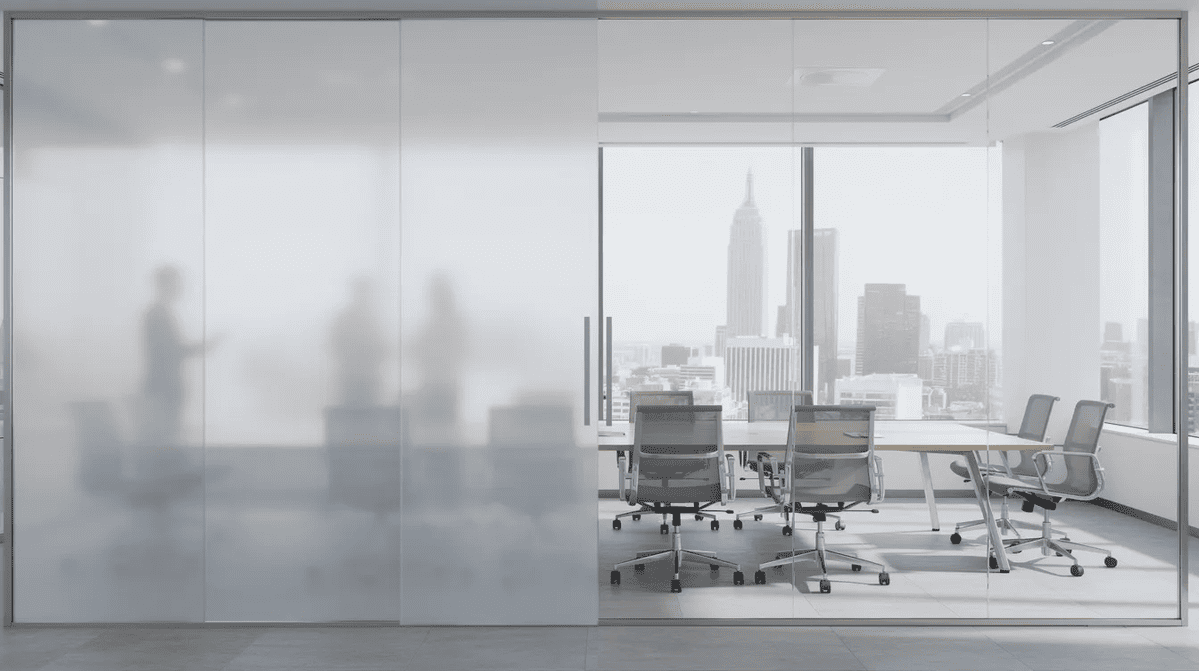
In the off state, with no power running to the device, the liquid crystal molecules are randomly oriented and disorganized. This scattering of light produces a milky white, non transparent appearance similar to traditional frosted film. The glass panel looks opaque, creating a solid visual barrier.
When a low voltage power supply delivers AC current (typically 40–70 V) through the conductive layers, an electric field aligns the liquid crystal molecules so their refractive index matches the surrounding polymer. Light passes through freely, restoring full transparency. Smart film can switch from opaque to transparent in less than 0.1 seconds, and the transition from clear to frosted happens in milliseconds.
Control can be handled through a wall switch, a remote control, a smartphone app, or integration with building automation and motion sensors. The film itself is a laminated stack of PET layers, ITO conductive coatings, the active PDLC layer, and an adhesive layer for bonding to flat surfaces.
Key Benefits of Liquid Crystal Window Film
PDLC smart film delivers a combination of privacy, comfort, security, and flexibility that no single traditional window treatment can match.
Privacy on demand. Smart film switches from clear to opaque in seconds. PDLC smart films provide complete privacy or transparency on demand, making them ideal for offices, bathrooms, medical exam rooms, and any space where ad-hoc visual separation matters.
Natural light retention. Even in the frosted state, the film remains translucent, allowing light to pass through and diffuse evenly. This reduces reliance on artificial lighting and helps maintain a bright, comfortable room.
Heat and UV protection. Liquid crystal film can reduce solar heat gain by rejecting infrared light. Specifically, it blocks up to 78% of solar IR and can reduce indoor temperatures by up to 15 degrees Celsius on hot days. Smart film can reduce heat by up to 50%, leading to lower HVAC costs. It also blocks over 98% of UV rays, which helps protect furnishings, flooring, and skin from uv radiation damage.
Glare reduction. Liquid crystal film can reduce glare on monitors in offices, creating a more comfortable environment for screen-heavy work.
Hygiene. A smooth glass surface with film is far easier to clean with a standard glass cleaner than fabric curtains or shades, a critical difference in hospitals and clinics since 2020.
Dual-use surfaces. In its opaque state, the frosted surface can function as a high-definition rear-projection screen for presentations, digital signage, or video walls in reception areas and meeting rooms.
Safety layer. The film serves as a shatter-resistant layer if glass is broken, and the laminated nature of the film reduces risks of injury during breakage, adding an extra measure of security.
Energy performance. It provides enhanced energy efficiency by regulating indoor temperatures, cutting both cooling demand in summer and reducing the workload on HVAC systems year-round. A 2024 study modeling smart windows in an Istanbul office showed energy savings of approximately 22% when PDLC film was integrated with lighting control systems.
Types of Smart Glass and Where PDLC Fits In
Smart glass technology is a broad category. Understanding where each type fits helps you pick the right solution.
Electrochromic Glass
Electrochromic dynamic glass tints gradually from clear to dark, often over minutes rather than seconds. It is best suited for exterior façades and skylights where solar shading and variable opacity are more important than binary privacy. It does not produce a fully opaque, non transparent state.
PDLC Smart Film
PDLC smart film is the fastest and most definitive privacy option. It switches between a clear state and a frosted, milky white opaque state. Because it can be retrofitted onto existing glass, it is the go-to choice for interior glass partitions, conference room walls, bathrooms, and any application requiring instant privacy or a projection screen surface.
Suspended Particle Devices (SPD)
SPD film controls tint and glare by aligning suspended particles under voltage. It offers variable shading but typically cannot achieve the full privacy that PDLC delivers. SPD is often found in vehicle glass and skylights where graduated light control matters.
Thermochromic and Phase-Change Materials
These react passively to temperature or sunlight, requiring no wiring or power. They adjust automatically but cannot be user-controlled, making them poorly suited for privacy-on-demand scenarios.
| Feature | PDLC | Electrochromic | SPD | Thermochromic |
|---|---|---|---|---|
| Switching speed | < 0.1 s | Minutes | Seconds | Passive |
| Privacy level | Full opaque | Tinted only | Partial | Partial |
| User control | Yes | Yes | Yes | No |
| Best for | Interior privacy | Exterior shading | Glare control | Automatic shading |
For instant indoor privacy and projection applications, PDLC liquid crystal film is the clear winner. When exploring options from any smart glass country or region, PDLC remains the most widely specified switchable glass solution for interiors.
Applications: Where Liquid Crystal Film Delivers the Most Value
Smart film can be applied to large glass surfaces across nearly every sector, either retrofitted onto existing glass or specified in new builds.
Offices and conference rooms. Full-height glass partitions and boardroom fronts become private at the touch of a button during video calls, client meetings, or confidential sessions. When not needed, the glass stays clear, creating an open, collaborative feel. A 2024 corporate installation at Summerwood HQ replaced static partitions with PDLC switchable film, preserving natural light while giving HR and executive offices instant privacy.
Medical facilities. Smart film is used in hospitals for patient privacy in exam rooms, ICU observation windows, and nurses’ stations. The surface can be wiped down between patients, eliminating infection risks associated with fabric curtains.
Hospitality and hotels. Bathroom enclosures, spa partitions, and glass-walled suites gain a wow factor when guests control privacy from a switch by the bed. The demand for this feature has grown steadily in boutique and luxury properties.

Residential. Street-facing windows, shower enclosures, home office doors, and loft glass walls all benefit. Smart film can also be applied to skylights and roof windows where conventional blinds don’t fit or are impractical to operate.
Retail and public spaces. Storefront windows can switch to opaque for nighttime projection or private events. A 2024 retail project in Reseda, California retrofitted approximately 60 square feet of storefront with PDLC film, giving the business heat reduction during the day and a frosted display surface after hours, all controlled from a mobile app.
Installation, Power Supply, and Control Options
PDLC smart film is typically installed on existing glass by trained professionals. Installation requires trained professionals for optimal results because improper handling can introduce bubbles, misaligned busbars, or moisture ingress that shortens the film’s life. Installation can be performed on both new and existing glass surfaces.
Surface preparation. Glass must be perfectly clean, flat, and free of defects. Precise measurement matters because PDLC smart films can be cut to fit for installation, but factory cutting is preferred for large or complex shapes.
Power supply. The film runs on low voltage AC, generated by a small transformer connected to standard mains electricity. A certified electrician should handle all electrical connections. Power draw is roughly 3–7 W per square meter while on and nearly zero while off.
Control methods. It can be controlled via wall switches or smart device applications, as well as touch panels, remote control units, motion sensors, and building management systems connected to room-booking platforms.
Moisture protection. SONTE film, like most switchable film products, is installed from the inside to avoid moisture exposure. Edges must be sealed to protect busbars and prevent yellowing over time.
Retrofit vs. new build. Retrofits focus on upgrading existing conference room and office glass without demolition. New construction projects can hide wiring more elegantly within mullions and frames. Either way, early coordination with architects and electrical contractors prevents costly rework.
Design Options: From Clear to Frosted and Beyond
Most PDLC smart film produces a classic milky white frosted appearance in the opaque state, delivering maximum privacy and the best projection screen surface. Liquid crystal film can transition from clear to frosted in milliseconds, and that speed is consistent across all design variants.
Modern products expand the palette. Gray, smoke, and black tinted films are available for spaces where a warmer or more muted aesthetic is preferred. Some manufacturers offer custom tints to match brand colors or interior palettes.
Patterned and laser-cut designs allow logos or geometric shapes to appear and disappear based on the film’s on/off state, creating a dynamic glass effect for lobbies and reception areas. Pairing switchable film with minimal framing and patch fittings maintains clean sightlines in modern offices and luxury homes.
For rooms that need to double as presentation spaces, specify a projector-friendly PDLC smart film with high contrast and wide viewing angles. The frosted state acts as a purpose-built projection screen with no extra hardware needed.
Maintenance, Durability, and Operating Costs
A common concern: how long does this material last and what upkeep does it require?
Cleaning. The surface can be cleaned like regular glass using a non-abrasive glass cleaner and a microfiber cloth. Avoid harsh solvents, scrapers, or abrasive pads that could damage the conductive coatings.
Durability. High-quality PDLC smart film is designed for daily switching over many years. Under normal indoor conditions (typically −10 °C to +60 °C), film can last more than 10 years. Laminated smart glass units can reach approximately 100,000 hours of continuous transparent operation.
Edge protection. Film should be installed on the dry interior side of glazing, and edges must be properly sealed, especially in bathrooms and pool areas where moisture can accelerate degradation.
Power consumption. Running costs are minimal. At roughly 5 W per square meter during the on state and near zero in the off state, annual energy usage in a typical office amounts to only a few kWh per square meter. The process of keeping smart film running is far cheaper than maintaining blinds, replacing fabric shades, or covering the HVAC difference caused by uncovered windows on hot days.
FAQs About Liquid Crystal Window Film
Is smart film the same as smart glass?
Not exactly. Smart film is a retrofit product applied to existing glass. Smart glass, or switchable glass, is manufactured with the switchable layer already embedded between two pieces of glass. Film is less expensive and faster to install; glass units are more durable and better suited for new construction.
Can liquid crystal film be installed on existing windows?
Yes. Smart film can be installed on existing glass, including tempered and laminated panels. This makes it ideal for upgrading a conference room or office without replacing the window or glass wall.
What happens during a power outage?
The film defaults to its opaque state when power is off. This means privacy is maintained automatically. If your application requires clarity during outages, discuss backup power supply options with your installer.
Is PDLC smart film safe in bathrooms and wet areas?
Yes, provided edges are sealed properly and the film is mounted on the interior, dry side of the glazing. Moisture exposure on unprotected edges can cause yellowing or delamination over time.
Can I cut the film myself to size?
PDLC smart films can be cut to fit for installation, but factory cutting is strongly recommended. Field trimming can damage conductive busbars and may void the manufacturer’s warranty.
How much privacy does the frosted state really provide?
The frosted state obscures detailed vision effectively, making it nearly impossible to read text or identify faces through the glass. However, in high-contrast lighting conditions (bright room, dark exterior), faint silhouettes may be visible. Adding a secondary tint or ensuring balanced lighting on both sides eliminates this.
Can I dim the transparency, or is it just on/off?
Most PDLC films operate as a binary switch between fully transparent and fully opaque. Some systems allow intermediate variable opacity via PWM dimming, but this can reduce film clarity and lifespan. For most applications, the solid on/off form delivers the best results.
What are the basic electrical requirements?
The film needs a transformer converting mains power (120 or 240 VAC) down to low voltage AC (typically 48–60 V). A certified electrician should handle wiring and ensure busbars are connected safely within the frame or mullion. The system can then be connected to a wall switch, remote, or app for daily control.
Why Choose Our Team for Your Smart Film Project
Choosing an experienced installer is the difference between a flawless, long-lasting result and premature failure. Our team specializes in smart film and liquid crystal technologies, with hands-on experience across open-plan offices, executive conference rooms, medical suites, and high-end residential projects completed through 2024 and 2025.
We handle careful project planning and measurement, clean installations that hide cabling, and responsive support before and after the work is done. We coordinate directly with architects, designers, and electrical contractors so nothing falls through the cracks. We are committed to competitive pricing, clear timelines, and transparent communication at every stage.
Contact us to request a consultation, site visit, or quote. Share drawings or photos of your current glass and we will provide tailored advice for your specific space.

Conclusion: Next Steps to Upgrade Your Glass with Smart Film
Liquid crystal window film turns ordinary glass into switchable smart glass, delivering privacy, flexibility, energy efficient performance, and modern aesthetics without full window replacement. It works in conference rooms and offices, clinics and hotels, and homes where natural light and clean design matter.
The next step is straightforward: reach out to our team, describe your project, and we will help you find the right PDLC smart film solution for your space. Schedule a design consultation today.