- The Hidden Costs Lurking in Your Windows
- How Commercial Solar Window Film Solves the Problem
- The Financial Trifecta: Energy Savings, ROI, and Rebates
- Calculating Your Payback Period: A Practical Guide
- Choosing the Right Installation Partner
- A Strategic Investment in Your Business
- Frequently Asked Questions
The Hidden Costs Lurking in Your Windows
Your building’s windows connect you to the outside world, but they’re also one of the biggest weak points in your energy efficiency. While you’re busy managing day-to-day operations, untreated glass could be silently working against your bottom line. These hidden expenses go far beyond your utility bill, and understanding them is the first step toward a smarter, more cost-effective solution.
Think of a large pane of glass as an uninsulated hole in your wall. In the summer, it lets the sun’s heat pour in, forcing your HVAC system into a constant battle. In the winter, it lets your expensive heated air escape. This invisible energy transfer isn’t a minor issue. It’s a continuous drain on your operational budget, and it adds up to a very loud number on your monthly bills.
The primary culprit is solar heat gain. When solar radiation passes through glass, it heats up your interior. Your air conditioning then has to work much harder and run much longer to maintain a comfortable temperature. This extra workload directly translates to higher energy consumption and inflated cooling costs, especially during peak hours when electricity rates are highest.

Beyond Energy Bills: Hidden Productivity and Asset Losses
The problems don’t stop at your energy bill. Intense glare on computer screens causes eye strain and frustration, while “hot spots” near windows can make entire areas of your office unusable. This leads to drawn blinds, more artificial lights, and a measurable dip in employee productivity. Plus, the sun’s ultraviolet (UV) radiation streams through glass, causing irreversible fading and damage to expensive furnishings, flooring, and retail merchandise. This forces you to replace valuable assets far sooner than planned, creating a recurring cost that’s easy to prevent.
How Commercial Solar Window Film Solves the Problem
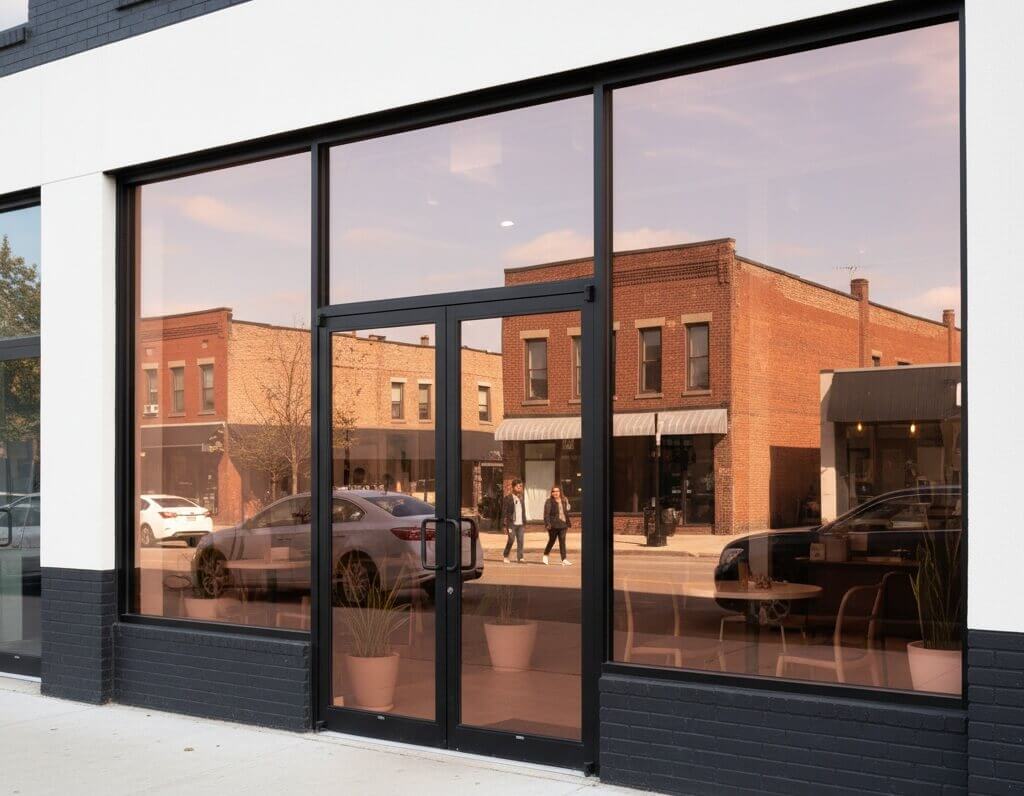
So, how do you fix these issues without resorting to a costly, view-obstructing solution? The answer is commercial solar window film. It’s a high-tech, multi-layered product that’s professionally applied to your existing glass, acting as a protective barrier that intelligently filters the sun’s energy.
It might look like a simple sheet, but it’s a sophisticated piece of engineering. A typical film includes a scratch-resistant coating, UV inhibitors that block over 99% of harmful rays, and advanced polyester layers that contain the technology to filter solar energy. This is how it rejects heat and UV rays before they can even enter your building.
Key Performance Metrics Explained
When you’re comparing films, you’ll see a few key performance metrics. Understanding them helps you choose the right product for your goals.
- Total Solar Energy Rejected (TSER): This is the most important number for energy savings. It tells you the percentage of total solar energy, including UV, visible light, and infrared heat, that a film blocks. A higher TSER means greater heat rejection and bigger savings on your cooling bills.
- Visible Light Transmission (VLT): This measures how much visible light passes through the film. A higher VLT percentage means the film is clearer and lets in more natural light, while a lower VLT provides more glare control and privacy. You can choose a VLT that perfectly suits your needs.
- Solar Heat Gain Coefficient (SHGC): This is the fraction of solar heat admitted through the window and film. It’s a number between 0 and 1, and the lower the SHGC, the less heat gets through, which is exactly what you want for cooling performance.

A common myth is that solar film will make your building feel like a dark cave. Thanks to incredible advances in spectrally selective technology, this is no longer the case. These films are engineered to precisely target and reject invisible infrared radiation, which is responsible for over half the sun’s heat. At the same time, they allow a high percentage of natural visible light to pass through. The result is a window that lets in the light you want while keeping out the heat and damaging rays you don’t.
The Financial Trifecta: Energy Savings, ROI, and Rebates
For any business, the decision to invest in a building upgrade comes down to the numbers. Commercial solar window film delivers a powerful and measurable financial return. It’s not about spending money; it’s about making a strategic investment that directly tackles one of your largest operational expenses.
By rejecting up to 80% of solar heat, the film dramatically reduces the workload on your air conditioning. The result is a direct and substantial reduction in cooling costs, often saving businesses up to 30% on their summer utility bills. Your building stays cooler, your employees are more comfortable, and your bottom line gets a welcome boost.
When evaluating any capital improvement, the key question is, “How long until it pays for itself?” With window film, the answer is impressively short. Compared to major upgrades like replacing an entire HVAC system, film offers one of the fastest payback periods available. For most commercial properties, the total cost of installation is typically recouped through energy savings in just two to five years. After that, the monthly savings become pure profit for the life of the film, which can be 15 years or more. This rapid commercial window tinting energy savings makes it one of the smartest financial decisions a property manager can make.

Rebates, Incentives, and Long-Term Savings
You can also lower the initial cost of your installation through government and utility incentives. Many programs offer rebates and tax credits to encourage businesses to adopt energy-efficient technologies, and solar heat control film for commercial buildings often qualifies. To find these, check with:
- Your local utility provider’s website
- Your state’s energy office
- The DSIRE database for renewables and efficiency
By reducing the daily burden on your building’s HVAC system, the film also reduces wear and tear. This means fewer breakdowns, lower repair bills, and a longer operational lifespan for your expensive equipment. Pushing a multi-thousand-dollar system replacement out by several years is a massive capital savings that goes straight to your business.
Calculating Your Payback Period: A Practical Guide
The return on investment isn’t just a detail, it’s the whole story. Here’s a straightforward guide to help you see the financial case for your own building.
Step 1: Audit Your Current Energy Bills
Gather your electric bills from the last 12-24 months. Chart your kilowatt-hour (kWh) usage by month to see the seasonal spikes. These hot summer months are where you’ll find your biggest opportunity for savings.
Step 2: Estimate Your Potential Savings
Many businesses see a reduction of 5% to 15% in their total annual electricity costs after installing solar film. To get a rough idea, take the total energy costs from your three most expensive summer months and calculate a 30% reduction. That figure gives you a tangible annual savings estimate to work with.
Step 3: Factor in Costs and Incentives
Your total project cost will depend on the square footage of glass and the type of film you choose. It’s crucial to research available federal tax credits, local utility rebates, and state programs, as these can dramatically shorten your payback period.
Step 4: Determine Your ROI Timeline
Now, you can bring it all together with a simple formula:
(Total Installation Cost – Applicable Incentives) / Estimated Annual Energy Savings = Payback Period in Years
For example, imagine a small office where the installation costs $12,000. The owner finds a $2,000 utility rebate and estimates an annual savings of $3,200.
- ($12,000 – $2,000) / $3,200 = $10,000 / $3,200 = 3.13 years
In this typical scenario, the investment pays for itself in just over three years. After that, the $3,200 in annual savings goes directly to the bottom line, year after year.
Choosing the Right Installation Partner
A fast payback and long-term performance depend on a quality installation by a true professional. The right partner doesn’t just sell you a product, they provide a complete solution.
Experience is a library of solved problems. An installer who has completed tens of thousands of projects has seen every challenge, from unique window layouts to tricky climate conditions. This means a more efficient process with minimal disruption to your business and a precise, clean application that’s done right the first time.
The needs of a ground-floor retail storefront are different from those of a large office building. An expert installer understands these nuances and can recommend a tailored solution that aligns with your specific goals, whether it’s UV protection window film for office assets or maximum glare reduction for a retail space.
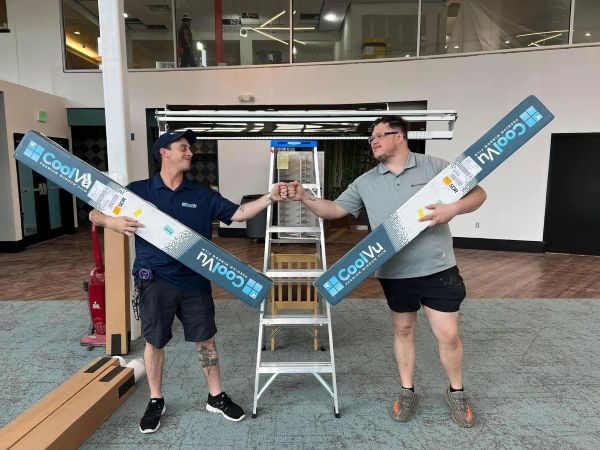
A quality installation starts with a thorough on-site consultation. A professional will discuss your pain points, assess your building’s orientation, analyze your existing glass, and provide an accurate, transparent quote. This commitment to quality should be backed by a comprehensive manufacturer’s warranty that covers the film, the glass, and the labor, giving you total confidence in your investment.
A Strategic Investment in Your Business
We’ve seen that commercial solar window film is much more than a cosmetic touch. It’s a strategic upgrade that tackles some of the most persistent challenges businesses face, from high energy bills to workplace productivity. For any business serious about reducing operational costs, it offers one of the most significant returns on investment available today.
It’s about taking control of your energy consumption, protecting your assets, and creating an environment where your team can do its best work. When you calculate the ROI, the benefits are clear:
- Drastic Energy Savings: See an immediate reduction in cooling costs, often by up to 30%, leading to a payback period of just a few years.
- Extended HVAC Lifespan: Lessen the daily wear and tear on your HVAC units, helping you defer costly repairs and premature replacements.
- Enhanced Employee Productivity: Create a more comfortable and glare-free environment, which has been shown to boost employee focus and satisfaction.
- Protection of Interior Assets: Block up to 99% of harmful UV rays to protect your valuable furniture, flooring, and inventory from fading.

Understanding these benefits is the first step. The next is to see what they could mean for your specific property. A professional consultation can give you the concrete numbers you need to make a confident and informed investment, moving you closer to a more profitable and comfortable business environment.
Take control of your energy costs with CoolVu—connect with a local expert for commercial solar window film solutions today.
Frequently Asked Questions
How much money can you actually save with commercial window tinting?
Most businesses see a reduction of 5% to 15% in their total annual electricity costs. The savings are most dramatic during peak summer months, where you can cut cooling costs by up to 30%. The exact amount depends on your building’s climate, window size, and energy rates, but the investment often pays for itself in 2 to 5 years.
Will solar film make my office or store too dark?
Not at all. Modern films use spectrally selective technology to block invisible infrared heat while allowing a high percentage of visible light to pass through. You can choose from a wide range of films, including options that are virtually clear, so you don’t have to sacrifice natural light or your views to get powerful heat rejection.
How long does commercial solar window film last?
Professionally installed, high-quality solar film is incredibly durable. Most products come with a comprehensive manufacturer’s warranty of 10 to 15 years, and they often perform well beyond that. It’s a long-term upgrade that continues to deliver energy savings for well over a decade.
Does installing window film qualify for energy rebates or tax credits?
Yes, frequently. Many utility companies and government bodies offer incentives for energy-efficient upgrades, and solar window film often qualifies because it reduces peak demand on the power grid. A knowledgeable installer can help you identify local and state programs that can help lower your initial project cost.