Table of Contents
- Why Commercial Security Window Film Matters Now
- How Commercial Security Window Film Works to Stop Break-Ins & Hold Glass in Place
- Key Benefits of Security Window Films for Commercial Buildings
- Choosing the Right Security Film & Understanding the CoolVu Installation Process
- FAQs About Commercial Security Window Films
- Why Commercial Clients Choose CoolVu for Safety and Security Films
- Next Steps: Schedule a Commercial Security Window Film Assessment with CoolVu
Why Commercial Security Window Film Matters Now
Commercial security window film is a multi-layer polyester laminate bonded to the interior surface of existing glass. It transforms a standard security window into a reinforced glazing system that holds broken glass together during break ins, storms, or accidents-dramatically reducing flying glass shards and slowing unauthorized entry. It does not make glass indestructible, but it fundamentally changes how glass fails, keeping shattered panes in the frame instead of collapsing inward or spraying across occupied spaces.
Between 2020 and 2025, the commercial demand for safety and security films surged. Smash-and-grab incidents increased in frequency and severity across U.S. retail corridors, with the National Retail Federation reporting a roughly 12–18% rise in external theft incidents from 2023 to 2024. The Jewelers’ Security Alliance documented 137 smash-and-grab attacks in 2025-matching 2024’s count but with losses jumping 25.6% to $38.8 million, partly driven by vehicle-ramming tactics. Meanwhile, extreme weather events like the 2024 Houston Derecho and multiple hurricane seasons exposed the vulnerability of commercial glass façades in ways that forced facility managers to reconsider their building envelopes.
The window film industry itself has a long history of innovation. 3M received the first patent for window films back in 1966, and the technology has evolved considerably since then-today’s films combine multi-ply polyester construction, advanced adhesives, and optional solar-control layers that would have been unimaginable six decades ago.
This article is written from CoolVu’s perspective as a national commercial window film and surface solutions provider. CoolVu’s franchise network serves facility managers, building owners, and property managers across the country, delivering security films, decorative privacy films, anti graffiti film, and architectural surface solutions for offices, retail stores, schools, healthcare facilities, and government buildings.
In the sections ahead, you will learn exactly how security window films work during a real break-in or impact event, what measurable benefits they deliver, how they compare to alternatives like laminated or ballistic glass, and what to expect from a professional CoolVu installation process-from the initial assessment through the finished project.
How Commercial Security Window Film Works to Stop Break-Ins & Hold Glass in Place
When a standard commercial window takes a direct hit-whether from a hammer, a brick, a wind-driven tree branch, or a kicked-in glass door-the glass breaks and pieces fall away almost instantly. Annealed glass fractures into jagged, dangerous shards. Tempered glass crumbles into small cubes that scatter across the floor. Either way, the opening is immediate: intruders can gain entry in two to three seconds, debris floods into the space, and occupants face serious injury risk from broken glass fragments. That failure sequence changes entirely when a commercial security window film is bonded to the interior surface.
Security films are constructed from multiple laminated polyester (PET) layers bonded with a high-performance, pressure-sensitive adhesive. Film thickness is measured in mils (one mil equals 0.001 inch), and commercial options typically range from 4 mil for basic safety applications up through 8, 12, and even 15 mil for more demanding forced entry or blast mitigation scenarios. Avery Dennison SF Clear i films, for example, range from 4 to 15 mil thick, giving specifiers a wide selection based on threat level. Some systems go further by pairing thicker film with structural edge anchoring-mechanical clips or structural silicone connecting the film to the window frame-so the entire panel stays locked in position even under repeated, aggressive attack.
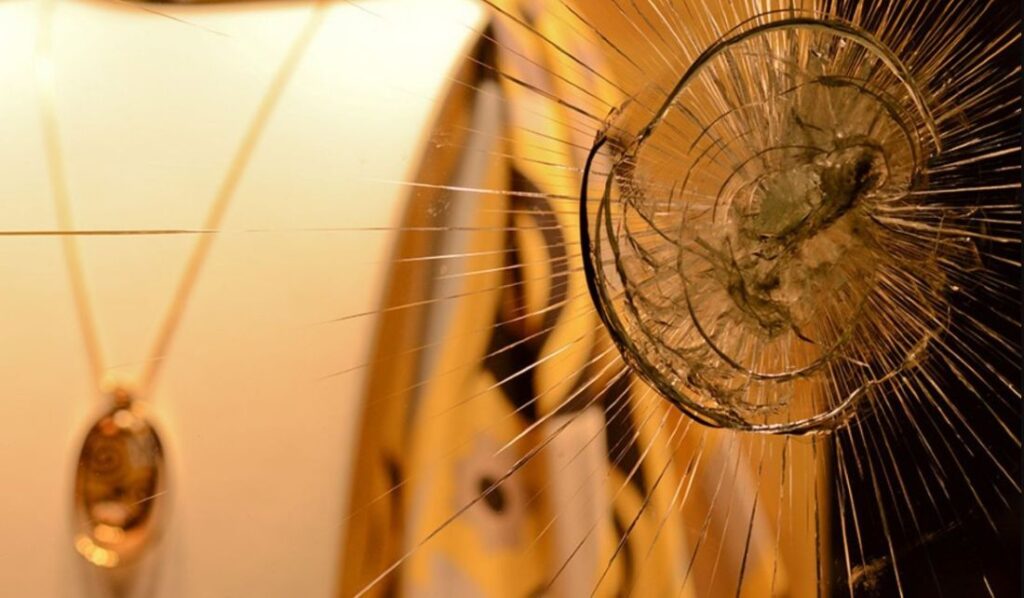
Here is what happens during an impact event when film is present. The object strikes the glass. Cracks radiate outward and the pane fractures, but instead of collapsing, the broken glass remains adhered to the polyester film. The adhesive bond and the polyester fibers absorb and distribute the impact energy across the panel. An intruder swinging a hammer at a retail storefront now faces a cracked but largely intact barrier; to actually breach it, they must cut, pry, or tear through both the fractured glass and the tough film-a loud, time-consuming process that draws attention and triggers alarms. 3M Safety & Security Films delay intruders during break-ins precisely this way, adding an additional layer of defense that turns a quick smash into a prolonged, difficult struggle. Avery Dennison films protect against flying glass shards by keeping fragments bonded to the film membrane rather than allowing them to become projectiles.
The distinction between basic safety film and true safety and security films matters. A 4-mil safety film is primarily designed for human impact scenarios-someone falling into a glass partition, a child running into a glass door-where the goal is to prevent laceration injuries from broken glass. Security-grade films at 8 mil and above are engineered for deliberate attacks: smash-and-grab burglaries, vandalism, and even small-scale blast events. 3M films hold glass in place during explosions, which is why they meet federal GSA/DOD/USACE standards for government and military facilities. In practice, the difference between these film categories is the difference between containing an accident and resisting an attack.
Beyond crime, security films mitigate hazards that commercial property owners deal with regularly: seismic glass movement in earthquake zones, spontaneous tempered glass breakage (which happens more often than most people realize in commercial curtain walls), wind-driven debris during severe thunderstorms, and pressure differentials during blasts. 3M films add impact resistance against natural disasters, helping glass façades survive events that would otherwise leave buildings exposed. Throughout all of this, most commercial security window films remain nearly invisible from normal viewing distances, preserving natural light, views, and the aesthetic integrity of the building’s exterior.
Key Benefits of Security Window Films for Commercial Buildings
Facility managers rarely invest in glass upgrades for a single reason. The appeal of security window film is that it solves multiple problems simultaneously-safety, security, comfort, energy performance, and maintenance-through a single retrofit that does not require replacing the glass itself. Here is how those benefits break down in real commercial settings.
Safety and injury reduction. When glass breaks in a high-traffic lobby, a hospital corridor, or a school hallway, the first concern is always human safety. Security films keep broken glass laminated to the film surface, dramatically reducing the risk of lacerations during accidents, storms, or spontaneous breakage. This matters in spaces where occupants include patients, students, visitors, and family members who may be unable to protect themselves. Hotels with interior glass partitions, healthcare facilities with glass stair railings, and office buildings with floor-to-ceiling glazing all benefit from the simple fact that film-held glass stays in the frame rather than scattering across the floor. Security window films can also improve compliance with building codes for safety standards, particularly in areas where safety glazing is required for doors, sidelights, and partitions in public-access areas.
Break-in delay and theft reduction. Loss prevention professionals consistently identify delay time as one of the most useful metrics that security films provide. Without film, a determined intruder can breach a standard storefront window in seconds. With properly selected and installed film, that same entry attempt becomes 30 to 120 seconds or more of noisy, visible effort-often enough for alarm activation, police dispatch, or staff lockdown procedures. 3M films help deter smash-and-grab burglaries effectively because the glass simply refuses to fall away, forcing intruders to work much harder and longer to gain entry. For a store carrying high-value merchandise, that delay is often the difference between a successful theft and an abandoned attempt.
Protection from riots, civil unrest, and smash-and-grab events. Recent years have seen incidents where multiple windows along a retail corridor were attacked simultaneously by organized groups or opportunistic looters. Reinforced glass with security film stays in the frame far longer than unprotected panes, and when attackers see that their efforts are not producing quick openings, they frequently move on. The FBI has documented a rise in flash-mob-style shoplifting incidents between 2020 and 2024, and retailers in high-density urban settings have responded by hardening their storefronts with film as a first line of defense. 3M films delay intruder access, enhancing security across vulnerable façade zones where rapid breach has historically been the primary threat.
Weather and windstorm protection. While security film is not a substitute for hurricane-rated glazing where building codes require it, it significantly reduces interior damage during severe weather. When wind-borne debris strikes a filmed window, the glass cracks but stays in the opening, blocking rain, debris, and pressure differentials from fully breaching the building envelope. In the Southeastern U.S. alone, over 18,900 commercial storm events between 2021 and April 2026 caused an estimated $2.91 billion in property damage-much of it to glass and building envelopes. Properties in Florida, the Gulf Coast, and Tornado Alley face this exposure every season, and film provides a practical, cost-effective layer of protection between storms and the people inside.
UV blocking and energy savings. Many security window films also block up to approximately 99% of UV rays, protecting interior furnishings, flooring, and merchandise from fading while reducing occupant exposure to harmful radiation. Avery Dennison SF Clear X films provide high UV protection alongside their safety properties. Solar control films also provide security while reducing heat gain, and when combined with solar-control layers, these films can reduce cooling loads by 10–20% in sun-exposed commercial spaces. Security films reduce energy costs by blocking solar heat and glare-a south-facing bank branch or medical office, for example, can cut summer cooling costs while simultaneously upgrading its safety security posture. The uv protection alone often justifies the investment in spaces where inventory, artwork, or furnishings are at risk from prolonged sun exposure.
Graffiti and vandalism resistance. Anti graffiti film acts as a sacrificial layer on storefront glass and interior displays. When vandals scratch, tag, or etch the surface, they damage the film rather than the glass itself. Clear Poly X films protect against vandalism and acid attacks, providing a renewable barrier that maintenance teams can peel and replace at a fraction of the cost and downtime of full glass replacement. For storefronts in urban corridors, transit facilities, and schools, this functionality eliminates the expensive cycle of glass replacement that vandalism would otherwise create.
Security films can also enhance privacy with tinted or reflective options, giving tenants or building operators control over visibility from the exterior while maintaining natural light inside. This makes them a versatile tool across retail, schools, healthcare, offices, and government facilities where each space has different requirements for security, comfort, and aesthetics.
Choosing the Right Security Film & Understanding the CoolVu Installation Process
Not all security window films or installations deliver the same results. Film selection, glass type, frame condition, and installation quality all directly affect how a filmed window performs under real-world stress. Here is what to consider at each stage.
What to consider before choosing a security film. Film thickness and construction should match the threat profile of the property. A 4-mil safety film is appropriate for basic human-impact scenarios-interior glass doors, partitions, and low-risk settings. For most storefronts and commercial spaces facing a moderate risk of break ins or weather damage, 8 to 12 mil films provide meaningful forced entry resistance and debris protection. High-threat environments often require thicker films for protection, and facilities with specific blast or ballistic concerns may need multi-layer film systems with structural anchoring. The existing glass configuration also matters: annealed glass, tempered glass, laminated glass, single-pane versus insulated glass units, and glass doors versus fixed panels all respond differently to film application. Before any project begins, building codes, fire egress requirements, and landlord or tenant agreements should be reviewed to ensure compliance. Consult your local CoolVu franchise for additional information on code considerations specific to your region.
How the professional CoolVu process works. Professional installation is recommended for optimal performance of security films, and CoolVu’s process reflects that standard. It begins with an onsite security and glass assessment: a trained specialist walks the property, identifies the most vulnerable glass locations, evaluates frame conditions, and discusses the client’s threat concerns-whether those involve smash-and-grab crime, severe storms, accidental breakage, or all of the above. Based on that assessment, CoolVu provides a clear written proposal specifying the recommended film products, thicknesses, and any anchoring or edge-sealing systems needed.
During installation, surfaces are thoroughly cleaned and any existing decals, coatings, or residue are removed to ensure a strong adhesive bond. Film is precision-cut and applied wet to the interior glass surface, then carefully squeegeed to remove air and moisture. Edges receive particular attention-for higher-security applications, structural sealants or mechanical attachment systems anchor the film to the frame perimeter, preventing the entire panel from being pushed inward even under sustained attack. This edge-anchoring step is what separates a basic safety installation from a true security-grade system.
What customers can expect after installation. Cure time typically runs 30 to 60 days, depending on climate, humidity, and glass orientation. During this period, minor haziness or small moisture pockets may be visible-this is normal and dissipates as the adhesive fully bonds. Cleaning should use non-abrasive cleaners and soft cloths; razor blades and harsh solvents should be avoided to preserve the film surface. CoolVu-backed films carry manufacturer warranties covering peeling, bubbling, discoloration, and optical clarity under normal conditions, giving clients peace of mind knowing that their investment is protected for years. Most commercial films carry warranty periods of 10 to 20 years under standard exposure.
FAQs About Commercial Security Window Films
This section answers the most common questions CoolVu hears from commercial clients evaluating safety and security films for their properties.
Will security window film make my glass completely unbreakable?
No. Security window film dramatically improves the performance of existing glass by holding broken glass in place and resisting forced entry, but it does not make standard commercial glass bulletproof or hurricane-certified on its own. The glass still cracks under sufficient impact-what changes is that the cracked pane stays in the frame rather than collapsing, which buys time and prevents shattering into dangerous fragments. For true ballistic protection, a full tested and certified glazing assembly (glass plus interlayer plus frame) is required. Film alone cannot address that level of threat, and any company claiming otherwise should be viewed with skepticism. That said, even modest security film makes glass significantly more difficult for intruders to breach and keeps occupants far safer during natural disasters and accidents.
How thick should a security film be for my business?
General guidance: 8 mil film is a solid starting point for many storefronts, office lobbies, and commercial spaces facing a low-to-medium risk of forced entry or weather-related damage. Higher-risk facilities-jewelry stores, pharmacies, schools, government buildings-benefit from 12 to 15 mil films with edge anchoring. Avery Dennison’s SF Clear i line, for example, offers a range from 4 to 15 mil to address everything from basic safety to heavy security. The right thickness depends on the specific glass type, frame condition, and threat profile, which is why CoolVu recommends an onsite evaluation before specifying any product. A thicker film on a weak frame with no anchoring can underperform a thinner film on a properly secured system.
Can I get both energy savings and security in one film?
Yes. Combination solar-security films are one of the fastest-growing product categories in commercial window film. These products deliver meaningful security performance-holding broken glass together, resisting forced entry-while also rejecting solar heat, reducing glare, and blocking UV radiation. Solar control films provide security while reducing heat gain, which can lower cooling loads by 10–20% in sun-exposed spaces. For a south-facing retail store or a corporate office with extensive glazing, a combo film eliminates the need for two separate installations and delivers year-round value.
Does security window film go on the inside or outside of the glass?
Most safety and security films are installed on the interior surface of the glass. This positioning protects the film from weather, environmental degradation, and physical contact from the exterior, extending its lifespan and maintaining optical clarity. Certain specialty products-including anti graffiti film and exterior-rated solar films-are designed for exterior application. Anti graffiti film, for instance, is applied to the exterior surface precisely because it needs to intercept scratching, etching, and tagging before those attacks reach the glass. Your CoolVu installer will recommend the correct application surface based on the film type and intended function.
How much does commercial security film cost?
Pricing varies based on film thickness, project size, glass accessibility, and whether structural anchoring is required. As a general range, installed security film typically runs $8 to $18 per square foot for most commercial applications. By comparison, full laminated glass replacement or ballistic glazing assemblies can cost $70 to $150 or more per square foot-making film a significantly more accessible option for building owners looking to secure large areas of glass without a capital-intensive renovation. CoolVu provides free, no-obligation site assessments and written quotes so that facility managers can evaluate exact costs for their specific property before committing.
Will tenants or employees notice a difference after installation?
Most commercial security window films are optically clear and virtually undetectable from normal viewing distances. Daylight transmission, views, and the overall aesthetic of the space remain largely unchanged. If a tinted or reflective solar-security option is selected, occupants will notice a slight reduction in glare and heat-effects that are typically welcomed. The most common post-installation feedback CoolVu receives is that people are unable to tell the film is there at all, which is exactly the point: discreet protection that does not compromise the look or feel of the building.
Why Commercial Clients Choose CoolVu for Safety and Security Films
CoolVu operates as a national franchise network specializing in window film, surface finishes, and architectural solutions for commercial, institutional, and government properties. Unlike generic tint shops or single-location contractors, CoolVu’s model combines local market knowledge with national-scale resources-giving each franchise team access to a full lineup of security films, solar-security films, anti graffiti film, decorative privacy films, and architectural surface solutions tailored to each facility’s needs.
CoolVu’s local, franchise-based teams understand the specific crime patterns, weather risks, and code considerations in their service areas. A CoolVu team in Florida approaches a project differently than one in the Midwest-because hurricane-zone glazing requirements, storm frequency, and even the types of retail crime differ significantly by region. Every installer is trained and vetted for complex commercial glass systems, from retail storefronts and curtain walls to interior glass railings and glass doors in high-traffic buildings, and can recommend architectural window films designed for energy efficiency, safety, privacy, and aesthetics.
The range of typical CoolVu commercial clients reflects this versatility, and many rely on security window films as an effective and economical solution to prevent theft, vandalism, and forced entry:
- Retail chains hardening multiple storefronts against smash-and-grab attacks, often coordinating installations across a regional or national portfolio, while schools and other vulnerable facilities may explore ballistic and bullet-resistant glazing solutions to delay intrusion and contain glass fragmentation
- Schools and universities creating delay at entrances and vestibules without making campuses feel like fortresses-keeping the environment safe and welcoming for students and family members
- Healthcare, corporate, and government facilities upgrading safety security while simultaneously improving energy performance and reducing glare for occupants
CoolVu’s consultative approach begins with a risk assessment walk-through, followed by a clear ROI discussion that accounts for reduced glass replacement costs, potential energy savings, lower insurance exposure, and avoided downtime after incidents. For multi-site portfolios, CoolVu offers turnkey project management that standardizes specifications, timelines, and quality across every location. Choosing a dedicated window film company like CoolVu typically delivers better long-term performance than a general contractor or a DIY security film kit, because the difference between a secure installation and an underperforming one often comes down to edge anchoring, adhesive quality, and installer expertise-details that only a specialist consistently gets right.
Next Steps: Schedule a Commercial Security Window Film Assessment with CoolVu
Security window film remains one of the most practical, cost-effective ways to upgrade safety and security across existing commercial glass-without the expense, disruption, or lead times of full window replacement. The right film, properly installed and anchored, protects people and property for years while delivering additional benefits in energy savings, UV protection, and vandalism resistance that improve daily building operations.
If you manage a commercial property, retail location, school, healthcare facility, or government building, the next step is straightforward: request a free on-site security and glass assessment from your local CoolVu franchise, such as CoolVu of Lower Fairfield County for clients in that region. Before the visit, it helps to gather basic information-building type, glass locations of concern, any recent incidents or near-misses, and any energy, privacy, or code requirements you need to address. This allows your CoolVu specialist to arrive prepared and move quickly toward a tailored recommendation.
You can reach CoolVu by phone, through the website contact form, or by scheduling a consultation online, connecting directly with regional teams such as CoolVu of Northeast Columbus, CoolVu of Northeast Columbus for window and wall enhancement solutions, CoolVu of Northern Virginia, or CoolVu of North Milwaukee. Whether you need to secure a single storefront or coordinate a rollout across dozens of locations nationwide, CoolVu has the products, the installation expertise, and the project management infrastructure to make it happen. The goal is simple: make your buildings safer, more comfortable, and more efficient for your employees, customers, and tenants-with properly selected and installed safety and security films that deliver peace of mind knowing your glass is no longer your weakest link.