Table of Contents
- What Is Security Window Film and How Does It Work?
- Types of Security Films for Residential Windows
- Technology Behind Modern Security Window Films
- Key Benefits of Security Window Film for Homeowners
- How to Choose the Right Security Window Film for Your Home
- Signs It’s Time to Upgrade or Add Security Window Film
- Frequently Asked Questions About Home Security Window Film
Why Security Window Film Matters for Home Security Today
Even with U.S. burglary rates declining to 229.2 incidents per 100,000 residents in 2024, windows remain a critical vulnerability. Roughly 23% of burglaries involve first-floor windows as the point of entry, making glass one of the weakest links in any home security plan. At the same time, severe weather events across the 2020–2025 period have intensified, with tornadoes, hailstorms, and wind-borne debris causing widespread window failures and property damage in communities across the country.
Security window film is a heavy-duty polyester laminate applied to glass that absorbs impact energy and holds shattered glass in place. Unlike ordinary decorative tint or basic solar film, security window film is engineered with multiple layers of tear-resistant polyester and industrial adhesive to delay forced entry and prevent flying glass shards from scattering through your home.
Security window film helps homeowners in three measurable ways: it strengthens glass windows against break ins and smash-and-grab attacks, it provides reliable protection during natural disasters by keeping broken glass contained, and it blocks up to 99% of harmful uv rays that fade interiors and damage skin. CoolVu provides professional installation of safety and security films for homes and businesses across the U.S., bringing commercial-grade expertise to residential projects.
What Is Security Window Film and How Does It Work?
Security window film is a clear or lightly tinted multi-layer polyester (PET) membrane applied to the interior surface of existing glass. The film bonds to the glass through a pressure-sensitive or chemically bonding adhesive that maintains adhesion through heat, cold, and moisture extremes. This layered construction is what turns windows into a shatterproof barrier rather than a fragile opening.
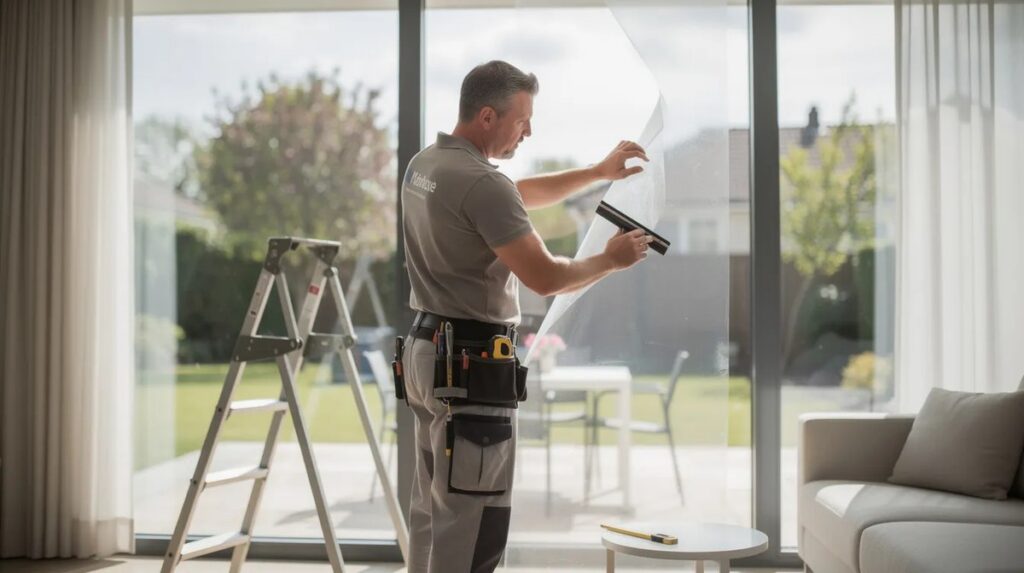
When glass breaks, the film holds the fragments together instead of letting them scatter as dangerous flying glass shards. The adhesive and layered PET distribute impact forces across the surface, so instead of a clean hole or a shower of razor-sharp pieces, intruders or storm debris face a flexible, clinging membrane that resists penetration. Security window film is installed on the interior surface of windows, where it works quietly behind the scenes without changing how your home looks.
It helps to understand the differences between film categories. Standard solar or UV control film manages heat and light but offers minimal structural strength. Safety film (typically 2–4 mil) adds fragment retention to reduce personal injury from broken glass. Security film (7 mil and above) goes further, resisting forced entry by requiring sustained effort to breach.
Consider two real scenarios. A stray baseball strikes an unprotected sliding glass door: the pane shatters and scatters shards across the living room. With security film installed, the glass cracks but stays bonded to the film, keeping your family safe and making cleanup a small job. A ground-floor window attacked with a hammer by someone trying to gain entry: with 8-mil film and proper anchoring to the window frame, the glass fractures visibly but the intruder is unable to push through quickly, often abandoning the attempt entirely.
Professionally installed security films typically deliver 10–20 years of performance, are compatible with annealed, tempered, and most double-pane glass, and maintain optical clarity throughout their lifespan.
Types of Security Films for Residential Windows
Not all security films deliver the same level of protection. Security films typically range from 4 to 14 mil in thickness, and the construction, number of PET layers, and tint determine real-world performance. Thicker films with multi-layer construction resist tearing and penetration far better than single-layer products.
CoolVu consultants help homeowners match film type to their specific risk profile, whether that means protecting against accidents with young children, preparing for storm-prone weather, or hardening ground-floor glass against break in attempts by using security window films. Here’s how the main categories compare:
- 3–4 mil: Basic safety and natural disaster protection
- 7–8 mil: Forced entry resistance for most residential scenarios
- 12–15+ mil: High-security protection for extreme potential threats
3–4 Mil Safety and Natural Disaster Protection Film
Safety film in the 3–4 mil range is designed primarily to reduce injury from broken glass during storms, everyday accidents, or minor impacts. In areas prone to hurricanes and tornadoes, this thickness helps keep glass in the window frame during windborne debris events, preventing flying glass from becoming a hazard inside the home.
While 3–4 mil film can slightly slow intruders, it is not engineered as a primary forced entry barrier. Its strength is injury prevention. Large picture windows in living rooms, playroom windows near kids’ activity spaces, and glass doors leading to patios are common candidates. CoolVu often pairs this thickness with solar and UV control technology so homeowners get combined safety and comfort in one installation.
7–8 Mil Forced Entry Security Film
This thickness is the sweet spot for homeowners focused on home security. Research and testing show that 8 mil films are sufficient to deter most criminals, dramatically increasing the time and effort needed to breach a window with tools like crowbars or framing hammers. Security film can prolong forced entry time to 1 minute or more, which is critical because most burglars expect to gain entry in under 30 seconds.
Ground-floor windows, patio sliders, glass next to entry doors, and basement egress windows are the most common use cases. For enhanced protection, security window films should be paired with attachment systems, such as a silicone anchoring bead connecting the film to the frame, which keeps the glass in place even after repeated impacts. Many homeowners choose this category in combination with alarm systems and cameras to create layered security measures.
12–15 Mil High-Security Film for Extreme Threats
High security films can be 13 to 15 mil thick and are designed for higher-risk environments: homes storing high-value items, exposed corner lots, or properties in urban areas dealing with vandalism or civil unrest. Higher-end films rated 12 mil or thicker can withstand blast overpressure, making them similar to what’s specified for schools, government buildings, and storefronts.
Multi-layer construction at this thickness improves tear resistance dramatically, making it far harder for intruders to quickly create a passable opening even with heavy tools like sledgehammers. These films are usually installed by certified professionals only, due to the precision and expertise required. CoolVu can recommend high-security solutions when a standard film isn’t sufficient for the threat profile of a particular property.
Technology Behind Modern Security Window Films
Modern security window films rely on engineered polyester, micro-layer lamination, and advanced adhesives tested to international safety standards. The multi-layer construction disperses impact energy across a broader area, resisting tearing and holding glass fragments together under stress. Some premium films use 10 or more laminated PET layers with scratch-resistant hard coats and optically clear adhesives that resist yellowing over time.
The industry traces its roots back decades. 3M received the first patent for window films in 1966, and the technology has evolved significantly since then. Today, films are tested against recognized standards like ANSI Z97.1 for safety glazing, ASTM F1233 for forced entry resistance, and ASTM E1886/E1996 for windborne debris impact. Many CoolVu architectural window films also integrate uv protection, solar control, and glare reduction into the same high-strength construction, delivering multiple benefits from a single installation.
Key Benefits of Security Window Film for Homeowners
Security window film strengthens windows to prevent forced entry while simultaneously delivering uv protection, comfort improvements, and property value benefits in one upgrade. The real-world value comes from slowing intruders, reducing injuries from shattered glass, and protecting furnishings from harmful uv rays, all of which add up to a valuable addition to any home.
Slowing Break-Ins and Smash-and-Grab Attempts
Security window film delays intruders during attempted break-ins, but it does not make glass completely unbreakable. What it does is make it dramatically harder to push through quickly. Security window film provides 60 to 90 seconds of extra resistance, which is a big difference when most burglars abandon attempts that take longer than 30 seconds.
The visible resistance, multiple blows bouncing off, tools deflecting, glass clinging to the membrane, can cause intruders to move on to an easier target. Thicker films in the 8-14 mil range offer better protection against break-ins. Combining CoolVu security window films with alarms, smart locks, and exterior lighting creates a layered defense strategy that provides better protection than any single measure alone.
Protection During Storms, Accidents, and Natural Disasters
Security window film protects against storm debris during high winds, hurricanes, and severe weather events. When windborne objects strike glass, the film holds the broken glass together instead of allowing it to become dangerous projectiles inside your home. During the 2021–2025 U.S. hurricane and derecho seasons, many homes experienced catastrophic glass breakage that could have been mitigated with properly installed film.
Everyday household accidents matter too. Kids throwing toys, ladders tipping over, or pets colliding with glass doors can all cause glass to break unexpectedly. Security film holds shattered glass together, reducing injury risk from razor-sharp shards. While window film is not a replacement for storm shutters in extreme coastal zones, it is a highly recommended secondary layer for safety and security.
UV Protection, Fading Control, and Comfort
Security film blocks up to 99% of harmful UV rays, which are responsible for roughly 40% of interior fading. Security window film reduces UV damage to interiors, protecting hardwood floors, area rugs, artwork, photographs, leather furniture, and cabinetry near sunny windows.
Many security films reduce glare and solar heat gain, which can lower energy costs during summer months. CoolVu offers options with varying visible light transmission, from nearly clear to tinted, so homeowners can balance natural light with privacy and solar control. Llumar films enhance energy efficiency while providing security, and Vista films combine safety with aesthetic appeal for homeowners, but CoolVu consultants can recommend the best match for your specific needs.
Everyday Safety, Privacy, and Glass Management
For families with young children, elderly residents, or pets, security film dramatically reduces the risk of personal injury from flying glass if a pane breaks during an accident. Security film enhances privacy while allowing natural light to fill your rooms, which means you don’t have to choose between a bright interior and a secure home.
Privacy options range across various types: clear security film for full visibility, tinted film for daytime privacy, and reflective films for enhanced visual screening. Some homeowners use privacy and decorative window films on sidelights, bathrooms, and street-facing windows to balance style and protection. Keep in mind that privacy levels can change between day and night, especially with interior lights on.
How to Choose the Right Security Window Film for Your Home
Choosing the right film starts with evaluating your specific risks: local crime rates, storm exposure, large pets or active children, and which windows face the most vulnerable areas of your property. CoolVu consultants typically begin with an on-site or virtual assessment, mapping window types (tempered, annealed, double-pane) and recommending appropriate security films based on your threat profile and budget.
If budget requires a phased approach, prioritize high-traffic and ground-level glass first, then expand coverage over time. Balancing aesthetics with performance is important: you want to protect your family without sacrificing curb appeal or natural light.
Key Factors: Thickness, Materials, and Ratings
For most homes, 4 mil provides basic safety, 7–8 mil delivers solid forced entry resistance, and 12–15 mil handles high-risk scenarios. Security films typically range from 4 to 14 mil in thickness, with material quality playing an equally important role. Look for multi-layer polyester or PET construction, scratch-resistant hard coats, and optically clear adhesives that resist yellowing.
Ask your installer to explain product ratings in simple terms. CoolVu works with proven, tested film technologies and can provide technical data sheets on request so you can verify quality before committing.
Clarity, Tint, and Aesthetics
Many security window films are virtually invisible from both inside and outside, preserving your home’s original look. Security window films can be clear, tinted, or reflective, giving you options for every room. You might choose clear film on street-facing windows, a tinted option on sun-exposed rear sliders, or frosted film in bathrooms.
Darker tints can change interior lighting and may be subject to local codes in some jurisdictions, so discuss your preferences during your consultation. 3M films block up to 99% of UV rays while maintaining clarity, and similar performance is available across the product lines CoolVu installs.
UV Protection, Energy Performance, and Comfort Features
Choose security films that deliver both safety and uv protection to get the most value from your investment. Pairing security with solar-control layers can reduce hot spots, glare, and cooling loads in sunny rooms, making your house more comfortable year-round.
CoolVu offers transitional window film options that reject heat while maintaining high visible light transmission. Consider which rooms overheat in summer or feel cold near glass in winter and address those first for the biggest impact on comfort and energy costs.
DIY vs Professional Installation: What Homeowners Should Know
DIY installation kits exist for thin films on small windows, and DIY installation requires cleaning windows and accurately measuring film carefully. However, professional window film installation services are recommended because true security window films perform best with professional installation. The precision required, including cutting to exact size, removing contamination, squeegeeing out moisture, and ensuring full-edge adhesion, is difficult to achieve without training and professional tools.
DIY mistakes like trapped dust, bubbles, weak adhesion, and edge lift don’t just look bad; they compromise the film’s ability to hold glass during an impact and can void manufacturer warranties. Professional installation is recommended for optimal performance of security window films. CoolVu uses trained installers, professional tools, and manufacturer-approved techniques to maximize safety and durability. Reserve DIY attempts for non-critical decorative film, and choose professional installation for any safety and security project. Proper installation makes a measurable difference in how the film performs under stress.
What to Expect from Professional Security Film Installation
The typical process includes an on-site assessment, glass inspection, film selection, exact measurements, surface preparation, application, trimming, and final inspection. The best installation method involves removing the glass first when possible, though most residential installs are done in-place with meticulous surface prep.
Installers clean glass thoroughly, use slip solutions and professional squeegees, and carefully detail film edges for a near-invisible finish. A silicone bead is recommended around the glass edge after installation to create a secure bond between the film and the window frame. Films may appear slightly hazy or show small water pockets for several days to weeks before fully curing clear. CoolVu provides clear aftercare instructions covering when to start cleaning, what cleaners are safe, and signs the film has fully cured.
Cost, Value, and Long-Term Return on Security Window Film
Professionally installed residential security window film is typically priced per square foot, with the price varying by thickness, features, and project complexity. Basic 4 mil safety film sits at the lower end, 7–8 mil forced entry film falls in a mid-range bracket, and 12–15 mil high-security film commands a premium. Factors like window size, access difficulty, number of panes, and any attachment system affect the final quote.
The long-term value is where security film stands out. With a typical lifespan of 10–20 years, the cost per year of protection is remarkably low. You’ll see fewer glass replacement bills after storms, extended life of furnishings from UV protection, and reduced energy costs. Security film is a multi-decade improvement for your property, not a disposable product. Premium brands often include strong warranty coverage: some residential products carry lifetime limited warranties.
Maintenance, Cleaning, and Inspecting Your Security Window Film
Once fully cured, security window films require minimal maintenance. Use soft cloths or squeegees with mild, non-ammonia cleaners. Avoid abrasive pads or razor blades on the film surface. Most installers recommend waiting approximately 30 days after installation before the first cleaning.
Periodically inspect edges, corners, and high-touch areas for signs of lifting, bubbling, or physical damage. CoolVu can replace or upgrade aging films and will advise when film nearing end-of-life should be professionally removed and renewed, keeping your protection current.
Common Myths and Misunderstandings About Security Window Film
Realistic expectations matter. Security film is a powerful tool, but it is not a magic shield.
- Myth: Security film makes glass unbreakable. Reality: the glass still breaks, but the film keeps broken glass attached and slows penetration significantly. Security window films delay entry rather than making windows bulletproof.
- Myth: All film makes your home look dark and tinted. Reality: many security films are virtually invisible. You only get a tinted or reflective look if you specifically choose that option.
- Myth: Any film sold online as “security” meets real standards. Reality: not all products meet recognized safety or forced entry performance standards. Always ask for test certifications.
- Myth: Film alone is enough. Reality: films work best as an extra layer in a comprehensive approach that includes quality locks, cameras, lighting, and good neighborhood awareness to help protect against potential threats.
Signs It’s Time to Upgrade or Add Security Window Film
Common triggers include a recent burglary in your neighborhood, more frequent severe weather, new children or elderly relatives in the home, or a major remodel. Physical signs on existing films, such as discoloration, persistent bubbling, edge peeling, or haziness, suggest aging or a low-quality product that needs replacement.
Comfort triggers matter too: faded hardwood floors, bleached furniture, screen glare, or rooms that overheat all point to windows that need attention. If you purchased a home with unknown film installed 10 or more years ago, scheduling an assessment with CoolVu of The Villages or your local franchise is a smart move. Upgrading to modern security film can often be done without replacing glass, keeping projects affordable and fast.
Why Local, Professional Expertise Matters
Security needs vary dramatically by region. Hurricane belts, hail-prone plains, high-crime urban areas, and sunny climates with intense UV exposure all demand different solutions. Local CoolVu franchise owners, such as CoolVu of Salt Lake, understand regional building codes, typical glass types, and common threat scenarios in their communities.
Local experts can also advise on pairings with other improvements like storm shutters, low-E glass, or security window film services in Des Moines for a home office or store. Professional installation from a reputable window film and surface solutions provider ensures documented product specs, warranty support, and recourse if anything goes wrong. Before committing to any installer, ask for references, photos of completed work, and proof of training.
Why Choose CoolVu for Your Home Security Window Film
CoolVu is a national network of trained franchise professionals focused on window films and architectural surface solutions. What sets CoolVu apart is the combination of specialization in safety and security films, access to a wide portfolio of performance products, and consistent training standards for every installer in the network.
CoolVu offers free on-site or virtual consultations, detailed written estimates, and clear explanations of film options, thickness levels, and expected results. Whether your project is residential or commercial, CoolVu of Central San Diego brings commercial-grade security practices into home projects when appropriate. With strong customer reviews, professional installation standards, and support available nationwide, CoolVu delivers the quality and peace of mind knowing your family and property are protected.
Frequently Asked Questions About Home Security Window Film
Does security window film stop glass from breaking altogether?
No. When glass breaks, the film holds the fragments together instead of allowing dangerous shards to scatter. It does not prevent cracking, but it prevents the glass from becoming a hazard and slows anyone trying to push through.
What thickness of security film is best for most homes concerned about break ins?
For most residential scenarios, 8 mil security film is sufficient to deter most criminals. Thicker films in the 8–14 mil range offer better protection for homes facing elevated risk. CoolVu consultants can help you determine the right thickness for your situation.
How long does professionally installed security film typically last?
Most quality security films last 10–20 years with proper installation and normal maintenance. Premium products from established manufacturers can extend toward 15–25 years under optimal conditions.
Can security film be installed on double-pane or low-E windows without causing damage?
Yes, but compatibility must be verified. Certain films can cause thermal stress on some glass types. A CoolVu installer will assess your specific windows and recommend compatible products.
Will security window film make my home too dark or change how it looks from the street?
Many security films are virtually invisible and maintain high visible light transmission. Unless you choose a tinted or reflective option, your home will look the same from the street while enjoying better protection indoors.
How does security film compare to replacing windows with laminated safety glass?
Full window replacement with laminated glass is significantly more expensive and disruptive. Security film applied to existing glass delivers comparable fragment retention and forced entry resistance at a fraction of the cost, without the construction hassle.
Can I install security window film myself, or should I always use a professional?
While DIY is possible for basic decorative films, security film requires precise application, proper anchoring, and edge sealing to perform as designed. Professional installation is highly recommended for any film intended to provide security or safety performance.
Does security film also block harmful UV rays that fade floors and furniture?
Yes. Security films block up to 99% of harmful UV rays, protecting floors, furniture, artwork, and other interior items from fading and sun damage. This uv protection is built into most modern security films.
Next Steps: Schedule Your Home Security Window Film Consultation
Home security window film strengthens your windows, helps protect your family during natural disasters, and blocks harmful UV rays, all without major construction or disruption. It’s one of the most practical, cost-effective upgrades you can make to secure your house and extend the life of your interior furnishings.
Your local CoolVu franchise is ready to help. Request a free estimate by phone, online form, or email. Most consultations can be scheduled within days, and installation for a typical home is completed in one to two days. Before your consultation, walk your property and note vulnerable windows, glass doors, and any areas where you’ve noticed fading, glare, or security concerns.
Every window you reinforce is one more barrier between your family and the risks outside. Whether you’re focused on preventing break ins, preparing for severe weather, or simply want the peace of mind knowing your home is safer, CoolVu’s trained professionals are here to make it happen. Reach out today and take the first step toward a more secure home.