Table of Contents
- What Is Privacy Window Film and How Does It Work?
- Types of Privacy Window Film for Offices
- Key Benefits of Privacy Window Film for Office Buildings
- Where to Use Privacy Window Film Inside and Around the Office
- How the Office Window Film Installation Process Works
- How to Choose the Right Privacy Window Film and Installer
- Frequently Asked Questions About Office Privacy Window Film
Why Privacy Window Film Matters for Modern Offices
Picture a typical 2026 office: floor-to-ceiling glass walls, open layouts, and people walking past HR screens showing employee records or finance dashboards with quarterly numbers. The transparency that once felt modern now creates real problems-distractions, data exposure, glare on every computer monitor, and conference rooms that feel like fishbowls.
Privacy window film for offices solves these issues without replacing windows or building new walls. It transforms clear glass into controlled-privacy glass in hours, not weeks. Companies across industries use it to shield sensitive information, reduce eye strain, improve thermal comfort for hybrid and in-office staff, and support compliance efforts around protected data.
This guide is written from CoolVu’s experience installing window films in corporate offices, medical suites, schools, and government buildings across the U.S. We’ll walk through types, costs, the installation process, and how to choose the right solution and installer for your space.
What Is Privacy Window Film and How Does It Work?
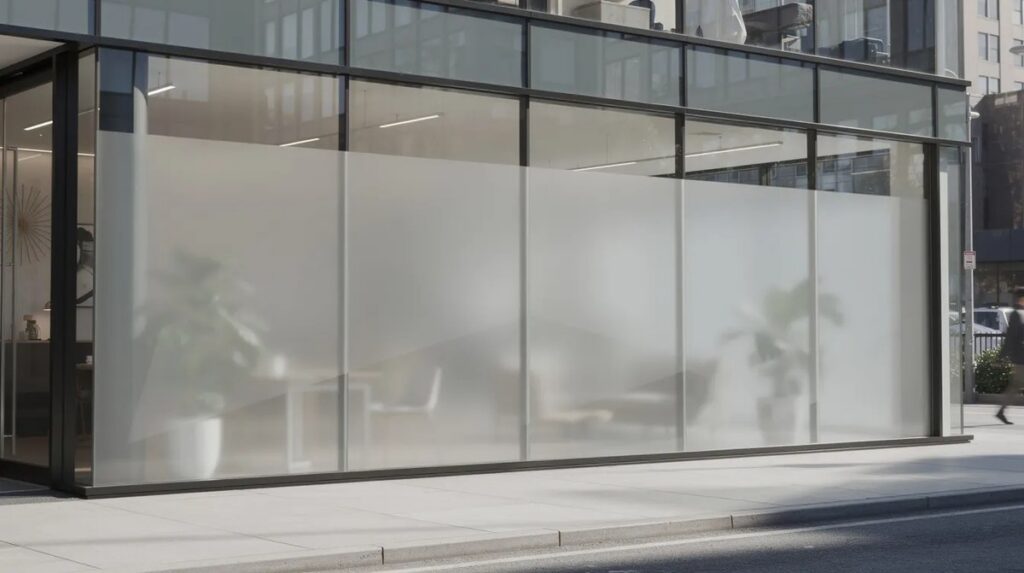
Privacy window film is a thin, adhesive-backed layer-typically polyester or ceramic-based-applied directly to existing glass. It controls what can be seen through the glass, how much light passes, and how the surface performs thermally and aesthetically, similar to broader architectural window film solutions used across commercial buildings.
The basic construction includes several layers: an adhesive backing, one or more polyester sheets, and specialized coatings (metalized, ceramic, or printed). Typical privacy films range from 2 to 8 mil in thickness, while security-grade options are thicker for impact resistance.
Privacy is achieved through a few distinct mechanisms:
- Light diffusion – Frosted or etched films scatter light, blurring shapes and text while still transmitting daylight.
- Reflectivity – Metalized layers create a one-way mirror effect when outside light is significantly brighter than inside.
- Opacity – Solid tinted or printed films block views partially or completely.
- Patterned designs – Graphics that obscure details but preserve silhouettes and ambient light.
Unlike blinds or shades, film keeps glass clean-lined and doesn’t eat into usable floor area. Unlike full smart glass replacements, films are retrofit solutions with far less disruption. Quality commercial privacy films typically last 10 to 15 years or longer with proper care, and many are removable or updatable when branding or layouts change.
Types of Privacy Window Film for Offices
Not all privacy films behave the same way. Choosing the right type depends on how much visibility you need to block, how much light should pass, whether branding matters, and whether security is a concern.
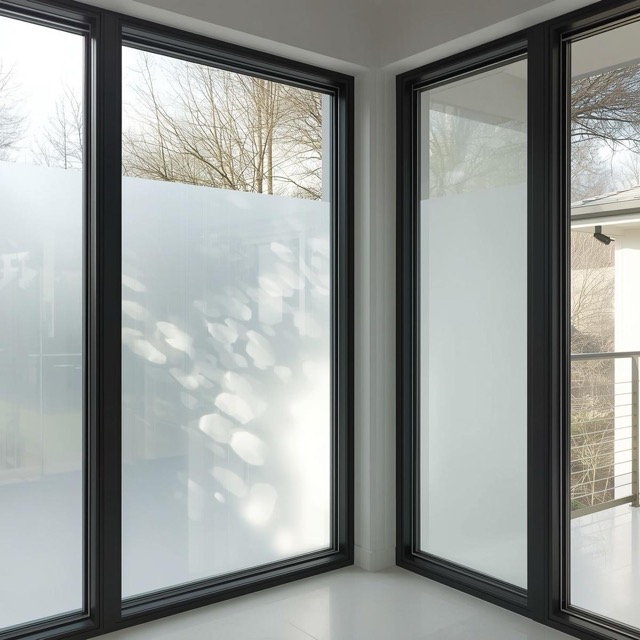
Frosted and etched films mimic the look of sandblasted glass. They’re the most popular choice for conference rooms, private offices, and sidelights because they provide consistent privacy day and night. Visible light transmission typically stays in the 80–90% range, so rooms stay bright while visual details are fully obscured. Options range from full-coverage frost to custom banding at eye level.
Decorative and branded films incorporate patterns, gradients, company colors, logos, and wayfinding graphics. CoolVu can print custom designs that integrate with existing brand standards, turning glass walls into a cohesive part of the office identity.
Reflective and tinted films deliver strong daytime privacy on exterior glass while cutting glare and solar heat gain. These solar window tinting films work best on windows with strong daylight exposure-south- and west-facing orientations, for example. The key limitation: at night, when interior lighting is brighter, the reflective effect reverses, so additional measures may be needed depending on the situation.
Dual-purpose privacy and security films combine visual obscurity with impact-resistant laminate layers. These are common in ground-level offices, street-facing glass, schools, and government buildings and draw on the same principles as security window films used for forced-entry and shatter mitigation.
Specialty options include switchable smart films that toggle between clear and opaque states electronically (typically $29–$75 per square foot for film alone), partial-gradient bands for eye-level coverage, and films designed for interior glass doors and partitions. Some offices opt for SmartVu switchable smart glass films to enable on-demand privacy and projection capabilities in high-visibility meeting spaces.
Key Benefits of Privacy Window Film for Office Buildings
Privacy window film upgrades both how an office feels and how it performs, often in a single-day retrofit with no construction dust or downtime.
Visual privacy and confidentiality. Executive offices, HR departments, legal teams, and healthcare tenants all handle information that shouldn’t be visible from hallways or adjacent workstations. Film instantly shields sensitive documents and screens without closing off a room entirely.
Improved focus and fewer distractions. In open-plan spaces, people walking past glass conference rooms create constant visual noise. Film cuts that down, keeping teams focused and reducing the feeling of being on display.
Comfort, glare control, and energy efficiency. Certain window films reject solar heat and block 99%+ of UV radiation, lessening glare on computer screens and improving thermal comfort. Regional experts such as CoolVu of Tucson (residential and commercial window film services in Tucson) routinely deploy these films in high-sun climates, often incorporating CoolVu Transitional Window Films where adaptive tinting and glare control are especially valuable. Research on open-plan offices has shown that combining solar film with daylight-linked lighting controls can cut electric lighting use by roughly 21% and cooling loads by about 7%.
Safety and compliance. When paired with security-grade laminates, privacy film adds shatter mitigation to glass surfaces. Visual screening also supports compliance efforts for organizations handling protected health information or financial data.
Branding and aesthetics. Films create a cohesive design language, break up large glass expanses, and make even dated buildings look and feel more modern and premium-all without replacing existing glazing. They add character to an office at a scale and speed that traditional renovation can’t match.
Where to Use Privacy Window Film Inside and Around the Office
An office rarely needs every pane covered. Smart planning focuses film where it delivers the most impact for privacy, comfort, and branding, often implemented through local providers such as CoolVu of West Contra Costa.
Conference rooms and meeting spaces. Full-height frosting, mid-band privacy stripes, gradient films, or small vision panels for safety-these are the most common starting points for any office privacy project.
Private offices, HR, and executive suites. Partial privacy bands at eye level shield seated occupants while preserving openness above. Door and sidelight films prevent casual glances from corridors.
Reception, lobbies, and client-facing areas. Decorative films provide subtle screening from waiting areas while reinforcing the brand story with graphics, patterns, or etched-look finishes.
Glass partitions in open-plan space. Patterned or gradient films define departments, collaboration zones, and focus areas without building permanent walls-ideal for layouts that change as teams grow.
Exterior office windows and doors. Tinted or reflective window films deliver street-level privacy, reduce glare for perimeter workstations, and improve thermal comfort for people sitting near sun-exposed glass.
Design, Style, and Branding Options with Privacy Films
Modern privacy window films are as much a design tool as a functional upgrade, especially when coordinated across multiple floors or locations.
Classic styles include full frosted panels, etched-glass lines, simple stripes or bands, and geometric patterns. These work across corporate, medical, and educational environments without looking dated.
Custom-printed films take things further: full-color murals, branded patterns, large-scale logos displayed on lobby glazing, mission statements on stairwell glass, and wayfinding graphics that help visitors navigate an office intuitively.
Gradient and ombré effects transition from opaque to clear, allowing natural light at the top of a pane while shielding eye-level areas for seated employees. These look sophisticated and solve the common tension between “we need privacy” and “we want daylight.”
Privacy zoning strategies use different densities and designs in distinct areas-more opaque in HR, more open in collaboration zones-to visually map how an office functions. The result is a space that communicates its purpose through the glass itself, especially when you leverage privacy and decorative window films in a coordinated way.
CoolVu consults with designers, facility managers, and branding teams, providing physical samples, mockups, and test installs before rolling out a large project, with regional providers like CoolVu of Salt Lake supporting high-performance privacy and security upgrades in their markets. That way the final look matches the vision and reflects the company’s glass and surface solutions expertise built over decades of industry experience, with regional specialists such as CoolVu of Sacramento Northeast and CoolVu of West Los Angeles supporting projects in their local markets.
How the Office Window Film Installation Process Works
Here’s a step-by-step overview of what facility managers, office tenants, or building owners can expect from first call to final walkthrough with CoolVu, whose broader window tinting and window film installation services follow a similar streamlined process delivered locally by franchises such as CoolVu of Central Pennsylvania.
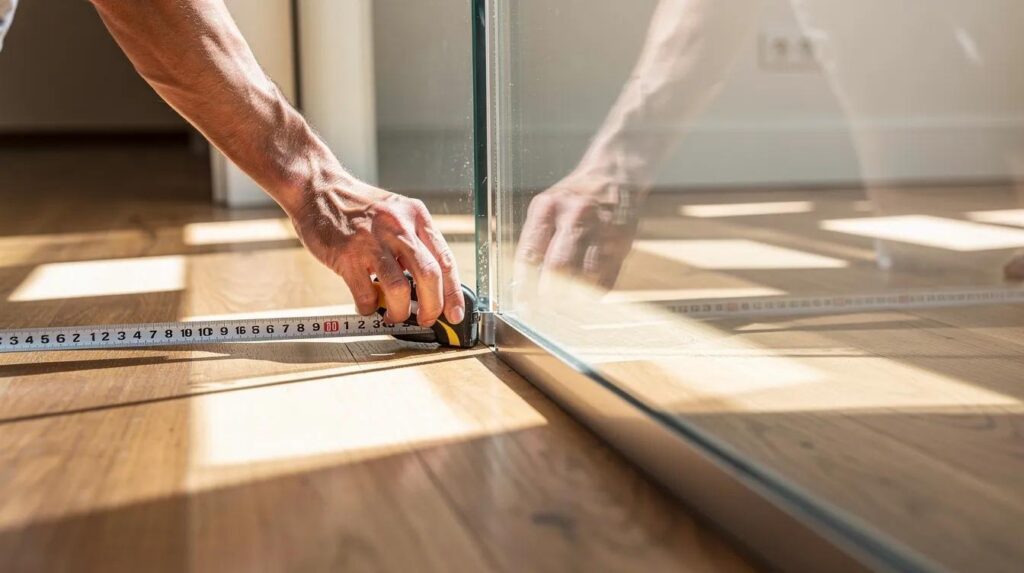
1. Pre-project consultation and site survey. CoolVu assesses existing glass types, measures every pane, reviews floor plans, discusses privacy goals, and checks for building or landlord requirements that could affect film selection or placement.
2. Film selection and design. Together, you choose specific film lines, opacity levels, and designs-including custom graphics if needed. Proofs and physical samples are reviewed and approved before anything is ordered.
3. Scheduling and prep. Typical timelines are set, coordinated around office hours. Furniture and equipment near glass are protected or temporarily moved. A disruption plan keeps the rest of the office running normally.
4. Installation day. Installers clean each glass surface thoroughly, cut film to precise measurements, apply it using a slip solution and professional squeegees, and inspect every panel for bubbles or particles. A single conference room can often be finished in a few hours.
5. Post-installation curing and care. Films need a curing period-typically a few days to a couple of weeks depending on film type and climate. CoolVu provides cleaning guidelines (no abrasive tools, no ammonia-based cleaners) and warranty documentation.
Cost, ROI, and Energy Savings of Privacy Window Film in Offices
Privacy window film is typically a fraction of the cost and time of replacing glass or constructing drywall partitions, making it attractive for both tenants and property owners.
Key price drivers include:
| Factor | Impact on Cost |
|---|---|
| Film type (frost vs. custom print vs. security) | Standard frost is lowest; security and smart films are highest |
| Square footage | Larger projects often benefit from volume pricing |
| Glass accessibility (height, interior vs. exterior) | Multi-story exterior work requires lifts and safety equipment |
| Design complexity | Custom graphics and gradients add design and production fees |
| Geographic labor rates | Vary by market in 2026 |
| For common office privacy film projects, installed costs generally fall in the $5–$20 per square foot range for standard products. CoolVu always provides a custom written estimate after a site visit, so you’ll know exactly what to expect. | |
| ROI goes well beyond aesthetics. Reduced need for blinds and shades, fewer complaints about glare and temperature, and potential cooling load reductions all add up. One IPMVP-guided commercial study measured 8.8% annual energy savings with film, achieving payback in under three years. Films also protect furnishings, flooring, and artwork from UV fading, extending the life of investments you’ve already made. | |
| For property owners, film upgrades can support tenant retention, attract higher-quality occupants, and help justify premium office space rates. |
Common Mistakes to Avoid When Choosing Office Privacy Films
Window film looks simple, but poor choices lead to glare problems, rooms that are too dark, or privacy gaps that only show up after move-in.
Not matching film type to use case. Reflective films on interior partitions create awkward mirror effects. Decorative films with insufficient opacity fail to screen sensitive areas. Always match the film’s mechanism to the actual problem you’re solving.
Ignoring light levels and orientation. Over-tinting already dim spaces forces more electric lighting. Choosing one-way mirror films on windows where interior lighting is often brighter than exterior defeats privacy at night-a common issue in offices that operate after sunset.
Overlooking code, safety, and landlord requirements. Tempered glass markings, egress code compliance, and multi-tenant building design standards all need to be respected. CoolVu helps navigate these requirements during the consultation phase.
Choosing budget-only options or DIY kits. Bubbling, peeling, visible seams, and voided glass warranties are real risks when non-professional installation or off-brand films are used on commercial insulated units.
Skipping a mockup or test panel. Before rolling out a floor-wide project, test key patterns, opacity levels, and the height of privacy bands in at least one conference room or office. What looks right on a sample swatch can feel different at full scale.
How to Choose the Right Privacy Window Film and Installer
Both the film product and the installer’s expertise determine how well the solution looks and lasts in a commercial office.
Questions to ask about films:
- What are the visible light transmission, solar heat rejection, and UV blocking specs?
- What warranty terms apply, and what’s the expected lifespan in commercial use?
- Is the film compatible with your existing glass types (single pane, double pane, low-E)?
Installer checklist:
- Licensing, insurance, and certified applicator status
- Years in business and experience with office and institutional projects
- Portfolio of comparable installations and references from property or facility managers
National reach with local support matters for multi-site companies. CoolVu’s franchise model means locally owned and operated teams backed by national training standards and access to a broad range of window film products and architectural surface solutions.
Ask about project management capabilities: phased installs on occupied floors, off-hours work, security clearances for schools or government buildings, and clear communication about disruptions.
The best partner isn’t just a one-time installer-it’s a provider who can also support future needs like security window film, printed graphics, murals, and architectural surface finishes for doors, walls, and furniture, much like CoolVu of Northeast Columbus, CoolVu of Central San Diego, and CoolVu of Central Pennsylvania do for their commercial clients.
Why Offices Choose CoolVu for Privacy Window Film
CoolVu is a specialized window film and architectural surface provider with national coverage and local franchise owners serving both small offices and large campuses, including regional experts like CoolVu of West Contra Costa.
Expertise. CoolVu’s trained installers have hands-on experience with commercial, institutional, and government properties. The product catalog spans privacy, decorative, security, and solar control window films-so every customer gets the right solution, not just what’s in stock.
Consultative approach. On-site evaluations, design collaboration with architects and interior designers, custom graphic and branding capabilities, and sample programs for key decision-makers are all part of how CoolVu works.
Reliability. Flexible scheduling (nights and weekends where necessary), clean job sites, and respect for confidential environments-law firms, medical practices, financial institutions-are standard operating procedure.
Integrated solutions. Beyond privacy films, CoolVu provides security window film, printed graphics and murals, and architectural surface finishes. That means coordinated upgrades across glass, walls, and casework from a single partner, delivered locally by franchise owners like CoolVu of South St. Paul and CoolVu of Des Moines.
CoolVu’s national franchise network in 2026 makes it straightforward for multi-location brands and property portfolios to roll out consistent glass and surface strategies across cities and states, supported by local teams like CoolVu of Central San Diego, CoolVu of Lower Fairfield County, and CoolVu of Madison.
Frequently Asked Questions About Office Privacy Window Film
These FAQs come from real conversations with facility managers, office tenants, and architects considering window films in recent years.
How long does privacy window film last in a typical office?
Quality interior privacy films typically last 10 to 15 years, and many outlast the current build-out or lease term. Lifespan depends on film type, sun exposure, cleaning practices, and whether the film was applied by a certified installer. CoolVu films come with manufacturer-backed warranties for added peace of mind.
Will privacy film make my office too dark?
Frosted and decorative films can still transmit 80–90% of visible light while fully obscuring visual details. Tinted solar films come in a range of light transmission levels. CoolVu helps model and test options so your team can balance privacy with the desire for a bright, inviting workspace.
Can privacy window film be removed or changed later?
Yes. Professional-grade films are removable by trained installers, which is helpful when you need to change branding, update layouts, or end a tenant improvement. Glass is cleaned afterward and ready for a fresh application or left bare.
Is privacy film applied on the inside or outside of the glass?
Most office privacy films-especially frosted and decorative types-are installed on the interior side for durability and easier maintenance. Certain solar control films may be applied exterior-side when glass construction or access conditions require it. CoolVu evaluates this during the site survey.
How long does installation take and will we need to close the office?
A single conference room can often be completed in a few hours, while full floors or buildings may be phased over days or weeks. CoolVu frequently works after hours or on weekends to minimize disruptions, and many offices continue operating with only localized area closures.
Can window film help with both privacy and security?
Absolutely. Thicker, laminated security window film can be combined with frosted or tinted privacy layers to both obscure views and improve glass impact resistance. This combination is especially valuable for ground-level offices, schools, and public-facing buildings where both threats need to be addressed.
Next Steps: Schedule a Privacy Window Film Consultation with CoolVu
Privacy window film for offices is one of the fastest, least disruptive upgrades you can make to improve confidentiality, comfort, and design across your workspace. Whether it’s a single conference room or an entire campus, the right film transforms glass from a liability into an asset.
Contact your local CoolVu franchise for a complimentary on-site assessment. We’ll take measurements, review your floor plan, and deliver a detailed proposal tailored to your budget and privacy goals.
If you’re a facility manager, office tenant, architect, or property owner planning a move, renovation, or lease renewal, share your floor plans and project timeline so CoolVu can coordinate around your schedule. We can pilot a single floor or suite first, then scale across multiple locations with consistent results.
Reach out by phone, online form, or visit the CoolVu website to get started, or connect directly with regional teams such as CoolVu of North Nassau County, CoolVu of Northern Virginia, CoolVu of North Milwaukee, CoolVu of The Villages, or CoolVu of New Orleans North Shore depending on your location. Your glass is already there-let’s make it work harder for your office.