Table of Contents
- Why Offices Are Turning to Energy Saving Window Film in 2026
- How Energy Saving Window Film Works in Offices
- Office Comfort, Glare Reduction & Natural Light
- Best Window Films for Commercial Energy Savings
- Energy Savings, Payback & Utility Rebates for Offices
- Why Choose CoolVu for Energy Saving Window Film in Offices
- Frequently Asked Questions About Energy Saving Window Film for Offices
Why Offices Are Turning to Energy Saving Window Film in 2026
Commercial energy costs have climbed steadily since 2022, and large glass facades remain one of the biggest culprits behind runaway HVAC bills. In many U.S. metro areas, cooling accounts for 30–40% of an office building’s electricity bill, and untreated glass can be responsible for up to a third of that load. Tenants complain about hot spots near perimeter desks, glare washing out monitors, and temperature swings that no thermostat adjustment seems to fix.
Energy saving window film for offices solves these problems as a retrofit, leveraging your existing windows to reduce cooling costs, lower heating costs, and preserve natural light-often without disrupting daily operations. Whether you manage a mid-rise commercial tower, a medical campus, a school, or a municipal building, window film offers a practical path to lower energy consumption without the price tag of full window replacement.
CoolVu is a national franchise network specializing in commercial window films and architectural surface solutions, with trained installers and free on-site energy consultations, backed by over 100 years of industry experience and more than 50,000 installations. In this guide, you’ll learn how window films work, which film type suits different office scenarios, real-world energy savings and payback timelines, key metrics to compare films, and how a professional installation process unfolds.

How Energy Saving Window Film Works in Offices
Energy saving window film-sometimes called sun control window film-is a thin polyester or nano-ceramic layer professionally bonded to existing glass. It manages the sun’s heat, glare, and harmful uv rays without darkening your workspace. Think of it as a thermal shield that’s nearly invisible once applied.
Modern films work by selectively blocking infrared radiation and ultraviolet light while allowing visible light to pass through. Solar window tinting films block up to 70% of solar heat gain, intercepting radiant energy before it enters the workspace and converts into indoor heat. Window films also block up to 99% of harmful uv rays, protecting both occupants and interiors. Films that block harmful uv rays at this level dramatically slow fading of carpets, furniture, and artwork.
Low emissivity window films add a second layer of benefit. Low e films improve insulation by reflecting indoor heat back inside during colder months, reducing heat loss through the glass. This makes them especially valuable on older single pane glass or clear double pane windows where winter energy waste is significant. Low e window films essentially mimic the performance of factory-applied low-E coatings at a fraction of the cost.
The causal chain is straightforward: less solar heat entering in summer plus better heat retention in winter means reduced HVAC runtime. Energy-saving window film acts as a thermal shield for improved energy efficiency, and window films significantly lower the load on HVAC systems. That reduced load also means energy-saving window film can reduce maintenance needs for HVAC systems, extending the life of compressors and air handlers. Properly selected low-emissivity retrofit window films can reduce perimeter HVAC energy use by approximately 29%. Many high-performance commercial films reject 50–80% of total solar energy depending on film type and glass configuration.
Consider a practical example: an open-plan office with a west-facing glass curtain wall. Before film, afternoon direct sunlight pushed interior temperatures 8–10°F above thermostat settings. After a spectrally selective film was installed, afternoon temperatures dropped by roughly 7°F, complaints stopped, and the building’s chiller ran fewer cycles each day.
Office Comfort, Glare Reduction & Natural Light
Productivity and employee comfort matter just as much as raw energy savings. Commercial window films improve aesthetics and comfort of office spaces by addressing the two complaints facility managers hear most: blinding glare and uneven temperatures.
Energy-saving films reduce glare by up to 95%, transforming conference rooms, trading floors, and open workstations into usable spaces all day long. Glare reduction improves visibility for reading and computer use, cutting down on eye strain and the headaches that come with it. Unlike heavy blinds or shades, the right window film keeps natural light flowing in and outdoor views intact. Preserving natural light supports circadian rhythm, which research consistently links to better focus and lower fatigue.
Ceramic films block heat without reducing natural light, making them a strong fit for offices that want bright interiors without the thermal penalty. Window films can improve employee comfort by eliminating hot spots near perimeter windows, smoothing out the temperature imbalances that trigger thermostat battles between departments.
Certain films extend the life of interior furnishings by blocking UV rays, and uv protection helps preserve furniture and flooring from fading-a real budget consideration for offices with high-end finishes. Picture a 15,000 sq ft corporate office where afternoon sun on the south elevation forced employees to close blinds daily. After installing a spectrally selective film, blinds stayed open, glare levels dropped, and meeting rooms remained comfortable and usable through the end of the business day.
Best Window Films for Commercial Energy Savings
The best window film for your building depends on climate, glass type, window orientation, design goals, and whether you need nighttime privacy or a neutral exterior appearance. Here are the four major categories CoolVu commonly specifies for office windows:
Solar Control Films Ideal for hot summers in sunbelt cities or buildings with large south- and west-facing glass. Solar control films reduce heat from the sun before it enters the space, focusing on aggressive heat control and cooling cost reductions. They deliver the highest heat rejection numbers but can have a more reflective exterior appearance.
Low-E (All-Season) Films The right film for mixed or cold climates-Midwest, Northeast, mountain regions-where both winter heat loss and summer heat gain are concerns. Low e films reflect indoor heat back into the building during winter while still reducing solar heat gain in summer months. These films offer year round comfort by addressing both seasons in a single application.
Ceramic & Spectrally Selective Films Ceramic films provide strong heat rejection with clear views, making them “premium clarity” options for Class A offices and storefronts. They use nano ceramic particles to filter infrared energy while maintaining high visible light transmission. If your building needs to look bright and modern, transitional window films that automatically adapt to sunlight are another advanced option to consider.
Dual-Reflective Films Reflective films mirror solar energy away, reducing glare during the day while keeping interior reflection low at night. They suit offices along busy streets, medical suites, and government buildings where daytime privacy matters.
Insulating films enhance insulation by reducing heat loss through glass, and choosing the right film depends on local climate and window orientation. CoolVu’s commercial advisors perform on-site glass audits and energy modeling to help facility managers select the right film type rather than guessing from a catalog, leveraging their broader window tinting and window film installation services.
Energy Savings, Payback & Utility Rebates for Offices
Window films can reduce energy bills by 15–30%, with many office projects seeing measurable reductions in cooling energy on treated facades. Energy-saving films can lead to monthly energy bill savings of 15–30% depending on climate, baseline HVAC performance, and how much glazed area is treated. Window films can lower cooling and heating bills by up to 30% in favorable conditions, and energy-saving films can reduce HVAC run time by 20–30%.
Here’s a concrete example: a 25,000 sq ft office with a $6,000/month average electric bill that reduces energy costs by 15% after film installation saves roughly $10,800 per year. With a typical project cost in the $15,000–$40,000 range, simple payback often falls within 3–5 years.
Applying window film is generally less expensive than full window replacement, and energy-saving films are a cost-effective alternative to replacing windows entirely. This makes film attractive under corporate ESG and decarbonization plans where capital budgets are tight. Films can also help landlords comply with local energy codes-NYC’s Local Law 97, Boston’s BERDO, and emerging city-level energy benchmarking rules-by lowering site energy use intensity and helping avoid penalties.
Extensive usage of window films can lower operating costs in office buildings across the board. Many U.S. utilities offer rebates or incentives for qualifying window film projects. Ask your local CoolVu office—such as CoolVu of South St. Paul in Minnesota—to research current rebate programs in your service area, as eligibility criteria and dollar amounts vary by utility.
One multi-tenant mid-rise office used film to avoid a costly chiller upsizing, extending existing HVAC capacity through reduced peak demand-a cost effective upgrade that delivered immediate comfort improvements and long-term savings.
Technical Performance Metrics Explained for Facility Managers
Facility managers should look beyond marketing names to a few core performance metrics when comparing energy efficient window film options:
| Metric | What It Measures | What to Look For |
|---|---|---|
| Solar Heat Gain Coefficient (SHGC) | Proportion of solar energy admitted through glass (0–1) | Lower = better heat control |
| Total Solar Energy Rejected (TSER) | Percentage of solar energy blocked | Higher = more heat rejection |
| Visible Light Transmission (VLT) | Percentage of natural light passing through | 30–60% typical for offices |
| U-Value | Rate of conductive heat loss | Lower = better insulation |
| Emissivity | Surface’s ability to radiate heat | Lower = better winter heat retention |
| A lower solar heat gain coefficient and higher TSER generally mean better heat control and lower cooling costs. For offices, VLT between 30–60% works for most commercial environments, with higher VLT reserved for lobbies and collaboration spaces. Films with low emissivity help retain warmth by bouncing interior heat back into the room in winter, boosting the effective R-value of existing glass. | ||
| Reputable manufacturers provide performance data tested to industry standards such as NFRC or ISO. CoolVu installers can supply detailed spec sheets for architects and engineers. Avoid fixating on a single number-the goal is balancing heat control, natural light, glare reduction, and aesthetics across the entire building envelope rather than chasing the lowest SHGC on every pane. |
Installation Process for Office Buildings
Commercial window film installation is fast, non-invasive, and can be phased to minimize disruption. Window film installation typically takes one to two days for smaller suites, with larger multi-floor projects phased over several days or weeks.
CoolVu’s typical commercial process follows a clear sequence:
- On-site assessment – Measurements, glass identification, and energy modeling
- Film selection – Matching the right film to each elevation and tenant use
- Proposal – Projected energy savings, timeline, and cost breakdown
- Scheduling – Phased by floor or zone to keep operations running
- Installation and walkthrough – Final quality check with property management
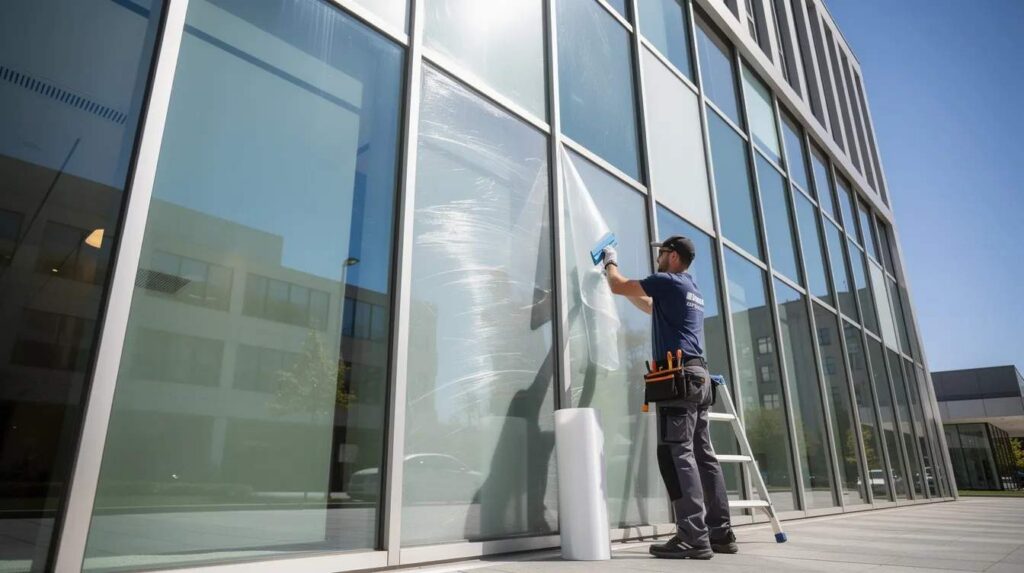
On installation day, furniture and blinds are carefully moved, glass is cleaned with commercial solutions, and film is precisely cut and applied using a slip solution, then squeegeed to remove air pockets. Professional installation prevents bubbles and creases in window film, delivering a clean, factory-like finish. Professional installers use commercial-grade tools for better adhesion, which is why DIY installation often leads to reduced film performance and lifespan.
A crew can typically complete 2,000–4,000 square feet of glass per day depending on access and glass configuration. Offices usually remain open during the work, with small sections addressed at a time. Lobby glass or sensitive areas like boardrooms and clinics can be scheduled before or after standard business hours. CoolVu franchises carry appropriate insurance and follow OSHA-compliant safety practices for mid- and high-rise projects, with local teams like CoolVu of The Villages bringing regional expertise to installation and service.
Maintenance, Lifespan & Warranty of Office Window Films
Modern commercial-grade window films are engineered for long service life. High-quality films can last 20 to 25 years when installed correctly, with minimal maintenance beyond standard window cleaning.
Care tips:
- Wait 2–3 weeks after installation before the first cleaning to allow full curing
- Use soft squeegees or microfiber cloths-never abrasive pads
- Avoid ammonia-based or highly alkaline cleaners that can damage scratch-resistant coatings
- Schedule periodic visual inspections for edge lifting or discoloration
What to avoid:
- Pressure washers directly on filmed glass
- Razor blades or scraping tools near film edges
- Adhesive stickers or tape applied directly to the film surface
Intense sun on south- and west-facing glass curtain walls may age film faster than shaded north facades, but performance remains stable for many years with quality products. Typical commercial warranties cover bubbling, peeling, cracking, delamination, and discoloration, with limited glass breakage or seal failure coverage where applicable.
When films eventually reach end of life-or when a tenant remodels-they can be professionally removed and replaced with updated film types that match new branding, energy goals, or evolving regulations.
Why Choose CoolVu for Energy Saving Window Film in Offices
CoolVu is a specialized national franchise network focused on window films, solar control, security films, and architectural surface solutions for commercial, institutional, and government properties. Rather than offering a one-size-fits-all product, CoolVu takes a consultative approach: on-site evaluations, energy modeling support, and tailored film recommendations by elevation, floor, and tenant use.
Trained, vetted professional installers handle complex commercial conditions-high glass, atriums, curtain walls, interior glass partitions-using professional-grade tools and safety equipment. CoolVu can also combine energy-saving window films with complementary solutions like privacy and decorative window films for conference rooms, branded graphics, or security films for ground-floor glass vulnerable to break ins, giving property managers a single partner for multiple upgrades through regional providers such as CoolVu of North Milwaukee.
CoolVu’s national footprint with local franchise ownership means fast response times for site visits and deep knowledge of regional climate conditions, utility rebate programs, and building codes. Regional teams like CoolVu of Sacramento Northeast and CoolVu of Central San Diego serve local commercial properties with energy-efficient window and wall solutions. Projects span offices, medical campuses, universities, and municipal buildings across the U.S., supported by local providers such as CoolVu of Des Moines. The business model is built around long-term relationships: ongoing support, warranty service, and future upgrades as building needs or regulations evolve. Most homeowners and commercial property owners find that working with a dedicated partner simplifies every phase from specification through maintenance, especially when supported by local experts like CoolVu of Salt Lake.
Frequently Asked Questions About Energy Saving Window Film for Offices
Below are the most common questions CoolVu hears from building owners, asset managers, and tenants about office window films.
How much can office buildings actually save on energy costs with window film?
Many office projects see 10–30% reductions in cooling energy for treated spaces. Actual savings depend on climate, building orientation, glass type, and HVAC system efficiency. For a building with an $8,000/month utility bill that achieves a 20% reduction in cooling expenses, that translates to roughly $19,200 in annual savings. Films also help save energy during colder months by reducing heat loss, lowering heating costs alongside cooling costs year round. CoolVu can coordinate a calibrated energy model during the consult phase to forecast results specific to your property.
Will energy saving window film make our offices too dark?
Modern spectrally selective and ceramic films allow high levels of visible light while targeting the sun’s heat and UV. Facility managers can choose different VLT levels-35%, 50%, or 60%-for different façades depending on sun exposure and interior design goals. The practical result is that blinds stay open more often, reducing glare while maintaining a bright, consistent lighting environment. Offices typically feel more open after installation, not darker, because reducing glare actually enhances comfort and perceived brightness.
Can window films be applied to existing double-pane or low-E glass?
Yes. Most commercial window films are designed for both single pane and double pane units, and many can be safely installed over factory low-E coatings provided product compatibility is verified. CoolVu installers perform a glass and coating assessment first to ensure the right film type is matched to the glazing system, preventing warranty or thermal stress issues. In many cases, film installed on existing windows with low-E glass further enhances performance, improving overall energy efficiency without full replacement.
How long does installation take, and will we need to shut down our office?
Small suites might be completed in a single day, while full-floor or multi-floor projects may be phased over several days or weeks, often outside of peak working hours. Complete shutdowns are rarely necessary. Work zones are isolated, and installers coordinate with property management to minimize noise and disruption. Sensitive areas like boardrooms, clinics, and executive areas can be scheduled during off-hours or weekends by arrangement with the local CoolVu team.
Do energy saving window films affect building appearance from the outside?
Appearance varies by film type. Reflective films create a mirrored look, neutral and ceramic films maintain a subtle, clear aesthetic, and low e window films are often nearly invisible from the street. For Class A or historic office buildings, CoolVu typically recommends neutral or spectrally selective films that preserve architectural intent while still delivering a significant amount of heat reduction. CoolVu can provide exterior mockups on representative windows so stakeholders can approve the look before full rollout.
Are there security or safety window films that also provide energy savings?
Yes. Multilayer safety and security films can be combined with solar control or low-E coatings, delivering both impact resistance and heat control on the same pane of glass. These combination films are popular for ground-floor glass in offices, schools, banks, and government buildings where forced-entry resistance and reduced solar load are both priorities. Security films add a large portion of shatter resistance while the control window film layer handles energy performance, and dedicated security window films are often specified for ground-floor or high-risk areas. CoolVu’s broader portfolio of architectural window films for safety, privacy, and efficiency allows them to design packages that layer both capabilities, tailored to each building’s risk profile and energy benefits goals.
Energy saving window film for offices lowers cooling costs, cuts heating costs, improves year round comfort, and protects furnishings from UV damage-often paying for itself within a few years. For commercial buildings facing rising energy bills, tightening regulations, and tenant expectations for better workspaces, film delivers measurable energy benefits without the cost or disruption of full window replacement.
Films block a significant amount of the sun’s heat and reduce solar heat gain while preserving natural light, helping offices feel brighter yet cooler. Whether you need aggressive heat reduction for hot summers, all-season insulation for temperature swings, reducing glare in conference rooms, or security for ground-floor glass, there is a film type and configuration that fits.
The next step is straightforward. Contact CoolVu today to schedule a no-obligation evaluation of your office windows and receive a customized energy savings proposal. Whether your property is in markets like Lower Fairfield County, North Nassau County, or served by CoolVu of Northeast Columbus, local teams can deliver the same consultative process and commercial expertise. CoolVu’s local franchise teams can also advise on complementary upgrades—decorative privacy films, branded glass graphics, security films, or smart window films that provide privacy on demand—as part of a broader improvement plan, with regional specialists like CoolVu of Northern Virginia tailoring solutions to local codes and climate. A single consultation can map out how to enhance comfort, reduce carbon emissions, and improve insulation across your entire building envelope.