Use this table of contents to jump directly to the section that matters most to you.
Table of Contents
- Introduction: Why Homeowners Are Turning to Residential Window Tint
- What Is Residential Window Tint & How Window Film Works
- Key Benefits of Residential Window Tinting
- Different Types of Window Films for Homes
- Daytime vs. Nighttime Privacy & Mirror Effect
- How to Choose the Right Window Film & Privacy Solution
- Professional vs. DIY Installation
- Cost Factors, Energy Savings & Free Estimate
- Residential Window Tinting FAQs
- Why Choose Our Team
- Conclusion & Next Steps
Introduction: Why Homeowners Are Turning to Residential Window Tint
If you have ever walked into a sun-drenched living room in July and felt the heat radiating off the glass, or noticed your hardwood floors fading unevenly near a west-facing window, you already understand the problem residential window tint is designed to solve. Since around 2015, more homeowners have started treating their windows as active parts of the building envelope rather than passive openings, and it is easy to see why.
Energy costs have climbed steadily through the 2020s, home offices have become permanent fixtures in modern homes, and dense neighborhood construction means street-facing windows now sit closer to sidewalks and neighbors than ever before. These realities create overlapping needs: lower energy bills, less glare on a computer screen, more privacy from prying eyes, and protection against sun damage to furniture, rugs, and art.
Window film offers a fast, non-invasive solution to all of these issues. Unlike a full window replacement project, a professional crew can typically install window film across an entire house in a single day with minimal disruption. In this article, you will learn how different types of window films work, how they handle privacy during the day and at night, what kind of energy savings to expect, what they cost, and how to request a free estimate tailored to your home.
What Is Residential Window Tint & How Window Film Works
Window film is a thin, multi-layered laminate, most commonly made from polyester (PET), that is applied to the interior surface of glass in your home. Depending on the product, it may contain dyes, metallic particles, ceramic or nano-ceramic layers, UV-absorbing compounds, infrared-reflective coatings, and a scratch-resistant topcoat. Once adhered to the glass, it changes how that pane interacts with sunlight.
In simple terms, the film works by filtering the solar spectrum into three categories: ultraviolet light, visible light, and infrared heat. Quality films block up to 99% of harmful uv rays, which are the primary driver of fading in fabrics, wood, and artwork. They also reject a significant portion of infrared heat, the wavelength band responsible for the warmth you feel on your skin near a sunny window. Meanwhile, visible light transmission, or VLT, controls how much natural light passes through, and it is the spec that determines how dark or bright your room feels after installation.
Residential window tint is engineered differently from automotive tint. It is designed for flat, static glass surfaces including double- and triple-pane insulated units, and it carries longer residential warranties. Automotive film is built for curved surfaces with different regulatory VLT limits and shorter coverage periods.
When evaluating films, three performance metrics matter most. Visible Light Transmission (VLT) tells you how much light inside reaches the room. Solar Heat Gain Coefficient (SHGC) measures the total fraction of solar energy that passes through the window system – lower means better cooling performance. Total Solar Energy Rejected (TSER) indicates better overall heat rejection by combining UV, visible, and infrared blocking into one number. A high Infrared Rejection (IRR) value means better heat reduction specifically from the infrared portion of the spectrum, while a lower U-Value indicates better insulation against winter heat loss.
Homeowners can apply film to living room windows, patio doors, transoms, bathroom glass, and sliding doors. However, some glass types, particularly older low-E coated units or certain insulated assemblies, require professional guidance to avoid compatibility issues.
Key Benefits of Residential Window Tinting
Modern residential films deliver multiple benefits simultaneously. A single installation can address comfort, protection, energy efficiency, and privacy across every room in your house.
UV protection and fade prevention. Premium window films block UV rays to prevent fading of interiors, including hardwood floors, leather furniture, carpets, and artwork. With UV rejection rates of 99% or higher on quality products, window films protect furniture and carpets from sun damage that would otherwise accumulate over five to ten years. If you have ever noticed a rug losing its color in a sun-streaked patch, that deterioration slows dramatically once film is in place.
Heat control and energy efficiency. Tinted windows reject solar heat in summer and retain warmth in winter. By lowering the SHGC of your glass, film reduces the heat coming through south- and west-facing exposures and eases the load on your air conditioning. A Lawrence Berkeley National Laboratory evaluation found that low-e window film retrofits saved approximately 29% on perimeter HVAC energy compared to single-pane clear glass baselines. Residential window tinting offers significant energy savings, and window films can reduce energy costs by reflecting sunlight back before it heats your interior.
Glare reduction. Glare reduction helps users work on computers or watch television more comfortably without keeping blinds or curtains drawn all day. Window films reduce glare on screens significantly – many products cut glare by 50 to 85 percent depending on film type. For home offices and living rooms where screens compete with sunlight, this alone can justify the investment.
Comfort improvements. Residential window tinting increases indoor comfort by eliminating hot spots near large windows and evening out temperature differences across a room. Rooms with large picture windows or sliding doors installed before 2010 often benefit the most. In summer, you will notice fewer temperature swings; in winter, insulating films help reduce drafts near the glass.
Energy savings range. Typical cooling cost reductions fall between 5 and 15 percent annually when film is installed on major glass areas, with homes in hot climates and those with extensive sun-exposed glazing toward the higher end of that range.
Shatter resistance. Thicker films add a layer of protection by holding broken glass in place during accidental impacts or storms, though they are not a replacement for laminated safety glazing or a full security system.
Different Types of Window Films for Homes
There are different types of window films engineered for specific goals: heat control, privacy, design, and safety. Understanding what each category does well – and where it falls short – helps you match the right product to the right window.
Ceramic window film. Ceramic films use inorganic nano-particle layers to reject infrared heat without metallic components. Ceramic film blocks 65% of heat or more, with premium products reaching 70 to 90 percent IR rejection. They maintain excellent natural light transmission and a neutral appearance, making them ideal for living rooms and sunrooms with large windows. Because they contain no metal, they do not interfere with Wi-Fi or cell signals. Lifespan typically runs 15 to 25 years. The trade-off is cost – ceramic is the most expensive solar control option.
Neutral or non-reflective film. Non-reflective film blocks 35% of heat or more using carbon or pigment-based layers rather than metallic coatings. These films offer a soft, natural look with low exterior reflectivity, so your house does not take on a mirror-like appearance. They provide moderate glare reduction and UV rejection without creating a strong reflection from either side. Lifespan ranges from 7 to 15 years, and they suit homeowners who want a balanced blend of performance and style.
Reflective (one-way mirror) film. Reflective films embed metallic particles that bounce solar energy away from the glass. Silver reflective film rejects more than 75% of heat, making it one of the highest-performing options for raw heat rejection. Daytime privacy is strong – people outside see their own reflection rather than your interior. However, the metallic, mirror-like exterior finish is not for every neighborhood aesthetic, and at night the effect reverses. Older metallic films may also interfere with wireless signals.
Frosted and decorative film. Frost and decorative films provide instant privacy day and night by diffusing light so that shapes and details become unreadable through the glass. They are popular for bathrooms, street-facing sidelights, and entry doors. Frosted films blur views while still allowing natural light into the room, creating a clean, modern look. Heat rejection is moderate compared to dedicated solar films.
Security and safety film. Security window film comes in thicknesses from 3 Mil to 15 Mil. Safety films hold shattered glass together if a window breaks, keeping fragments attached to the adhesive layer rather than scattering into the room. This is useful in storm-prone areas, for ground-floor windows, or in homes with children. Residential window tinting enhances home security by making forced entry through glass slower and louder, though it is not a standalone security system.
Spectrally selective and low-E films. These products allow high visible light passage while targeting IR and UV wavelengths specifically. They are especially useful in climates that swing between heating and cooling seasons, where you want the sun’s heat in winter but need to block it in summer.
Daytime vs. Nighttime Privacy: Mirror Effect & Lighting Strategies
Many homeowners want more privacy without sacrificing the light inside their rooms. Privacy performance, however, changes between day and night, and understanding why saves you from choosing the wrong product.
How daytime privacy works. Reflective window film creates a mirrored effect during the day. Because sunlight outside is much brighter than the interior, the film bounces that exterior light back, and daytime privacy films can obscure the view from the outside while you still see out clearly. Window films enhance privacy during the day on street-facing windows and in dense neighborhoods where visibility from sidewalks or neighboring yards is a concern.
Why nighttime is different. One-way mirror films offer daytime privacy but not at night. Once the sun sets and you turn on interior lights, the brightness ratio flips. Your lit room becomes the brighter side, and people outside can see in through the film. This is a physics limitation, not a product flaw – it applies to every reflective privacy solution on the market.
Reliable nighttime privacy options. For bedrooms, bathrooms, and any room where you need to stay private after dark, frosted window film provides 24/7 privacy while allowing light through. Blackout curtains provide total privacy at night and pair well with solar films for a layered approach. Combining film with shades or blinds is the most practical 24/7 strategy: the film handles heat, glare, and UV during the day, while soft treatments add nighttime privacy when you need it.
Lighting strategies. Installing exterior lights near windows can extend the mirror effect after sunset by keeping the outside surface brighter. Indoors, using dimmers or indirect fixtures near glass reduces how much of your room is visible from outside. Neither trick fully replaces a physical covering, but both help maintain perceived privacy longer into the evening.
How to Choose the Right Window Film & Privacy Solution for Your Home
The best film depends on your goals. Choosing window tint must consider solar heat rejection and privacy alongside aesthetics, glass type, and climate.
Start by defining priorities. If cutting energy bills is the main objective, focus on SHGC and TSER values. If you need a privacy solution for a bathroom, frosted or decorative film may matter more than heat rejection numbers. For rooms where you want to reduce glare on a computer screen without making the space feel dark, a ceramic film with moderate VLT offers the best balance.
Orientation matters. Darker tints or high-reflective films are often needed for south- and west-facing windows, where solar heat gain is strongest. North-facing glass rarely needs aggressive heat rejection and can use lighter films that preserve maximum brightness. Window films can vary in effectiveness based on local climate conditions, so what works in Phoenix may be overkill in Portland.
Glass compatibility is critical. Selecting the appropriate film prevents thermal shock and breakage of glass. High-absorption films should be avoided on dual-pane windows because they can trap excessive heat between the panes and stress the seal. A professional installer will cross-reference the film manufacturer’s compatibility charts with your specific glass type before putting anything on the surface.
For aesthetics, consider how the film looks from both sides. Neutral films maintain the original appearance of your house and complement most interior styles. Frosted options work well in bathrooms and entryways, creating a clean, modern look. Reflective films suit contemporary exteriors but can feel out of place on traditional homes.
A professional consultation lets you see on-glass samples under real lighting conditions, which is far more useful than judging a film from a small swatch in a catalog.
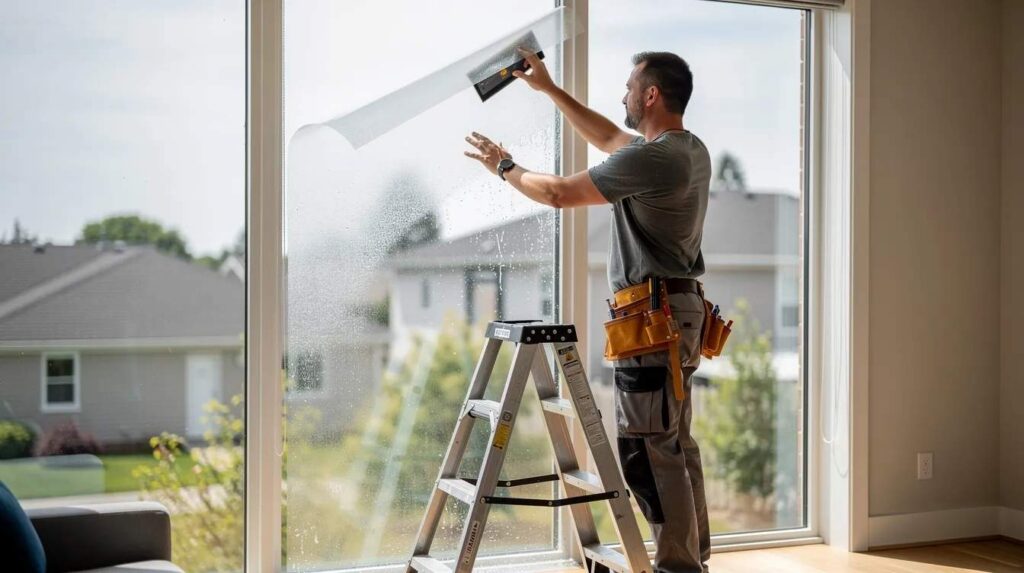
Professional vs. DIY: How to Install Window Film the Right Way
Homeowners can install window film using DIY kits from retail stores, but professional installation typically delivers a better-looking, longer-lasting result with full warranty coverage.
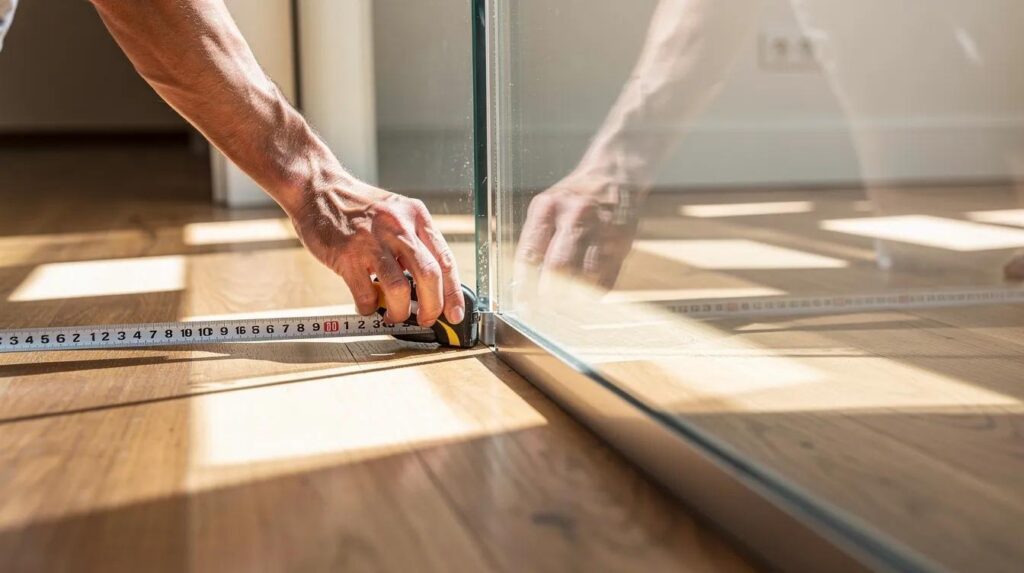
The professional process starts with measuring each pane, cutting film precisely to size, and cleaning the glass thoroughly with a non-ammonia solution. Many pros use rubbing alcohol or specialized glass prep to ensure no residue remains. The film is then placed using a slip solution, squeegeed to push out water and air, and trimmed to exact edges. Unlike a DIY attempt where maintaining consistent pressure is difficult, trained installers use calibrated tools and controlled environments to eliminate bubbles.
Curing takes 7 to 30 days depending on film thickness and weather. During this period, you may notice small water pockets or a slight haze – both are normal and clear gradually. Avoid cleaning the film until the curing window closes.
Common DIY problems include trapped dust, edge peeling, uneven application, and voided warranties. Installing aftermarket film often voids the manufacturer’s window warranty if the work is not performed by a certified technician, so the savings from a DIY kit can disappear quickly if something goes wrong.
Professional installers handle tall windows, skylights, and stairwell glass safely, often completing most homes in a single day with a hassle-free experience. Reputable companies back their work with manufacturer warranties covering color change, peeling, adhesive failure, and optical clarity for 10 years or longer on interior residential applications.
Cost, Energy Savings & Getting a Free Estimate
Pricing varies by film type, window size, glass accessibility, and total project scope. Here are approximate cost ranges per square foot for common residential products:
| Film Type | Cost per Sq Ft |
|---|---|
| Non-reflective film | $5.50 – $6.00 |
| Frost and decorative film | $6.00 – $10.00 |
| Ceramic film | $7.00 – $9.00 |
| Security film | $5.00 – $15.00 |
Installation of tall windows increases costs by $0.50 to $1.50 per square foot due to ladder or lift requirements. Half-moon shaped windows add an extra $1 per square foot for installation because of the precision cutting and fitting involved. A project covering three windows will cost significantly less per pane than a single custom piece, since setup and travel time are spread across more glass.
Long-term energy savings offset the upfront investment. Homes with large sun-exposed glass areas in hot climates often see payback periods of three to seven years. A documented case study in Temple, Texas showed return on investment in as little as 1.3 years when treating many sun-exposed windows with low-E film. Beyond the energy bills themselves, reduced HVAC run time can extend the life of your cooling system.
Non-monetary returns matter too: less fading, fewer temperature swings, and a quieter, more comfortable interior add up to daily quality of life improvements.
Residential Window Tinting FAQs
These are the questions homeowners ask most often before they install window film.
Does residential window tint really improve energy efficiency?
Yes. Films reduce solar heat gain through your glass, which lowers peak cooling loads and helps maintain steadier indoor temperatures. Depending on the product, films can block 35 to 80 percent of total solar energy. That translates directly into lower air conditioning run time and reduced energy costs during summer. Results vary by climate, window size, and orientation, so a professional assessment provides the most accurate projections for your specific home.
Will window tint make my home feel too dark?
Not if you choose the right VLT. Modern films come in a wide range of visible light levels – from nearly clear options that transmit 70 percent or more of light to darker films in the 20 to 30 percent range. Ceramic and neutral films in particular cut significant heat and glare while preserving bright, open sunlight in living spaces. VLT affects the darkness of the tint, so selecting a higher VLT for darker rooms and a slightly lower VLT where glare is harsh lets you customize room by room. Ask your installer for on-glass samples during daytime to see the difference before committing.
Can window film provide complete nighttime privacy?
Most privacy films, especially reflective one-way options, are primarily daytime solutions. At night, when interior lights are brighter than the outside, these films lose much of their one-way effect and visibility from outside increases. For full nighttime privacy, frosted films, blackout shades, or a combination of film plus curtains or blinds deliver better results. Layering solutions is especially practical in bedrooms and bathrooms where staying private around the clock is non-negotiable.
How long does residential window film last?
Quality interior films installed by professionals typically last 10 to 20 years or more. Ceramic and carbon films tend toward the upper end of that range, while dyed films may begin to show discoloration after 5 to 10 years in intense sun. Warranties from reputable manufacturers cover color stability, adhesive performance, and optical clarity for a defined period. Proper care – gentle cleaning with non-abrasive tools – helps films maintain their functionality and appearance over time.
Is window film safe for double-pane and low-E windows?
Most modern residential films are engineered for insulated and low-E glass, but film choice must match the glass type to avoid excess heat absorption that could stress the seal. Professional evaluation of each window ensures compatible products are specified according to manufacturer guidelines. Reputable installers work directly from film manufacturers’ compatibility charts and offer warranties specific to insulated glass applications.
How should I clean windows after film is installed?
Wait until the curing period is complete – often around 30 days – before the first cleaning to avoid disturbing the adhesive bond. After that, use soft, non-abrasive cloths or a rubber squeegee with a mild, ammonia-free cleaner. Avoid razor blades, abrasive scrub pads, or anything with glue residue that could scratch the protective coating. Treat the filmed surface the same way you would treat a high-end screen: gently and consistently.
Why Choose Our Team for Your Home Window Tinting
Our team specializes exclusively in residential window film. That focus means we stay current on the latest ceramic, spectrally selective, and security products rather than spreading thin across unrelated services.
Every installation is handled by certified technicians who follow careful in-home work practices – drop cloths to protect your floors, shoe covers, and clean workspaces from start to finish. We carry a curated range of premium films selected for proven performance and long-term reliability, not generic off-the-shelf rolls.
Our consultation process is straightforward: we visit your home, take precise measurements, apply film samples on your actual glass so you can see the difference in real light, and deliver a written proposal with exact specs, coverage details, and transparent pricing. No surprises, no hidden fees.
We offer flexible scheduling to minimize disruption, and our post-installation support means you can call with questions anytime – whether it is about cleaning, curing, or adding film to additional windows down the road. Every project is backed by manufacturer warranties that give you confidence your investment is protected.
Ready to get started? Reach out to schedule a visit or request your free estimate today.
Conclusion: Make Your Windows Work Smarter for Your Home
Residential window tint is one of the simplest upgrades that pays for itself. It reduces energy bills, protects your interior from UV-driven fading, eliminates hot spots, and gives you control over privacy – all without replacing a single pane of glass. The right film turns every window into a working asset for your house.
There are products for every need, from nearly invisible ceramic films that enhance energy efficiency in your living rooms to frosted options that deliver around-the-clock privacy in bathrooms and entryways. The key is matching the film to the window, the room, and your climate.
Take the next step: request a free, customized estimate to see which films fit your windows, your budget, and your goals. The process is quick, the installation is clean, and the results last for years. Contact us today to put your glass to work.