Table of Contents
- Why Office Glass Privacy Film Matters in 2026
- What Is Office Glass Privacy Film and How Does It Work?
- Key Benefits of Office Glass Privacy Film for Businesses
- Types of Office Glass Privacy Films (Frosted, Decorative, One-Way & More)
- Cost, Value, and ROI of Office Glass Privacy Film
- FAQs About Office Glass Privacy Film
Why Office Glass Privacy Film Matters in 2026
The open-plan office revolution of the 2010s gave us walls of glass everywhere-conference rooms, executive suites, HR offices, and entire floor plates wrapped in transparent partitions. It looked great in design renderings. In practice, it created a confidentiality nightmare. People sitting in HR meetings visible from the corridor. Executives on sensitive calls displayed to every passerby. Conference room screens readable from twenty feet away.
Rebuilding those walls isn’t practical, especially in leased office space with hybrid teams that shift layouts regularly. That’s where office glass privacy film comes in. Privacy window films allow natural light in while providing privacy, turning glass from a liability into an asset without demolition, drywall, or major downtime.
Modern films go far beyond a simple frosted layer. They can be decorative, branded, solar-controlling, and even switchable-and they work on glass doors, glass windows, and office partitions alike. CoolVu, a nationwide franchise network specializing in window film and architectural surface solutions, helps commercial, institutional, and government buildings solve exactly this problem every day across the U.S. The company’s background and experience provide added confidence for large-scale projects.
What Is Office Glass Privacy Film and How Does It Work?
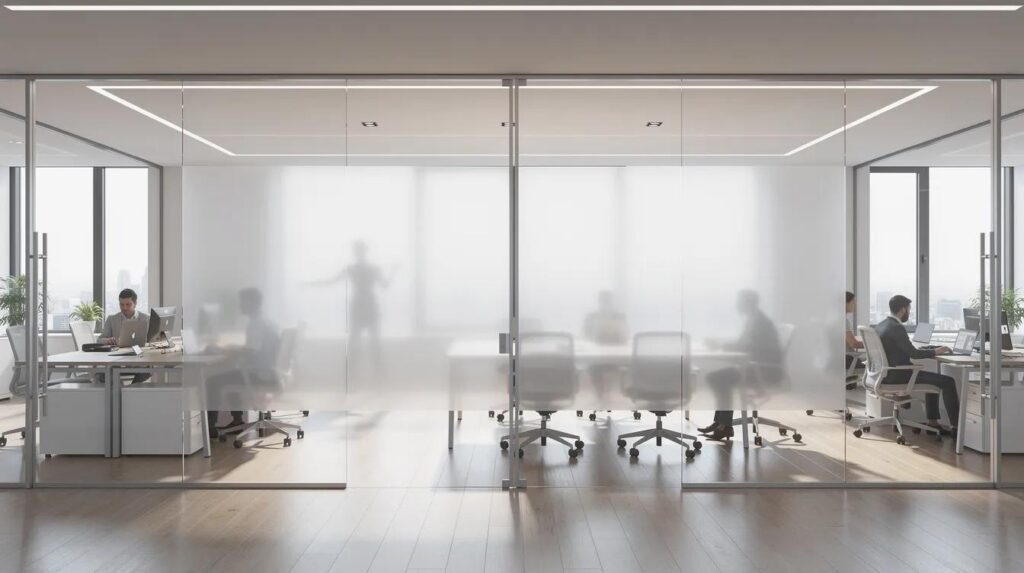
Office glass privacy film is a thin laminate-typically polyester, vinyl, or specialty polymer-applied directly to existing glass surfaces using adhesive bonding or static cling, similar to many architectural window film solutions used across commercial properties. Instead of replacing glass with opaque materials, film changes how light passes through it. Frosted window film scatters incoming light so people on one side see a blurred, milky surface rather than a clear view. Reflective window film bounces light back toward the brighter side, creating a mirror effect. Decorative window film uses patterns, gradients, or printed graphics to selectively block sightlines and is often part of broader window tinting and window film installation services for commercial buildings.
Films can be permanent, semi-permanent, or removable. Many privacy films are removable, making them ideal for leased spaces where tenants can’t alter the building shell. Frosted films provide similar benefits to etched or sandblasted glass without replacing existing windows-a critical distinction for budgets and building management.
Privacy levels range widely. Full privacy options completely obscure shapes and text through the glass. Partial privacy films blur silhouettes while keeping rooms from feeling closed off. Safety distraction bands-those horizontal or vertical stripes at eye level on glass doors-serve double duty as collision markers required under OSHA and ADA guidelines and as subtle privacy elements. Films work equally well on interior conference room glass and street-facing façades, reception sidelites, and lobby windows.
Key Benefits of Office Glass Privacy Film for Businesses
If you manage facilities, oversee HR, or run day-to-day operations, here’s why office glass privacy film deserves a line item in your next improvement budget.
Privacy and confidentiality. Glass privacy film enhances confidentiality in office environments where sensitive discussions-salary reviews, legal strategy sessions, patient consultations-happen behind transparent walls. A medium-frost film on a conference room partition keeps screen content and facial expressions private without creating the isolation of a solid wall.
Light and comfort. Privacy film reduces visual distractions in open-plan offices while preserving the daylight that keeps employees energized. Unlike blinds or curtains that block light and require constant adjustment, film is always working, always consistent.
Branding and aesthetics. Decorative films can enhance company branding while providing privacy. Custom-printed or patterned films integrate logos, brand colors, and design motifs directly into glass surfaces, turning every partition into a subtle brand touchpoint.
Cost effective upgrades. Frosted window films are cost-effective alternatives to etched glass-often running 50–70% less than replacing glass panels with factory-obscured panes. No glass removal, no structural work, no extended closures.
Flexibility. When your office space is reconfigured for a new team structure or a lease renewal changes your footprint, films can often be removed and reapplied to new partitions without replacing glass.
Security and safety. Many films hold shattered glass together for safety and security, keeping dangerous shards contained in the event of impact. Safety films increase the tensile strength of glass against breakage, which matters in high-traffic commercial settings and ground-floor offices.
Energy performance. Tinted films can lower cooling costs by blocking UV rays, and when privacy film is paired with solar control layers, the combination can meaningfully reduce HVAC load-particularly in sun-drenched offices.
Types of Office Glass Privacy Films (Frosted, Decorative, One-Way & More)
Not all privacy films perform the same job. Selection depends on where the glass sits, who needs privacy, and how the space should feel. Office glass privacy films include frosted, patterned, and smart switchable options, each suited to different scenarios.
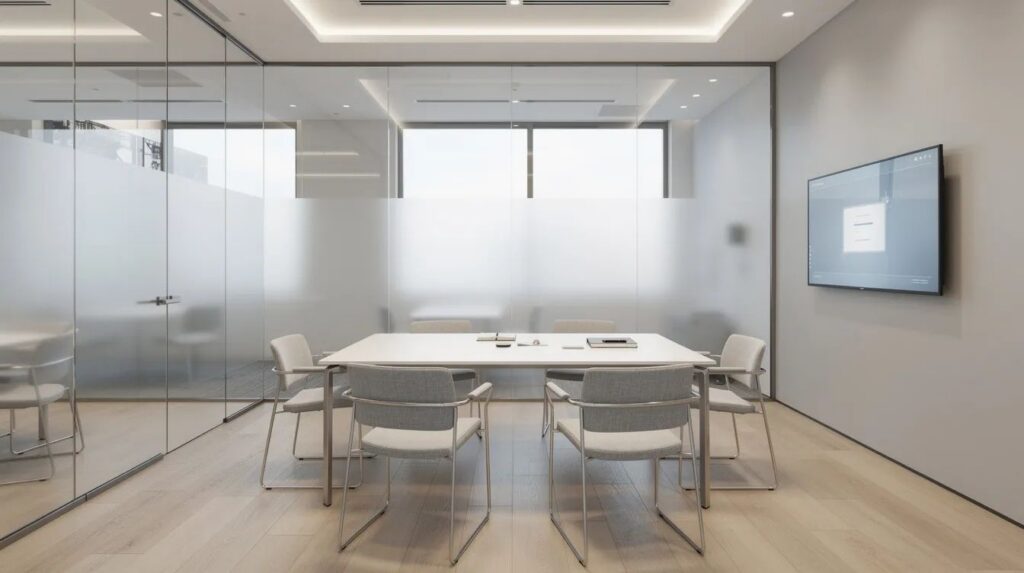
Frosted window film delivers the classic etched-glass look at a fraction of the price of actual etched glass. Frosted window films come in various levels of light transmission-from a light haze that gently blurs views to a heavy frost with visible light transmission as low as 5–10%, blocking nearly all detail. Conference rooms, private offices, and sidelites are the most common applications, and frosted films remain a consistent best seller in commercial projects.
Decorative window film goes beyond uniform frosting into stripes, geometrics, color gradients, and custom patterns. Gradient films transition from opaque to transparent on a single sheet, creating an ombre effect that adds a design touch while allowing views above or below the privacy zone. Creative agencies, healthcare waiting rooms, and tech start-ups frequently choose patterned options to align aesthetics with brand identity, often pairing film selection with local window film installation services in markets like Tucson.
One-way reflective films. One-way mirror films provide daytime privacy while allowing visibility from the inside. The exterior surface appears mirrored, while occupants look out clearly. The limitation: at night, when interior lights are brighter than outside, the effect reverses. These films work well for offices facing streets or parking lots but aren’t ideal for interior-only partitions.
Reeded, fluted, and textured films. Reeded Glass Film offers a medium privacy level of 3/5 and mimics the appearance of expensive fluted glass without replacing panes. Reception areas and office partitions seeking a high-end look benefit most from these options.
Specialty films. Smart film can switch between frosted and clear states for flexibility in privacy, toggling electronically in under a second. Printed graphic films combine logos and imagery with privacy, and combination films layer privacy with solar control or security reinforcement for a multi-purpose solution.
Design Ideas for Conference Rooms and Open-Plan Office Spaces
The tension between transparent design and real-world privacy needs doesn’t have to end in compromise. The right film turns glass walls into design features.
Conference room concepts. A popular 2026 approach is applying full-height frosted film on the lower 60% of glass walls with a clear band above, maintaining overhead sightlines and ceiling light while protecting everything at table and screen level. For boardrooms and executive meeting spaces, gradient frosted window options create a polished, modern effect that keeps meetings confidential without darkening the room.
Open-plan office space. Along glass partitions between work zones, partial frosting at seated eye level-roughly 36 to 60 inches from the floor-reduces distractions while keeping the upper portion transparent for an open, connected feel. Employees can focus without feeling boxed in.
Glass doors and sidelites. Vertical or horizontal stripe patterns, dot arrays, or custom geometric designs serve as safety markings (required on full-height glass to prevent collisions) and privacy film simultaneously. This is one of the simplest ways to add function and style to every glass door in a facility.
Brand-forward designs. Decorative films can be customized with company logos and patterns, turning meeting room glass, lobby partitions, and focus pod walls into branded surfaces. Wayfinding icons, mission statements, and department identifiers can all be integrated directly into the film.
Industry-specific examples. Law firms tend toward solid frosted panels for complete privacy and confidentiality. Co-working spaces lean into playful geometric gradients that feel welcoming. Medical and therapy offices favor soft, calming patterns paired with higher privacy levels to protect patient interactions.
Where to Use Office Glass Privacy Film: Doors, Windows, Partitions & More
Virtually any flat glass surface in a commercial building can benefit from the right film application.
Glass windows on exterior walls. Ground-floor offices on busy streets, healthcare facilities near public sidewalks, and storefront-style office fronts all face the same problem: people outside can see in. Privacy film on exterior-facing glass windows lets daylight pass while blocking casual views. This is especially relevant for any business handling sensitive records or customer data.
Interior glass doors. Swing doors, sliding glass doors, and frameless systems can all receive film. Beyond privacy, integrating room names, ID graphics, or safety bands into door film streamlines signage and eliminates the need for separate adhesive labels that peel over time.
Office partitions and demountable walls. Full-height film on private office partitions gives the occupant visual seclusion. Partial bands on shared space dividers maintain the collaborative feel of an open layout while reducing the “fishbowl” effect that drives people to book rooms they don’t need.
Conference rooms and huddle spaces. These are high-priority zones. When screen-sharing, conducting interviews, or holding executive meetings, even moderate transparency creates discomfort. Medium-to-heavy frosted film on conference room glass is one of the highest-impact upgrades a facility manager can make.
Special zones. HR offices, payroll departments, counseling rooms, school administrative offices, and university advising centers all handle information where confidentiality isn’t optional. Film supports compliance with privacy expectations-and in healthcare settings, aligns with HIPAA-adjacent concerns-without closing off spaces entirely.
Balancing Privacy, Natural Light, and Aesthetics
Decision-makers often worry that adding privacy film will darken an office and undo the open, airy feel they invested in. That concern is understandable but largely outdated.
Visible light transmission, or VLT, measures what percentage of light passes through the film. A light frost might allow 60–80% VLT, meaning rooms stay bright and welcoming. A heavy frost drops VLT to 5–10% for situations demanding complete privacy. Frosted window films vary in visible light transmission, so specifying the right level for each room is the key to keeping spaces bright where they should be bright and private where they must be private.
Frosted window films provide privacy while allowing natural light to fill the room-the film scatters light rather than absorbing it, so illumination stays high even as visibility drops. Frosted films provide extensive visual privacy day and night, unlike one-way reflective films that depend on lighting differentials.
Techniques like ombre films, top-only or bottom-only frosting, and patterned decorative window film maintain a sense of spaciousness. In a 2025 marketing agency retrofit, for instance, designers applied a gradient film to conference room glass that faded from opaque at 42 inches to fully clear at the ceiling-preserving views of downtown while hiding everything at desk level. A university library study room upgrade used light frosting at eye level only, keeping the study spaces visible to librarians above shoulder height for safety while giving students visual separation.
The best outcomes happen when facilities managers, designers, and film specialists collaborate to sample multiple films on-site before committing. CoolVu consultations include applying test panels directly to your glass so the decision is based on what you see in your space, not a catalog photo, and many clients work with local window tinting specialists in areas like Milwaukee for this on-site sampling.
Installation: Professional vs DIY and What “Easy Installation” Really Means
Small decorative film projects on a home bathroom mirror or kitchen cabinet door? A confident DIYer can handle those. Full-height office partitions, conference room walls, and glass doors in a commercial building? That’s a different category entirely.
Professional installation follows a specific sequence: on-site survey and glass measurement, film selection and material ordering, thorough surface cleaning, application using a slip solution and professional squeegees, precision trimming to edges, and a final quality check. CoolVu installers follow standardized processes developed across hundreds of commercial projects, ensuring consistent results from a single conference room to an entire floor.
When product packaging advertises easy installation, it typically means the film is forgiving for trained hands-not that anyone with a squeegee can cover a 9-foot glass wall without bubbles, creases, or misaligned seams. On mission-critical glass in an office, professional application is the difference between a polished result and a visible mistake that undermines the space.
Timing and disruption are usually minimal. A typical project covering 5–10 conference rooms or office partitions can often be completed in a single day, scheduled over a weekend or after hours, especially when handled by regional window tinting and privacy film providers in markets like The Villages. Larger multi-floor rollouts are phased zone by zone so teams keep working while installers handle designated areas.
For leased spaces, CoolVu uses techniques and adhesives that allow film to be removed cleanly when tenants move or rebrand. And importantly, many manufacturer warranties-and CoolVu’s own workmanship guarantees-apply only when films are installed by certified professionals. DIY application can void those protections entirely.
Cost, Value, and ROI of Office Glass Privacy Film
Most facility managers want a clear cost framework before they pick up the phone. Here’s how pricing typically breaks down.
Major cost drivers include total square footage, film type (standard frosted vs. custom decorative window film vs. printed graphics), glass height, physical accessibility, and project location. A 2026 commercial project might look something like this:
| Film Category | Typical Installed Cost (per sq ft) |
|---|---|
| Standard frosted or solar control | $5–$12 |
| Ceramic or high-performance | $12–$18+ |
| Safety and security multi-layer | $12–$25+ |
| Custom decorative with graphics | $15–$30+ |
| A single conference room project might run $400–$1,200 for frosted or decorative film. Multi-wall installations spanning 500–2,000 square feet of glass commonly land between $5,000 and $25,000, depending on film complexity and access requirements. |
Compared to alternatives, frosted films are a cost-effective alternative to etched glass, sandblasted panels, blinds systems, or drywall construction. Film avoids the structural work, long timelines, and high price tags of those approaches.
ROI beyond aesthetics is real. Increased productivity from reduced distractions, better utilization of glass-front rooms that were previously avoided for sensitive meetings, and energy savings when paired with solar control layers all contribute. Measured studies have shown overall energy savings of 8–9% across cooling and heating seasons with solar films, with payback periods under three years in favorable climates.
Budgeting tip: phase installations room by room, starting with the highest-impact areas-street-facing glass, the main conference room, HR. CoolVu franchise locations provide free on-site assessments, so you can request a tailored estimate without commitment.
Durability, Maintenance, and Lifespan of Office Privacy Films
Modern office glass privacy film, when professionally installed, delivers years of reliable performance in commercial environments. Frosted window films have a durability of over 5 years, and many interior installations last 10–15 years before needing replacement. Frosted Privacy Window films specifically carry a durability expectation of over 5 years as a baseline, with premium products often exceeding that range significantly under normal interior conditions.
Exterior-applied films face harsher conditions-sun exposure, temperature swings, weather-and may have shorter effective lifespans of 5–10 years depending on climate and orientation. Interior films, shielded from direct weathering, generally outlast their warranties.
Manufacturer warranties for commercial films typically cover 6–15 years and address performance issues like bubbling, peeling, delamination, adhesive failure, and optical clarity changes. CoolVu provides workmanship guarantees alongside manufacturer coverage and specifies expected lifespans at the proposal stage for each project.
Maintenance is straightforward:
- Clean with a soft cloth and mild soap solution
- Avoid ammonia-based cleaners, abrasive pads, and razor blades
- Wait the recommended curing period (usually 30 days) before the first cleaning
- Address lifted edges early-a small spot repair prevents larger failures
Properly maintained films resist yellowing, peeling, and bubbling, retaining a professional appearance even in high-traffic corridors and conference rooms. If a panel does get damaged by furniture or tenants, individual sections can typically be replaced without redoing an entire wall.
Common Mistakes to Avoid When Choosing Office Glass Privacy Film
Most missteps happen before installation-during product selection and planning-not during the application itself.
Choosing the wrong privacy level. Film that’s too opaque creates a claustrophobic feel and eliminates the open-floor benefit you paid for. Film that’s too transparent still exposes sensitive meetings and screens. The fix: always request physical samples and view them on your actual glass before committing. Mockups take minutes and prevent months of regret.
Ignoring day/night conditions on one-way films. Exterior reflective window film works beautifully during daylight hours. But when interior lights come on at night and the outside is dark, the effect reverses-people outside see in. If your office regularly operates after dark, a one-way film alone won’t provide reliable privacy.
Overlooking design cohesion. Installing different patterns, opacities, or brands of film across different floors or departments over the years creates a patchwork that undermines professionalism. Develop a master glass design plan that covers your entire facility so future additions align with the original vision.
DIY on mission-critical glass. Bubbles, misalignment, and visible seams on tall glass walls look worse than bare glass. And non-certified installation can void manufacturer warranties. For any space where appearance and longevity matter, professional installation pays for itself.
Not involving key stakeholders. When HR, IT, and end users aren’t consulted, you risk films that interfere with camera-based meeting technology, block whiteboard visibility, or frustrate employees who feel their workspace was changed without input. Loop people in early.
Consulting with a CoolVu office glass privacy film specialist before purchasing avoids these pitfalls and ensures your investment performs as expected.
Real-World Applications: Offices, Schools, Healthcare, and Public Institutions
Office glass privacy film is now standard across industries, not just corporate headquarters. Here’s how different sectors are putting it to work in 2026.
Corporate and co-working spaces. The hybrid work era has driven a wave of reconfigurations. Companies are converting open areas into video-call-friendly focus rooms and hot-desk neighborhoods separated by glass. Privacy film on those new partitions makes the spaces functional for calls and concentration without losing the collaborative energy of an open plan. Co-working operators use playful decorative film to define zones and brand individual suite clusters.
Educational institutions. Universities and K–12 districts are applying frosted window film to advising suites, administrative offices, and library study rooms. The goal: protect student privacy during sensitive conversations without darkening spaces that need to feel safe and visible. Safety bands on full-height glass in school corridors also serve a dual role as collision markers and subtle design accents.
Healthcare and wellness. Clinics, counseling centers, and physical therapy rooms use high-privacy frosted and decorative films to protect patient interactions. Calming patterns-soft waves, organic shapes-enhance the therapeutic environment. These films help facilities meet HIPAA-adjacent expectations for visual privacy without the cost of solid-wall renovations.
Government and public buildings. City permit counters, court-adjacent offices, and civic service desks use film to direct public flow and protect records while maintaining an open, welcoming appearance. Decorative films with directional patterns can subtly guide visitors while keeping staff workstations screened from direct view.
Why Choose CoolVu for Office Glass Privacy Film
CoolVu operates as a national franchise network in 2026, specializing in window film, architectural surfaces, printed graphics, and surface finishing solutions for commercial properties. That combination of local ownership and national infrastructure creates advantages that matter for office glass privacy film projects.
Expertise and training. Every CoolVu installer is trained on commercial building codes, ADA/OSHA safety marking requirements, and corporate brand standards. They understand how to work in occupied buildings with minimal disruption-something general contractors or online film sellers can’t replicate.
Comprehensive product range. CoolVu offers frosted window film, decorative window film, solar control films, security films, reeded and gradient options, vinyl surface solutions, and custom-printed graphics. That versatility means your project isn’t limited to what one manufacturer stocks. The team can explore a full portfolio of options to find the right combination for your needs.
Local franchise advantage. Each CoolVu location is locally owned, providing fast response and direct accountability. Local owners know regional climate conditions, common glazing types, and design trends in their market-knowledge that informs better film recommendations.
End-to-end service. From initial consultation and design support (including sample boards and on-glass mockups) through professional installation and post-install follow-up, CoolVu manages every step as part of its broader window tinting and security window film services. You’re not buying film off a website and figuring out the rest yourself.
Proven experience. CoolVu’s track record spans offices, schools, universities, and government sites nationwide, with the ability to scale from a single conference room to a multi-floor headquarters project. That range of experience means fewer surprises and better outcomes.
Compare CoolVu’s consultative approach and long-term support against commodity online film purchases that offer no installation guidance, no design input, and no warranty backing.
FAQs About Office Glass Privacy Film
Here are answers to the questions we hear most from facility managers and business owners evaluating office glass privacy film.
How private is frosted window film compared to blinds or curtains?
Quality frosted film can fully obscure shapes, text, and screens at close range while still letting in diffused natural light. Blinds and curtains block more daylight, require ongoing adjustment, and often look inconsistent across a floor when different people set them differently. For most conference rooms and private offices, medium-to-heavy frost delivers more than enough privacy for screen content and face-to-face meetings-without the maintenance burden of mechanical window coverings.
Can office glass privacy film be removed without damaging the glass?
Yes. Professional removal uses controlled heat and specialized tools to lift the film cleanly. On standard commercial tempered glass, properly installed films usually leave little to no adhesive residue, and any remaining residue can be cleaned safely. This makes film a practical choice for leased office spaces where the landlord expects glass to be returned to its original condition.
Will privacy film make my office too dark?
Most interior frosted and decorative films diffuse light rather than blocking it, maintaining high visible light transmission. A light frost may allow 60–80% of daylight through. The best approach is to use test panels on key glass windows or partitions to verify brightness levels before a full rollout-something CoolVu includes in every consultation.
How long does office glass privacy film last?
Interior frosted and decorative films typically last 5–10 years or more, with many premium products performing well for 10–15 years under normal office conditions. Lifespan depends on product type, UV exposure, and cleaning practices. CoolVu specifies expected lifespans and warranty coverage at the proposal stage so you know exactly what to expect.
Can we add our logo or custom graphics into the privacy film?
Absolutely. Custom-printed and plot-cut films allow integration of logos, patterns, text, and full-color imagery. Conference room glass doors, reception areas, and lobby walls are the most common locations for branded film. CoolVu works with existing brand guidelines and vector artwork to ensure color accuracy and design consistency across every surface.
How much downtime should we expect during installation?
Small projects-a few conference rooms or a single office suite-can often be completed in a single day, scheduled around meetings. Larger floor-wide installations are phased so teams keep operating in unaffected zones while installers work through designated sections. Weekend and after-hours scheduling is standard for projects where daytime disruption isn’t acceptable.
How to Get Started with Office Glass Privacy Film from CoolVu
If you’re considering office glass privacy film in 2026, the first step is simple and costs nothing.
Gather your basics. Take photos of the glass surfaces you want to address-conference rooms, glass doors, office partitions, exterior windows. If you have floor plans, those help too. Note which areas are highest priority: the conference room where client meetings happen, the HR office visible from the break room, the street-facing executive suite.
Reach out to CoolVu. Contact your local CoolVu franchise through the website or by phone to request a free estimate. Every location offers complimentary on-site assessments, so there’s no pressure and no guesswork.
What happens next. A CoolVu specialist walks your space, applies film samples directly to your glass doors and windows so you can see the effect in your own light conditions, and provides privacy and design recommendations tailored to how your people actually use each room. You’ll receive a clear written proposal with product specifications, pricing, timeline, and warranty details.
The result is improved privacy, better use of glass-front rooms, and a more polished office space-without major construction, extended closures, or the headaches of a full remodel. Your glass walls are already there. It’s time to make them work harder.