Table of Contents
- What Is Liquid Crystal Window Film (PDLC) and How Does It Work?
- Key Benefits of Liquid Crystal Window Film for Homes and Businesses
- Smart Film vs Smart Glass vs Traditional Frosted Film
- Ideal Applications for Liquid Crystal Window Film
- Design Options: Clear, Frosted, and Beyond
- What to Consider Before Choosing Liquid Crystal Window Film
- FAQs About Liquid Crystal Window Film and Smart Glass
What Is Liquid Crystal Window Film (PDLC) and How Does It Work?
Liquid crystal window film is a switchable film that transforms any glass surface from transparent to opaque using an electrical voltage. The technology behind it is called PDLC, which stands for Polymer Dispersed Liquid Crystal. Inside the film, microscopic liquid crystal droplets sit within a polymer matrix sandwiched between two layers of transparent conductive material.
When the power supply is off, those liquid crystal droplets scatter light randomly, creating a frosted, milky white, non transparent appearance that blocks visibility. When low voltage AC power is applied, the crystals align instantly, allowing light to pass through and restoring full transparency. PDLC smart films switch from opaque to transparent in under 0.1 seconds, far faster than electrochromic devices, which can take 20 to 30 minutes to change opacity.
It helps to clarify some terminology. Smart film and switchable film typically refer to retrofit PDLC film applied to existing glass. Smart glass usually means a factory-laminated glass panel with the liquid crystal layer built in during final manufacturing. Static frosted film is always opaque and cannot switch. Think of it this way: a conference room with glass walls and a wall switch that flips the space from open collaboration to private meeting in a fraction of a second. That is liquid crystal film in action. Products like SONTE electric film can be applied to any smooth glass surface, and smart window film technology can be retrofitted onto existing glass surfaces without replacing the glazing.
Key Benefits of Liquid Crystal Window Film for Homes and Businesses
People choose liquid crystal film for a combination of privacy, flexibility, energy management, and cleanliness that no single traditional product can match. Switchable smart glass films provide privacy on demand, and the film allows for instant privacy and energy management without the clutter of blinds or curtains.
Here are the primary benefits:
- Instant privacy on demand. One switch changes your space from open to private. No pulling cords, no adjusting slats.
- Daylighting and open feel. In clear mode, quality films deliver 80 to 92 percent visible light transmission, keeping rooms bright and connected.
- UV and heat protection. Smart Tint blocks 99% of UV rays and solar heat, protecting furnishings from fading and reducing uv radiation exposure. Smart films also provide glare reduction by diffusing harsh sunlight when in their frosted state.
- Hygienic surfaces. Glass partitions with switchable film replace fabric curtains, creating easier-to-clean flat surfaces that support modern infection control standards in medical and office environments.
- Multi-use surfaces. This film can act as a surface for high-definition rear-projection displays, and smart film can be used as a projection screen for advertising or presentations in meeting rooms.
- Modern aesthetics. No blinds, no hardware, no visual clutter. Just clean glass that responds to your needs.
Compared to traditional frosted film, which is always opaque and offers zero flexibility, or blinds that collect dust and require regular maintenance, liquid crystal film delivers a fundamentally different level of control over your environment.
Smart Film vs Smart Glass vs Traditional Frosted Film
Buyers often confuse these three options, and the distinction matters because costs and installation requirements are dramatically different.
Retrofit liquid crystal film, or adhesive smart film, is a self adhesive smart film layer applied directly to existing glass. Costs typically range from $18 to $60 per square foot depending on grade and performance level. Installation is minimally disruptive and usually completed in hours for a single room. The technology delivers switchable privacy with smart home integration, and PDLC technology is used across various environments including residential and commercial spaces.
Factory-made smart glass is a complete glazing unit with the dynamic glass layer laminated between two layers of glass during production. Expect $100 to $300 or more per square foot. It requires removing and replacing existing glass, longer lead times for shop drawings and fabrication, and more disruption to operations.
Static frosted or decorative film costs under $20 per square foot and installs quickly, but it is always frosted. There is no ability to switch, no control, no flexibility.
For most retrofit projects, self adhesive smart film hits the right balance: switchable performance at a fraction of the cost of full smart glass technology, without replacing the glass you already have. CoolVu focuses specifically on these switchable smart glass film retrofit solutions and project-based installations rather than selling loose rolls to DIYers.
How PDLC Smart Film Technology Works in Everyday Use
The PDLC film requires electrical power to switch between states. Inside the film stack, you have a protective PET layer on each side, an ITO (indium tin oxide) conductive coating, the polymer layer containing dispersed liquid crystal droplets, an optical-grade adhesive layer, and bus bars with wiring that connect to the power supply.
The film operates on low voltage AC, typically 48 to 65 volts, driven through a transformer. AC is used rather than DC because it prevents ion migration and degradation of the liquid crystal material over time, which is critical for long-term durability. PDLC films consume an average of 3 watts per square meter. Smart films can consume as little as 3 watts per square meter, meaning an 80-square-foot glass wall in a conference room draws roughly 30 watts when transparent, similar to a small light bulb running for 10 hours a day.
Smart film can switch from opaque to transparent in 0.1 seconds, making the transition feel instantaneous. Operating temperature ranges for quality films span approximately −20°C to +80°C, and switch cycle life often exceeds 100,000 cycles. For interior architectural applications, expected lifespan is 10 to 15 years with proper installation.
Ideal Applications for Liquid Crystal Window Film
Liquid crystal window film is best suited for interior or protected glass where privacy, flexibility, and design are priorities. Smart film is ideal for use in hospitals and classrooms, and SONTE liquid crystal film can be applied to large glass surfaces in virtually any building type. Liquid crystal films can be used in medical facilities for privacy, and privacy window film solutions complement this technology while working equally well in home offices, hotels, and government buildings.
Conference Rooms and Executive Offices
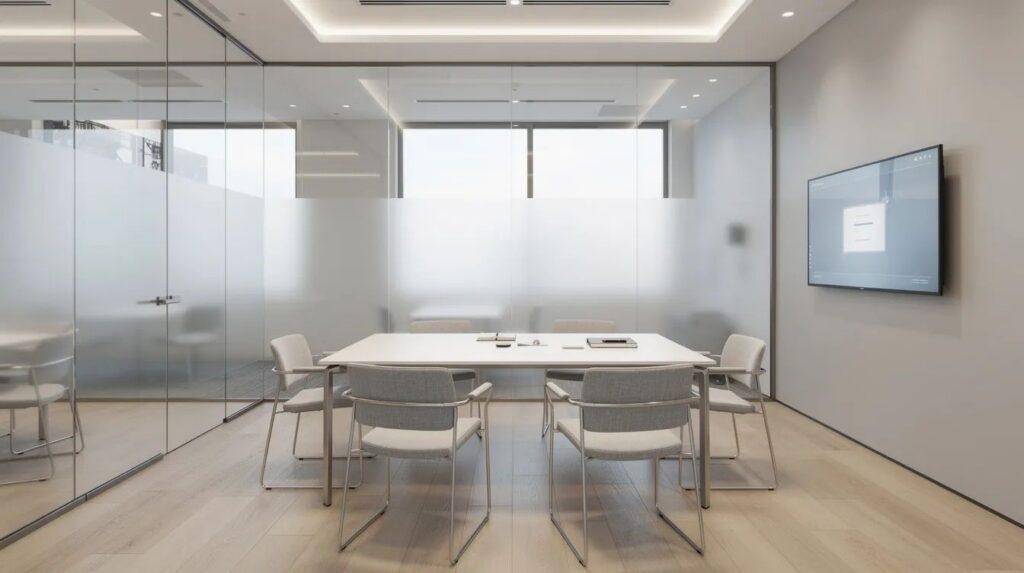
Glass conference room walls that switch from open, transparent collaboration space to private meeting rooms are the most common commercial application. In a 2025 flexible office layout, a 10 to 15 person conference room with switchable smart film replaces blinds entirely. The frosted opaque state doubles as a projection screen for presentations. Law firms, financial advisors, and tech companies with sensitive discussions use this daily to control who sees what.
Healthcare, Clinics, and Wellness Spaces
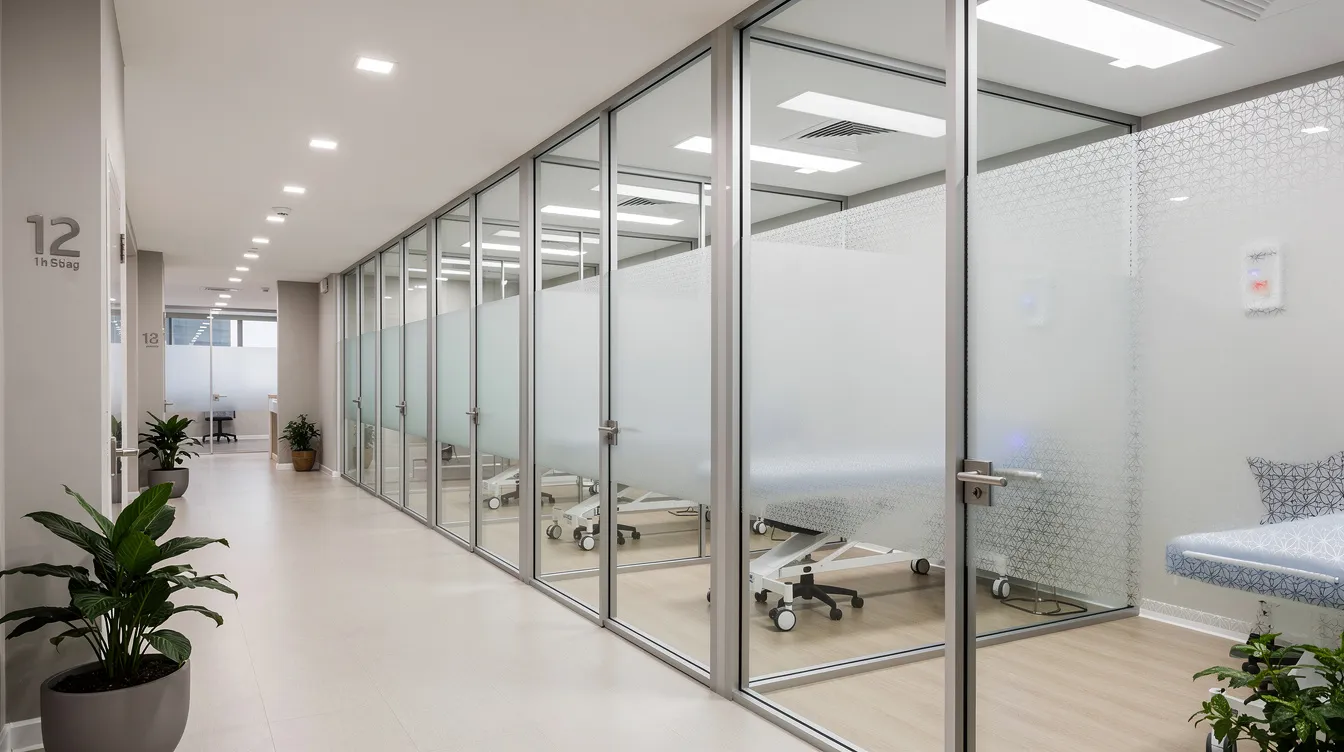
Exam rooms, procedure rooms, and nurses’ stations are phasing out fabric curtains in favor of glass partitions with PDLC smart film. The glass surface is easier to sanitize with standard hospital-grade cleaning protocols. On-demand privacy supports HIPAA requirements without permanent barriers. A 2024 outpatient surgical center replaced all fabric curtains with PDLC smart partitions, improving both hygiene and patient experience.
Hotels, Hospitality, and High-End Residential Baths
Bathroom glass walls that switch from clear to frosted with a wall switch or phone-based smart control are a signature feature in boutique hotels and luxury rentals built or renovated between 2022 and 2026. The wow factor is immediate for guests. SONTE film is installed from the inside to protect it from moisture, and installation is typically on the dry side of glazing to ensure durability.
Sliding Doors, Glass Partitions, and Open-Plan Spaces
Switchable film works on interior sliding doors and fixed glass partitions. A home office with a glass barn door that turns private during video calls is a practical residential example. For operable doors, careful planning of wire locations and cable routing is essential. Retrofitting existing partitions avoids major construction and keeps the project manageable.
Education, Government, and Institutional Spaces
Schools and universities adding glass walls for supervision in classrooms and observation rooms can switch to privacy for testing, counseling, or sensitive meetings. Government facilities, police interview rooms, and training rooms also benefit. Organizations in regions such as Northeast Columbus can partner with local window tinting and film installation experts to implement these solutions. Long-term durability and low maintenance make liquid crystal film a strong alternative to blinds that break, tangle, and need replacement every few years.
Design Options: Clear, Frosted, and Beyond
The default appearance of most PDLC films is a milky white frosted look when off and clear when on. This is the most common design for conference rooms, healthcare, and residential applications.
Color options include white, gray, and darker tints. Gray and tinted films reduce visible light transmission in their transparent state but can create a more subdued, translucent aesthetic. Film versus laminated smart glass also matters here: laminated options can incorporate colored interlayers during final manufacturing.
- Combine PDLC film with printed graphics, logos, or architectural vinyls on adjacent glass for branded environments, a CoolVu specialty.
- Bus bars and edge detailing can be concealed behind framing or trim for a clean, solid architectural finish.
- Architects and interior designers should specify film color and performance early in the project to align with the overall material palette.
Power, Controls, and Smart Home Integration
Every liquid crystal window film installation needs a matched power supply and a control method. Switchable smart glass films connect to a wall switch for operation in most standard installations.
- The power supply outputs low voltage AC matched to film specifications. Typical locations include above the ceiling, in millwork, or in an adjacent room.
- A licensed electrician handles final connections in most jurisdictions, ensuring compliance with ul standards and local codes.
- Control options include a wall switch, remote control, RF or IR controllers, and smart home integration via systems like Crestron, Lutron, Control4, or consumer platforms like Google Home and Alexa through compatible relays. You can also operate the film from your phone through dedicated apps.
Zoning lets you control individual windows versus entire glass walls from one controller. For example, three conference rooms on independent circuits can each be switched separately, with a master “all private” scene connected to a single touchscreen.
Energy Performance, UV Rejection, and Comfort
Liquid crystal film contributes meaningfully to comfort and energy efficiency, though it is not a full replacement for dedicated solar control film on every window in a building.
Smart Tint blocks 99% of UV rays and solar heat, protecting interiors from uv rays that cause fading and material degradation. Solar Control LC films block up to 78% of solar IR, and smart film can block up to 78% of solar infrared light in the opaque state. When frosted, the film scatters and absorbs solar heat, reducing heat gain through glass. Gauzy’s films can reduce indoor temperatures by up to 15 degrees Celsius in sun-exposed spaces. Smart Tint can save up to 49% on heating and cooling costs depending on orientation, climate, and glass type.
Consider a medium-sized glass-walled conference room on a south-facing facade in Dallas. An 80-square-foot glass wall retrofitted with PDLC smart film that blocks 78% of infrared load in its opaque state can meaningfully reduce cooling demand during peak summer months. PDLC film can reduce energy usage by managing solar heat gain throughout the day, and the power cost to operate the film is negligible, around 9 kWh per month, compared to the air conditioning savings.
For best performance, combining PDLC smart film on privacy glass with other CoolVu architectural window films on separate glass surfaces maximizes both comfort and energy use reduction.
- UV blocking: 95 to 99 percent in both on and off states
- Infrared rejection in frosted mode: 60 to 90 percent depending on film thickness and product
- Glare reduction: significant when in frosted or translucent state on hot days
- Power draw: approximately 3 to 5 watts per square meter when on
What to Consider Before Choosing Liquid Crystal Window Film
Not every pane of glass is a good candidate, and professional assessment prevents costly mistakes.
- Glass type and condition: tempered, laminated, or IGU panels all work, but the glass surface must be clean, flat, and free of defects. Smart Tint applies to any smooth glass surface instantly, but scratched or textured glass can cause adhesion problems.
- Location: interior glass partitions are ideal. Exterior windows exposed to direct weather and moisture require careful product selection and mounting on the interior face.
- Wiring access: the power supply and wire locations need planning before installation, not after.
- Size: large panes may require multiple pieces of film with carefully aligned seams. Final measurements should account for gaskets, silicone joints, and tolerances.
- Privacy behavior: decide whether you need normally clear or normally frosted as the default state based on room usage patterns.
- Budget: compare total cost of ownership against blinds, curtains, or full smart glass replacement or professional window tinting and security window film installation services. The material cost is higher upfront, but the lifespan and low maintenance often deliver better long-term value.
A site visit or virtual consultation with a CoolVu specialist to review drawings and project goals is the best starting point.
Common Mistakes to Avoid with Smart Film Projects
PDLC smart film is a performance product, and cutting corners during planning or installation leads to problems.
- DIY installation without experience. Film bubbles, misalignment, and damaged bus bars are common when untrained hands attempt adhesive peel and application on large panels.
- Ignoring electrical requirements. Failing to plan space for the power supply and transformer leaves no clean path for wiring.
- Applying film on exterior surfaces exposed directly to weather. Moisture degrades adhesive and electronics over time.
- Overlapping film across mullions or expansion joints. This creates stress points and potential failure zones.
- Poor cable concealment. Not planning wire exits leads to messy, unprofessional finishes that undermine the clean look of the installation.
- Wrong dimensions. Not taking final measurements that account for gaskets and tolerances means the film is cut wrong, wasting material and time.
CoolVu uses trained installers and project managers to prevent these issues on every project, whether you are installing PDLC smart film or transitional window film with photochromic technology.
How the Liquid Crystal Film Installation Process Works with CoolVu
CoolVu operates as a national franchise network with local installers across the U.S. in 2026. PDLC smart films are installed by trained professionals backed by an experienced glass and surface solutions team, and installation includes engineering support for project implementation.
The process follows a clear sequence:
- Initial consultation and needs assessment, onsite or virtual
- Site survey with final measurements of each glass lite
- Product selection covering PDLC film type, color, clarity, control method, and power supply specifications
- Proposal with pricing, timelines, and warranty terms
- Coordination with your electrician or facilities team for power routing and wire locations
- Professional installation: glass prep with glass cleaner, film application, wiring, testing, and clean-up
- Final walkthrough, control setup, and user training
Typical timelines: a single conference room can be completed in one day. A full office floor with multiple rooms may take three to five days. High-end residential projects vary based on scope. All work adheres to local codes, safety standards, and manufacturer guidelines.
Maintenance, Cleaning, and Long-Term Durability
Properly installed PDLC films are low-maintenance. Clean the glass surface with a soft cloth and a non-abrasive glass cleaner. Avoid razor blades directly on the film, harsh chemicals, and scouring pads. Keep wiring, bus bars, and edges protected from impact and moisture.
Expected lifespan for quality film in a normal interior environment is 10 to 15 years. Warranties vary: film, electronics, and workmanship may have different coverage periods, typically ranging from 3 to 10 years depending on the manufacturer and product grade. Switch cycle ratings of 100,000 or more cycles are standard.
If a panel is damaged, contact your installer. Avoid self-peeling or attempting repairs without professional guidance, as this can void the warranty and cause further damage.
Liquid Crystal Film and Privacy Regulations
On-demand privacy through liquid crystal film supports compliance with several regulatory frameworks, though the film is typically one part of a broader strategy.
- HIPAA in healthcare: glass partitions in clinics and hospitals that switch to opaque protect patient privacy during exams and consultations.
- Corporate confidentiality: boardrooms, HR offices, and executive suites use switchable film to prevent visual exposure of sensitive discussions.
- Education: observation rooms, counseling offices, and testing spaces in schools and universities benefit from glass that can go private as needed.
CoolVu teams often work alongside architects and facility managers to ensure installations meet design briefs and regulatory requirements for each specific project.
FAQs About Liquid Crystal Window Film and Smart Glass
How much does liquid crystal window film cost per square foot in 2025–2026?
Retrofit PDLC smart film typically costs $18 to $60 per square foot depending on grade, performance, and project size. Factory-laminated smart glass runs $100 to $300 or more per square foot.
Can PDLC smart film be installed on any existing glass?
It works on most smooth, flat glass surfaces including tempered, laminated, and insulated glass units. Textured or damaged glass is not suitable. Smart Tint applies to any smooth glass surface, and a site assessment confirms compatibility.
What happens to the film if the power goes out?
In standard mode, the film defaults to its frosted, opaque state when power is off. Your space stays private. This is a safety feature in many environments.
Is liquid crystal film safe around children and pets?
Yes. The film is a thin layer bonded to glass with no accessible moving parts. The low voltage electrical system operates safely behind the glass and within sealed connections.
Can switchable film be used on exterior windows or just interior glass?
It performs best on interior glass or the interior face of exterior windows. Direct exposure to weather and moisture can degrade the adhesive and electronics over time.
How is the film controlled?
Options include a wall switch, remote control, smart home integration via systems like Alexa or Google Home, and building automation platforms. You can also control it from your phone.
Does the film block UV and reduce heat?
Yes. Quality PDLC films block 95 to 99 percent of UV radiation. In the opaque state, smart film can block up to 78% of solar infrared light, reducing solar heat gain.
How long does installation take for a typical conference room?
Most single-room installations are completed in one day, including glass prep, film application, wiring, and testing.
Why Choose CoolVu for Liquid Crystal and Switchable Smart Film
CoolVu is a national franchise network with trained local installers across major U.S. metros, specializing in window film, smart film, and architectural surface solutions, including window tinting and smart film services in South St. Paul.
- Experience across residential, commercial, institutional, and government projects including hospitals, corporate headquarters, universities, and boutique hotels
- Ability to combine PDLC smart film with solar control films, security films, and decorative printed graphics for a complete glass and surface transformation
- Professional project management from initial estimate through final walkthrough
- Strong relationships with glass contractors, electricians, and design professionals who operate on the same standards
- Transparent pricing, manufacturer-backed warranties, and ongoing support after installation
CoolVu does not simply sell film. The team delivers a finished, working privacy solution tailored to your space.
Next Steps: Schedule a Smart Film Consultation with CoolVu
Ready to explore whether liquid crystal window film is right for your project? Contact your local CoolVu representative to schedule a free on-site or virtual assessment. Share your floor plans, elevations, or photos for a preliminary consultation. If you are coordinating with an upcoming renovation or new build in 2026, early planning ensures seamless integration.
Consultations are educational, not high-pressure, and focus on whether switchable film is the right fit for your glass, your space, and your goals. Homeowners, architects, facility managers, and franchise-interested entrepreneurs are all welcome to connect.