Table of Contents
- How Commercial Privacy Window Film Works (In Plain Language)
- Key Benefits of Commercial Privacy Window Film for Businesses
- Types of Commercial Privacy Window Films (And When to Use Each)
- How to Choose the Right Commercial Privacy Film for Your Building
- Costs, Payback, and ROI of Commercial Privacy Window Film
- Common Questions About Commercial Privacy Window Film (FAQs)
- Why Commercial Property Owners Choose CoolVu
- Next Steps: Schedule a Commercial Privacy Film Consultation with CoolVu
What Commercial Privacy Window Film Solves Today
Walk into most commercial buildings built or renovated in the last decade and you will find one thing in common: glass everywhere. Glass partitions between offices, floor-to-ceiling curtain walls, glass doors separating departments, and storefront windows that put everything on display. That openness looks great on an architect’s rendering, but in daily use it creates real problems – visual distractions, screen glare, confidentiality concerns, rising cooling costs, and occupants who feel like they work inside a fishbowl.
Commercial privacy window film is a thin laminate applied directly to glass surfaces to control who can see through, how much solar heat gets in, and how much natural light the space retains. It is not the same thing as a standard tint (which mainly darkens glass for heat control) or a purely decorative film (which focuses on aesthetics). Privacy window film sits at the intersection of all three, delivering visual privacy while often adding energy savings, UV protection, glare reduction, and design appeal in one layer. Commercial privacy window films enhance privacy, security, and aesthetics in various building types – from offices and schools to healthcare facilities, retail, and government buildings.
This guide is written from CoolVu’s perspective as a national provider of window film solutions, architectural surfaces, and printed graphics for commercial spaces. Below, you will find a practical breakdown of how privacy films work, their key benefits, the main film types available in 2026, where they make the biggest impact, how to choose the right product, and what a professional installation looks like. Privacy films are a cost-effective upgrade for commercial buildings, and the technology available today is far more refined than what was on the market even five years ago.
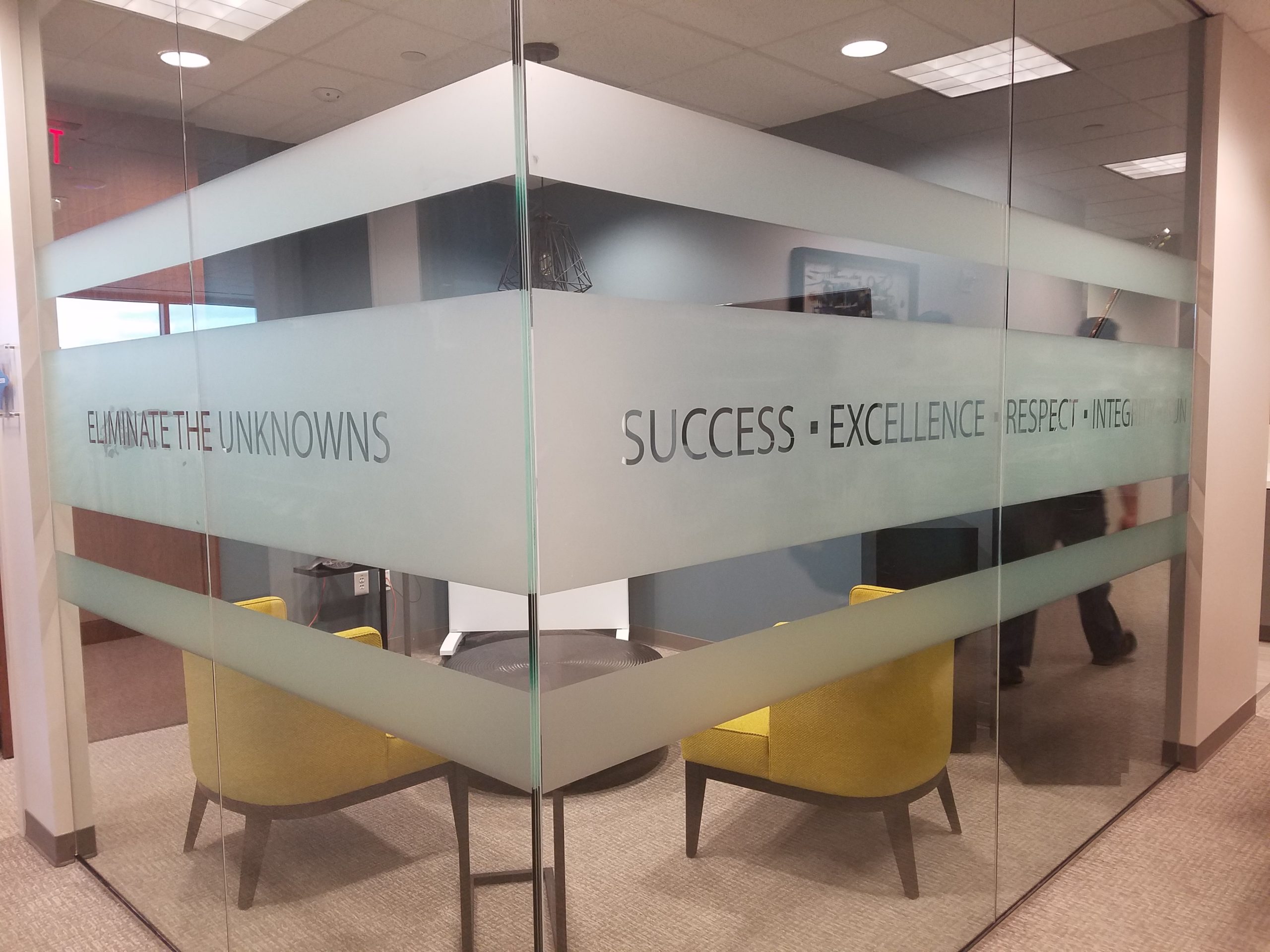
How Commercial Privacy Window Film Works (In Plain Language)
Privacy films control visibility through three basic interactions with light: reflection, diffusion, and absorption. A reflective film bounces light back from the brighter side, creating a mirror effect. A frosted or etched film scatters incoming light so you see a soft blur rather than clear shapes. A tinted or dyed film absorbs a portion of visible light to darken the view. Most commercial window film products use a combination of these effects to hit a specific balance of privacy, daylight, and heat control.
The construction is straightforward. A polyester base substrate carries the optical layer – whether that is a metallic coating, a ceramic nano-particle layer, a dye, or a textured surface. An adhesive bonds the film to the glass, and a scratch-resistant topcoat protects the exposed side. This entire assembly is typically thinner than a credit card, yet it can reject up to roughly 99% of harmful UV rays and significantly reduce the solar heat passing through the glass.
The most important distinction buyers need to understand is between frosted or opaque films and one-way reflective films. Frosted films blur details while allowing natural light to pass through, and they maintain consistent privacy both day and night. Reflective films provide daytime privacy by reflecting external light, essentially turning the glass into a one-way mirror – but only when the outside is brighter than the inside. At night with interior lights on, the mirror effect reverses, and one-way mirror films no longer block inside visibility during the day. If nighttime privacy matters, frosted or opaque options are typically the better call. Visible light transmission across commercial privacy films ranges from about 15% to 70%, and heat rejection can reach 55–80% depending on the product and glass type.
Key Benefits of Commercial Privacy Window Film for Businesses
Privacy films address two categories of need simultaneously: controlling who sees what through the glass, and improving the building’s thermal and optical performance. Many films provide benefits such as UV protection, glare reduction, and energy savings – all from a single installation. Here is what that looks like in practice.
Visual Privacy Without Closing Off the Space
Privacy films transform clear glass partitions, conference room walls, and storefronts into controlled-visibility surfaces without the closed-in feel of drywall or the maintenance headaches of blinds. An HR office can hold a sensitive conversation behind frosted and decorative privacy glass that still lets light flow into the corridor. A medical intake room can shield patient information while staff maintain line-of-sight awareness. A coworking space can give private offices real separation without blocking sunlight from the open floor.
Frosted films are preferable for conference rooms and interior partitions in open-office settings because they offer reliable privacy regardless of lighting conditions. You can also choose degrees of coverage – a subtle privacy band at eye level with clear glass above and below, partial frosting, or full-height opacity – so the space still feels open. Privacy films enhance aesthetics without blocking natural light, which is a major reason they have replaced traditional blinds and curtains in so many commercial buildings.
Energy Savings, Heat Rejection, and Cooling Cost Reduction
Commercial window films can improve energy efficiency by reducing solar heat gain – the primary driver of cooling loads in glass-heavy buildings. South- and west-facing curtain walls on office towers, glass-fronted retail stores, and school atriums are the biggest offenders. Modern films can reject 55–80% of total solar energy on certain glazing systems, which translates to measurable drops in cooling costs.
Privacy films can reduce energy costs by blocking heat, and the numbers from real projects back that up: buildings with single-pane or older double-pane windows have documented cooling cost reductions of 25–35% after film installation. Films can lower cooling costs by blocking heat and UV rays, reducing peak demand by 20–30%, and helping extend HVAC equipment life. For building owners targeting ENERGY STAR, LEED, or local energy codes, film retrofits often represent the fastest path to improved window performance without replacing the glass itself.
Glare Control and Screen Comfort
Films improve employee comfort by reducing glare on monitors, digital signage, and presentation screens. In call centers, trading floors, design studios, classrooms, and healthcare nurse stations, direct sun on screens creates eye strain, headaches, and lost productivity. A well-chosen privacy film cuts that glare without making the space feel like a cave.
Privacy films improve workplace performance and employee productivity by letting people actually see their screens without squinting or repositioning. The same benefit extends to lobby digital displays and menu boards near windows – reducing glare means your content stays readable all day.
Occupant Comfort and Wellness
Beyond glare, privacy film helps eliminate hot spots and cold spots near perimeter glass, creating more even temperatures across open office plans. UV blocking protects skin from long-term exposure at perimeter workstations and reception desks – a real consideration given that unfiltered glass transmits UV rays linked to skin cancer and premature aging.
There is also a psychological dimension. Employees and visitors feel less “on display” in glass-walled environments when privacy film is in place. Post-pandemic expectations for comfortable, controlled workplaces have only amplified this – occupant comfort is now a factor in talent retention, not just a nice-to-have.
Branding, Aesthetics, and Decorative Film Options
Decorative film turns glass partitions and storefront windows into design elements and brand carriers. Decorative films can feature custom designs or logos, from company wordmarks on lobby glass to geometric patterns on conference room walls to gradient patterns that fade from opaque to clear. Decorative films add a polished aesthetic that can enhance modern office appearances without requiring permanent etching or expensive specialty glass. Companies like 3M offer decorative films that mimic frosted or etched glass finishes, and CoolVu can take it further by combining privacy film with printed graphics or murals for cohesive interior branding.
Decorative films can include custom logos and patterns, and they enhance aesthetics without blocking light. They can also transform glass into branding opportunities – turning every glass partition and every storefront window into a surface that reinforces your identity. Because film is removable, you can update designs when branding evolves or tenants change, at a fraction of the cost of replacing architectural glass.
Added Glass Safety and Security
Some films strengthen glass, adding safety during breakage by holding shards together rather than letting them scatter. Safety and security window films can hold glass together during breakage events caused by accidental impact, windborne debris, or even explosions. This added protection matters most for ground-floor retail, schools, government facilities, and any street-level glass susceptible to forced entry or smash-and-grab attempts.
Not every privacy film is security-rated, but CoolVu can pair privacy film with dedicated security film where the situation calls for it. Thicker security film on exterior glass can delay intruders and reduce the risk of property damage, while decorative or frosted privacy film handles the interior visibility and branding needs on the same glass.
Types of Commercial Privacy Window Films (And When to Use Each)
Choosing the right film starts with understanding what each type does best. This section is a practical guide for building managers, architects, and property owners evaluating their options. Film choice depends on glass type, privacy level, design preferences, and performance goals. CoolVu offers a full portfolio spanning privacy films, decorative film, solar control, and security-focused options.
Frosted and Etched-Look Privacy Films
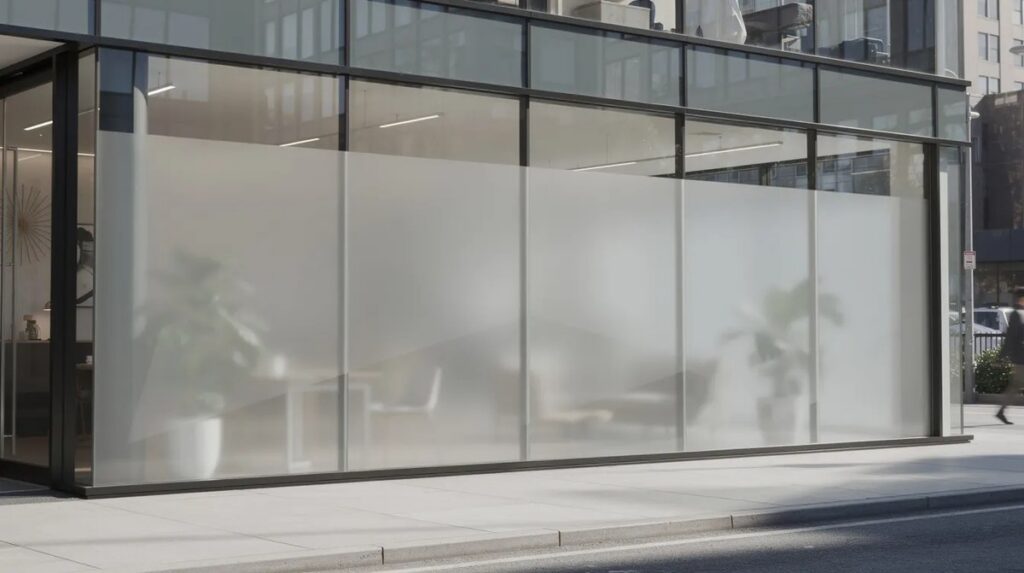
Frosted films diffuse light and obscure detail while allowing natural light transmission – the workhorse of interior commercial privacy. Common applications include conference room glass, internal glass partitions, restroom entry doors, and clinic partitions. You can apply full-coverage frosting for complete obscurity or use pattern-based and banded applications for partial privacy. The standout advantage: consistent privacy day and night, unlike one-way mirror films. Frosted and tinted films are generally affordable options that deliver reliable results for many years.
Decorative Pattern, Gradient, and Textured Films
Patterned films – stripes, dots, geometric patterns – along with gradient films that transition from clear to opaque and textured films like linen or rice paper finishes, offer design-forward solutions that combine privacy with corporate identity. Common layouts include gradient from floor to eye level, custom-cut logos within a frosted field, and decorative panels on glass partitions. CoolVu can work from brand style guides to develop cohesive decorative film packages for multi-location rollouts, ensuring every office or retail location looks consistent.
Reflective and One-Way Mirror Films
Reflective privacy films create a mirror-like exterior appearance during the day while preserving interior views out. The lighting rule is simple: the effect works when the exterior is brighter than the interior. Applications include street-facing offices, law enforcement observation rooms, cash offices, and server rooms. At night, with interior lights on, privacy is reduced and blinds or shades may still be necessary. Building managers should factor this into their planning if 24-hour visibility control matters.
Neutral and Tinted Solar Privacy Films
Tinted and neutral solar films darken the glass slightly while adding mild to moderate privacy and strong solar heat rejection. These work well on glass-heavy office towers, hotels, universities, and hospitals that want lower energy bills and softer exterior reflectivity. Darker tints suit glare-heavy facades; lighter neutral films preserve daylight for spaces where brightness is a priority. Light transmission should balance privacy needs and daylight requirements in film selection – CoolVu can model performance outcomes by façade orientation and glass type.
Blackout, Whiteout, and Opaque Films
Blackout films completely block visibility and light. Whiteout films provide a solid white appearance. Both are used in storage areas, back-of-house retail, medical imaging rooms, vacant retail units, and temporary construction hoarding. These films can hide clutter, protect sensitive equipment, or create visual “walls” on glass while remaining removable. Opaque films can also be combined with printed graphics for branded backdrops on storefronts.
Switchable Smart Films (PDLC) for High-Flex Spaces
Switchable smart window films change from clear to opaque with electricity, delivering on-demand privacy at the flip of a switch. Executive boardrooms, consultation rooms, multi-use training spaces, and healthcare observation rooms benefit most. The pros are compelling – instant privacy, a modern look, and controllability through wall switches or building automation. The cons are real too: higher cost, electrical integration, and potential maintenance. CoolVu can consult on when smart film is worth the investment versus standard decorative or privacy film.
Where Commercial Privacy Window Film Makes the Biggest Impact
Commercial privacy window films serve various applications including offices, retail, and healthcare. Here is how film is applied in the most common commercial spaces and what the finished result looks and feels like. CoolVu works with architects, facility managers, and general contractors on both retrofits and new build-outs.
Corporate Offices and Glass Partitions
Open-plan offices with glass partitions benefit from frosted bands at eye level that create focus zones and protect confidential discussions. Gradient film on executive offices adds distinction, while branded film on lobby glass reinforces corporate identity. Privacy films directly address employee feedback about feeling “on display” in all-glass environments.
Conference Rooms, Training Rooms, and Boardrooms
Confidentiality during strategic meetings, HR discussions, and virtual presentations demands visual shielding. Full-height frosted or gradient privacy film blocks hallway views into meeting content. Adding company logos or subtle patterns differentiates rooms and supports wayfinding. Smart film or dual-purpose privacy options maximize flexibility in high-value meeting spaces.
Storefronts, Showrooms, and Customer-Facing Glass
Decorative and privacy film on street-facing glass helps retail, banks, and service businesses balance merchandising visibility with workstation and back-room privacy. Partial banding screens desks, branded whiteout film hides stock areas, and gradient film near fitting rooms maintains customer comfort. Films also protect merchandise and fixtures from UV fading while preserving curb appeal.
Healthcare Facilities and Clinics
Patient privacy expectations and regulatory requirements make privacy film essential on exam room glass doors, intake windows, nursing station glass, and recovery area partitions. Natural light and staff visibility are maintained while shielding patients from view. Many healthcare projects pair privacy films with safety-rated films on exterior glazing for added protection.
Schools, Universities, and Educational Campuses
K–12 schools, colleges, and training centers use privacy film on office glass partitions, counseling rooms, internal classroom windows, and glass library study rooms. Films limit outside views into sensitive spaces without making them feel dark or isolated. Some districts also add security and anti-graffiti films to exterior doors and sidelights alongside privacy solutions.
Government, Municipal, and Financial Institutions
City halls, court buildings, police precincts, and financial institutions use privacy films to protect sensitive operations, secure file rooms, and shield staff from public view. These facilities often require window film solutions that combine privacy, blast or impact mitigation, and sun control. CoolVu works within procurement requirements, security guidelines, and historic building constraints where applicable.
How to Choose the Right Commercial Privacy Film for Your Building
This section is a step-by-step decision frame for facility managers and property owners evaluating privacy films. Think in terms of goals: privacy level, appearance, energy efficiency, and long-term maintenance. A professional site assessment from CoolVu before final selection helps avoid costly mismatches.
Clarify Your Privacy and Visibility Requirements
Define exact privacy needs by area: total privacy, partial privacy, or simply reduced distractions. Walk each floor and list rooms that require full coverage versus banding versus decorative treatments. This step determines whether you need frosted, gradient, blackout, or more subtle decorative film. Different departments – HR, IT, finance, operations – may each require different solutions.
Evaluate Existing Glass, Orientation, and Sun Exposure
Consider façade orientation (east, south, west), glass type (single, double, low-E), and current glare or hot-spot issues. High-sun exposures benefit most from architectural window films that improve solar and UV control. Certain dark or highly reflective films may not be suitable for specific insulated glass configurations, requiring expert input. CoolVu can perform on-site measurements and recommend compatible commercial window film systems.
Balance Aesthetic Goals with Functionality
Collaborate with design teams to ensure films align with interior glass finishes, brand colors, and architectural intent. Use sample boards and mockups on a few panes before approving a full-building rollout. Decorative privacy film can be updated over time as branding or tenant needs change, making it a flexible investment compared to permanent glass treatments.
Consider Budget, Lifecycle, and Long-Term ROI
Look beyond initial cost and evaluate expected film lifespan, warranties, and maintenance needs. Higher-quality commercial films often deliver better energy savings, color stability, and long-term appearance. Estimate payback from reduced cooling costs, longer furniture life, and lower blind or curtain maintenance. CoolVu can help develop a business case comparing film options for building owners or asset managers.
Professional Installation Process for Commercial Privacy Film
Commercial projects should always use professional installers. Improper application leads to bubbles, gaps, premature peeling, and warranty issues. Professional installation prevents bubbles and gaps in the film and ensures the product performs as specified. The typical project stages are consultation, survey, product selection, scheduling, installation, and final inspection – with low disruption to operations. CoolVu operates via a trained national franchise network, ensuring consistent service quality backed by extensive industry experience and tens of thousands of installations.
On-Site Assessment and Project Planning
A CoolVu consultant walks the property, reviews glass types, measures openings, and discusses pain points. Documentation includes photos, measurements, and notes about sun angles, glare patterns, and privacy hotspots. The assessment leads to a tailored proposal summarizing film recommendations by area and performance goals. This phase is typically offered as a free estimate for commercial building stakeholders.
Installation Day: What Building Managers Should Expect
Installers protect floors and furniture, clean glass thoroughly, and precut film for efficiency. Using soapy water during installation reduces wrinkles and bubbles as the film is positioned and squeegeed into place. Professional installers use high-quality adhesives that resist peeling over the film’s lifespan. Minor visual effects immediately after installation – a slight haze or small water pockets – are normal and resolve during the cure period (typically 30–60 days). CoolVu crews coordinate with facility teams to manage access, security, elevator use, and tenant notifications.
Post-Installation Care, Cleaning, and Warranty
Wait the recommended cure period before cleaning film surfaces. Use mild soap and water with soft cloths. Avoid ammonia-heavy cleaners, abrasive tools, or scraping that can damage the surface. Commercial window films must comply with local building codes, and many commercial-grade films carry manufacturer-backed warranties covering bubbling, peeling, and discoloration when professionally installed. Add glass film locations and installation dates to your facility maintenance logs for future reference.
Costs, Payback, and ROI of Commercial Privacy Window Film
Budget is always a factor. The good news: installing window film is generally less expensive than replacing windows or installing custom glass. Exact pricing depends on film type, glass area, accessibility, and customization, but the general range and payback math are well-established. CoolVu can help building owners model ROI and prioritize phases based on budget.
Main Factors That Influence Project Cost
Key cost drivers include:
- Square footage of glass to be treated
- Film type (standard frosted versus smart film versus custom decorative)
- Design complexity (simple banding versus custom designs with logos or gradient patterns)
- Installation conditions (multi-story exterior access, union building requirements, off-hours work)
Standard privacy and decorative films are far more cost effective than glass replacement or etched glass. The total price for installed commercial film typically falls between $6–$18 per square foot. Smart films or highly customized graphic films may cost more. Request line-item quotes so stakeholders can see cost differences by film type and area.
Estimating Energy Savings and Operational Benefits
Solar-control privacy films can significantly reduce peak cooling loads and daily AC runtime in glass-heavy buildings. Basic approaches to estimating savings include comparing pre- and post-install utility data or using building energy modeling tools. Typical payback timeframes for commercial projects range from about 1.5 to 4 years depending on climate, orientation, and original glass performance. Secondary savings – longer life for furnishings, flooring, and electronics protected from UV – add further value to energy bills over time.
Long-Term Value for Tenants, Owners, and Property Managers
Privacy and decorative films help attract and retain tenants who expect modern, comfortable workplaces. Property managers gain the ability to reconfigure or rebrand glass quickly between tenants. Professionally installed privacy films can enhance asset value by improving both appearance and building performance. Quality films last between 7 to 15 years with proper care, and premium ceramic or spectrally selective products can extend well beyond that. Multi-location owners can standardize film specs with CoolVu across their portfolio for consistency and easier management.
Common Questions About Commercial Privacy Window Film (FAQs)
Below are answers to the questions facility managers, designers, and business owners ask most often. For building-specific questions, contact CoolVu directly.
Will privacy window film still work at night when the lights are on?
It depends on the film type. Reflective one-way films lose their mirror effect when interior lighting outshines the exterior – at night, people outside can see in. Frosted, opaque, and blackout privacy films maintain privacy day and night because they diffuse or block light consistently regardless of lighting conditions. If nighttime privacy is a top priority, choose frosted or opaque film, or plan to pair reflective film with blinds for after-hours use.
How long does commercial privacy window film typically last?
Quality films last between 7 to 15 years after installation, with premium ceramic and spectrally selective products often exceeding 15–20 years under proper maintenance. Film longevity depends on quality, sun exposure, interior versus exterior application, and cleaning practices. Many commercial-grade films carry manufacturer-backed warranties when professionally installed. CoolVu recommends films that balance budget with expected service life for each project.
Can privacy film be removed or replaced without damaging the glass?
Yes. Professional installers can remove most commercial films without damaging the underlying glass when done correctly. Common reasons for replacement include branding updates, tenant changes, design refreshes, or film reaching end of life. Tempered, laminated, and low-E coated glass require knowledgeable handling during both installation and removal. CoolVu’s teams are trained to work with different commercial glazing systems safely.
Will privacy film make my building too dark or change how it looks from outside?
Many privacy options – frosted, light decorative patterns, gradient films – let in ample daylight while obscuring views. Tinted and reflective films will change the exterior appearance to some degree, which can be a desired design effect or a concern depending on the building’s frame and existing facade. Use samples and test installations on a few panes to confirm brightness and exterior look before full deployment. CoolVu can recommend films that maintain a neutral appearance if the building’s existing design is a priority.
How disruptive is installation for occupied offices and commercial spaces?
Most work is done from the interior with minimal noise and no structural changes. Offices and departments can typically stay operational while installers work zone by zone. Early-morning, evening, or weekend installation is available for critical areas. CoolVu crews are trained to maintain cleanliness, protect furnishings, and coordinate with facility teams throughout the process.
Can privacy window film help with building codes or green building programs?
While film itself is not a code requirement, it can help meet energy performance goals in many jurisdictions by improving window SHGC and reducing sunlight-driven cooling loads. Film contributes to sustainability by cutting energy use, extending material life, and reducing the need for replacement glass or blinds. Some projects use film as part of LEED, WELL, or other green building strategies, especially for energy efficiency and daylighting credits. Consult CoolVu for product data and documentation specific to your certification or compliance needs.
Why Commercial Property Owners Choose CoolVu
CoolVu is a specialized national franchise network focused on glass and surface transformation for commercial, institutional, and government properties. Unlike single-product vendors, CoolVu window tinting and film installation services bring full-service capabilities under one roof: privacy films, solar control, decorative film, security film, architectural surface finishes, and printed graphics. Every project is backed by trained installers, standardized processes, professional project management, and manufacturer-backed products.
National Reach with Local, Trained Installers
CoolVu’s franchise model combines national standards with local teams who understand regional building styles, codes, and climate. This structure supports multi-site rollouts for corporate, retail, educational, and healthcare portfolios. Facility managers get a single point of contact for multiple locations, consistent specs, and coordinated scheduling through professional window film installation services. Free, on-site estimates and consultations are available for commercial properties nationwide.
Customized Privacy and Decorative Solutions for Commercial Spaces
CoolVu tailors film choices, patterns, and layouts to each building’s architecture, brand, and operational needs – from custom-printed logos on frosted film to coordinated glass partition designs across an entire floor. The team collaborates with architects, interior designers, and general contractors during both new construction and renovations. CoolVu can also bundle window films, tinting, and surface wraps with architectural surface wraps and wall graphics for a cohesive building transformation.
Quality Materials, Warranties, and Reliable Support
CoolVu specifies professional-grade commercial window films designed for longevity and visual stability. Projects include product and labor warranties, with details provided during the proposal stage. Aftercare support covers cleaning guidance, maintenance, and future changes or expansions. The focus is on long-term relationships, not one-time installations.
Next Steps: Schedule a Commercial Privacy Film Consultation with CoolVu
If your building has glass that is underperforming – too much heat, too much glare, too little privacy, or an outdated look – a commercial privacy window film upgrade is faster, cleaner, and more cost effective than major renovations. Contact CoolVu to schedule a free site visit and estimate. Have your building type, glass areas of concern, comfort complaints, and design goals ready, and a CoolVu consultant will walk your property and build a tailored recommendation. Your glass can do more. Let CoolVu show you how.